
Glass Liquor Bottles Wholesale: Extra Flint Iron Limits, 750 mL Weight Tiers and Bar-Top Bore Tolerances
Specify glass liquor bottles wholesale with extra-flint Fe2O3 limits, 750 mL weight and base knurling specs, and 18.5 mm or 19.5 mm bar-top cork tolerances.
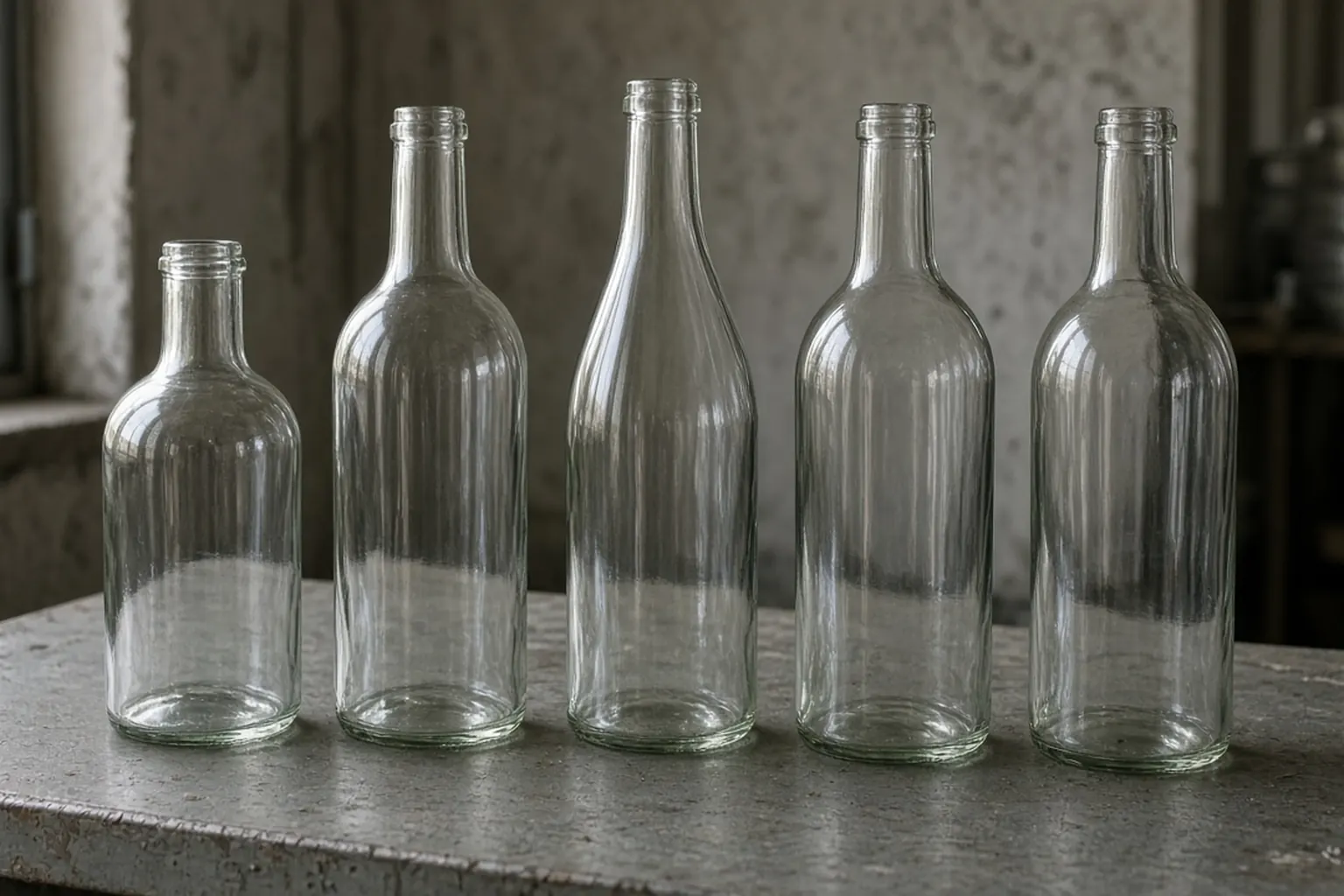
Ordering glass liquor bottles wholesale from a catalog photograph or a nominal volume figure alone exposes a bottling run to three frequent production failures: greenish edge tinting in heavy decanter bases, cork push-out or cap shear on bar-top neck finishes, and freight weight-outs on 53 ft dry vans. A comparable supplier request for quotation (RFQ) locks the iron oxide (Fe2O3) limit of the flint melt, separates the regulated standard of fill from brimful capacity and glass weight distribution, and specifies the internal neck bore across the top 15 mm sealing zone.
To purchase glass liquor bottles wholesale without optical or closure rejects, specify four engineering parameters on the master container drawing before requesting quotes. First, require Cosmetic or Extra Flint glass (Fe2O3 <= 0.012 to 0.020 wt%, visible transmittance >= 90.5% to 91.5%) whenever the base thickness exceeds 20 mm. Second, pair the 27 CFR 5.203 nominal fill (750 mL at 20 deg C) with an explicit brimful capacity (770 to 790 mL), fill point (55 to 75 mm below the rim), weight tier (420 to 1,150 g), and bearing-surface knurling profile. Third, constrain the bar-top spirits bottle neck finish (18.5 mm, 19.5 mm, or 21.5 mm nominal bore) to +/- 0.2 to 0.3 mm mouth tolerance and <= 0.3 mm ovality so a +1.0 to +1.5 mm oversized T-cork shank holds a 20 to 40 daN (45 to 90 lbf) extraction force. Fourth, gate lot acceptance on ASTM C148 polariscopic temper (<= Grade 2 to 3), ASTM C149 thermal shock (Delta T >= 42 deg C), and ISO 2859-1 defect AQL limits.
Use this specification guide alongside the buying resources overview to align container drawings with glass bottle supplier qualification and master bottle specification checklists.
Extra flint vs standard flint: iron oxide limits and thick-base optics
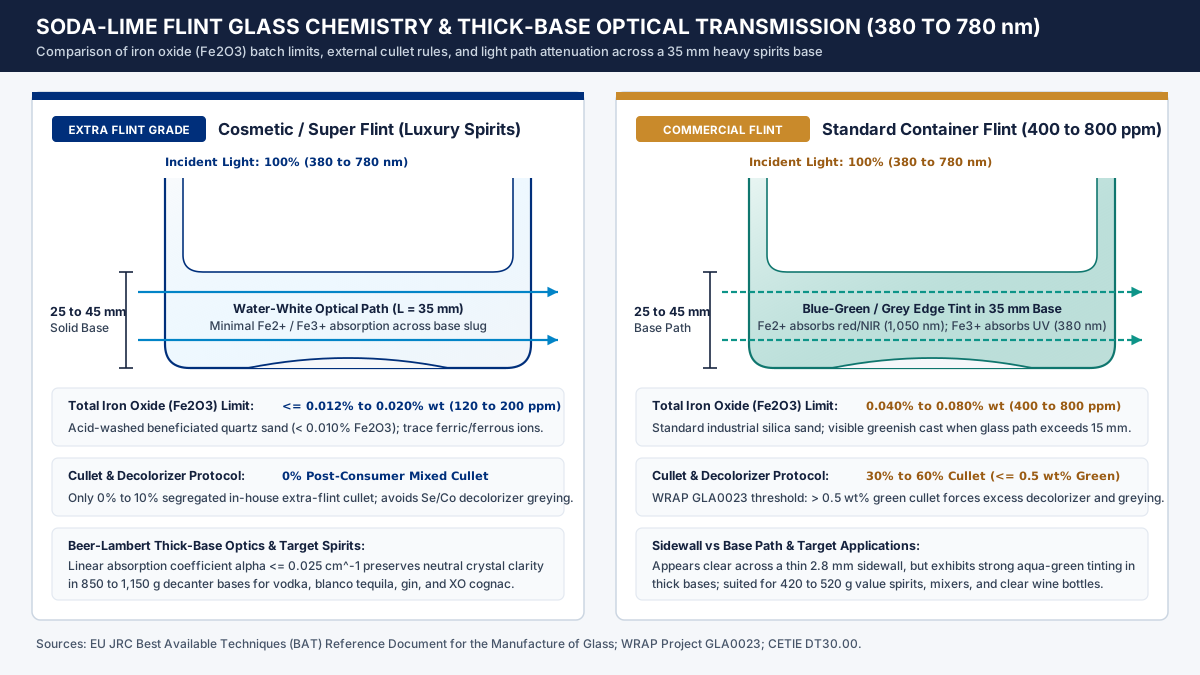
Container glass for distilled spirits and wine is melted from a soda-lime-silica batch containing 70% to 74% SiO2, 12% to 16% Na2O + K2O, 10% to 14% CaO + MgO, and 1.5% to 2.5% Al2O3, as documented in the European Commission JRC Best Available Techniques (BAT) Reference Document for the Manufacture of Glass. Within that matrix, trace iron oxide (Fe2O3) governs optical clarity and edge color. Iron exists in molten glass in a redox equilibrium between ferric iron (Fe3+, which absorbs ultraviolet and violet wavelengths near 380 nm to impart a pale yellow-brown cast) and ferrous iron (Fe2+, which absorbs red and near-infrared light around 1,050 nm to impart a strong bluish-green tint).
Across a thin 2.5 to 3.2 mm sidewall, standard container flint with 0.040 to 0.080 wt% Fe2O3 (400 to 800 ppm) appears colorless to the eye. However, Beer-Lambert optical attenuation scales exponentially with optical path length L:
T_vis = 100 * exp(-alpha * L)
When a brand selects a 750 mL craft spirits bottle or luxury decanter from catalogs such as Saverglass Catalog Spirits, the light path through the solid bottom slug (L = 25 to 45 mm) is ten to fifteen times longer than through the sidewall. At 0.050 wt% Fe2O3, that 35 mm base path turns visibly green-blue or dull grey. Attempting to mask high iron content with extra selenium, cobalt, or erbium decolorizers lowers total visible light transmittance below 86% and produces a dead grey cast in the punt. Heavy-base white spirits (vodka, gin, blanco tequila) and high-end aged spirits (bourbon, single-malt whisky, XO cognac) therefore require Cosmetic or Extra Flint glass melted from acid-washed low-iron quartz sand (< 0.010 wt% Fe2O3) and zero post-consumer mixed cullet. Buyers who also source glass wine bottles wholesale or dark spirits SKUs can specify standard flint for lightweight clear bottles or transition to UV-filtering amber and antique green compositions, where higher iron and chromium oxides work with high external cullet shares, as detailed in our guide to recycled glass cullet percentages and color windows.
Swipe or scroll horizontally to see all columns.
| Glass grade | Total iron oxide (Fe2O3 wt%) |
Visible transmittance (380 to 780 nm, 10 mm path) |
External cullet and decolorizer rules | Visual appearance in 25 to 45 mm heavy base |
Primary wholesale beverage applications |
|---|---|---|---|---|---|
| Cosmetic / Extra Flint (Super Flint / Extra-White) | <= 0.012% to 0.020% (120 to 200 ppm) |
>= 90.5% to 91.5% |
0% post-consumer mixed cullet; 0% to 10% segregated in-house extra-flint cullet only |
Water-white crystal clarity with zero green or grey edge cast | Ultra-premium vodka, gin, blanco tequila, single-malt whisky, XO cognac decanters |
| High Spirit Flint (Select Flint) | 0.020% to 0.035% (200 to 350 ppm) |
88.5% to 90.0% |
15% to 35% color-sorted flint cullet balanced with Se/Co/Er physical decolorizers |
Neutral clear in sidewalls; faint cool cast only when viewed edge-on through bases > 20 mm |
Mid-tier craft bourbon, rum, botanical liqueurs, 600 to 750 g custom bottles |
| Standard Commercial Flint (Container Flint) | 0.040% to 0.080% (400 to 800 ppm) |
85.0% to 88.0% |
30% to 60%+ external cullet (<= 0.5 wt% green cullet cap per WRAP GLA0023) |
Distinct Fe2+ bluish-green or decolorizer grey tint across heels and thick bases |
Value spirits (420 to 520 g), mixers, sauces, and clear glass wine bottles wholesale |
| Amber & Antique Green (UV-Filtering Glass) | 0.25% to 0.50%+ (+ ~0.25 wt% Cr2O3 in green) |
< 10% across 290 to 450 nm UV/blue band (amber) |
50% to 80%+ external cullet (amber tolerates 10% to 30% green cullet by shade spec) |
Intentional dark amber, dead-leaf green, or antique green UV-blocking coloration | Red and white glass wine bottles wholesale, herbal bitters, cream liqueurs, rye whiskies |
750 mL weight tiers, wall thickness, and base push-up knurling
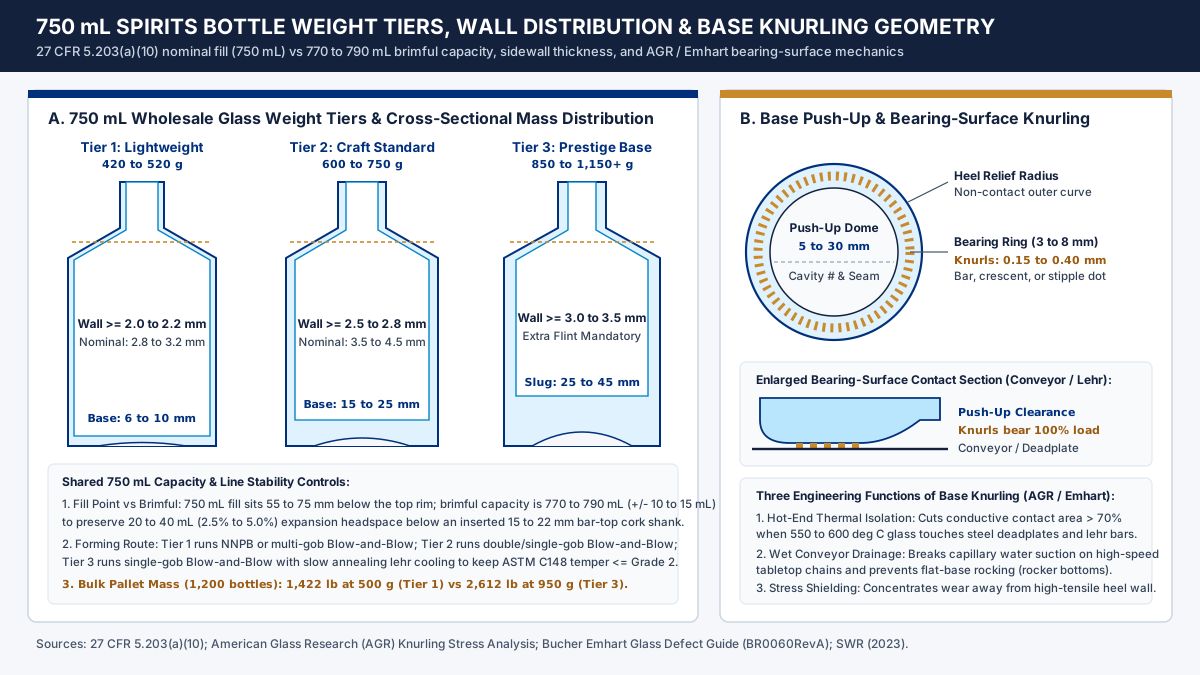
In the United States, distilled spirits must comply with the metric standards of fill codified in 27 CFR 5.203, where 750 mL (25.4 fl oz, under paragraph (a)(10)) and 700 mL (under paragraph (a)(13)) anchor commercial retail distribution alongside 375 mL, 1.00 L, and 1.75 L. As our spirits bottle regulatory checklist explains, the regulated nominal fill (750 mL at 20 deg C) never equals the container’s brimful overflow volume. A 750 mL bar-top spirits bottle is engineered with a brimful capacity of 770 to 790 mL (+/- 10 to 15 mL tolerance under ISO 8106 and CETIE DT02.00). When filled to a target fill point 55 to 75 mm below the top rim, the neck retains 20 to 40 mL (2.5% to 5.0% of liquid volume) of expansion headspace below an inserted 15 to 22 mm T-cork shank. Without that headspace cushion, summer transit temperatures (40 to 50 deg C inside a trailer) expand the 40% to 50% ABV hydro-alcoholic liquid and hydraulic the cork stopper out of the neck.
While internal capacity stays fixed around 775 to 785 mL brimful, wholesale glass weight spans three structural tiers that dictate forming speed in how glass bottles are made and line stability in lightweight wine and beverage bottle design.
Swipe or scroll horizontally to see all columns.
| 750 mL wholesale weight tier | Glass mass range | IS-machine forming process | Minimum sidewall thickness | Base slug and push-up depth | Empty bulk pallet mass (1,200 bottles) |
|---|---|---|---|---|---|
| Tier 1: Lightweight / Economy Standard | 420 to 520 g |
Narrow-Neck Press-and-Blow (NNPB) or double/triple-gob Blow-and-Blow | >= 2.0 to 2.2 mm (nominal 2.8 to 3.2 mm) |
6 to 10 mm base; 3 to 8 mm shallow push-up |
1,180 to 1,445 lb (535 to 655 kg) |
| Tier 2: Mid-Heavy Craft Spirits Standard | 600 to 750 g |
Double-gob or single-gob Blow-and-Blow | >= 2.5 to 2.8 mm (nominal 3.5 to 4.5 mm) |
15 to 25 mm base; 10 to 20 mm push-up or embossed dome |
1,655 to 2,055 lb (750 to 930 kg) |
| Tier 3: Prestige Heavy-Base Decanter | 850 to 1,150+ g |
Single-gob Blow-and-Blow with extended bottom cooling and slow lehr schedule | >= 3.0 to 3.5 mm (25 to 45 mm base slug) |
25 to 45 mm solid slug; 15 to 35 mm deep punt |
2,315 to 3,110 lb (1,050 to 1,410 kg) |
Across all three weight tiers, the bottom of a glass container never rests flat across its full diameter. Research published by American Glass Research (AGR) and the Bucher Emhart Glass Defect Guide (BR0060RevA) details why the center of the bottom is recessed into a push-up (5 to 30 mm deep, housing the mold cavity number and baffle seam) while the bottle stands exclusively on an outer annular bearing surface (3 to 8 mm wide) inside the heel curve. Molded onto this standing ring are raised knurling or stippling patterns (bar, crescent, dot, or chain knurls, 0.15 to 0.40 mm high). Bearing-surface knurling fulfills three mechanical requirements:
- Hot-end thermal isolation: When a newly blown bottle at
550 to 600 deg Cmoves across steel deadplates, transfer conveyors, and lehr loader bars, raised knurls cut conductive metal-to-glass contact area by more than70%, preventing thermal shock checks on the base. - Wet conveyor drainage and anti-suction: On
120 to 300 bpmrinsing and filling lines, knurl channels break the capillary water film between the bottle bottom and wet stainless or acetal tabletop chains, stopping vacuum suction stalls and flat-base rocking (“rocker bottoms”). - Tensile stress shielding: Concentrating contact on the sacrificial knurl tips isolates the high-tensile outer heel radius from micro-abrasions that reduce vertical load and internal pressure strength.
Spirits bottle neck finish: bar-top bore tolerances and T-cork extraction force
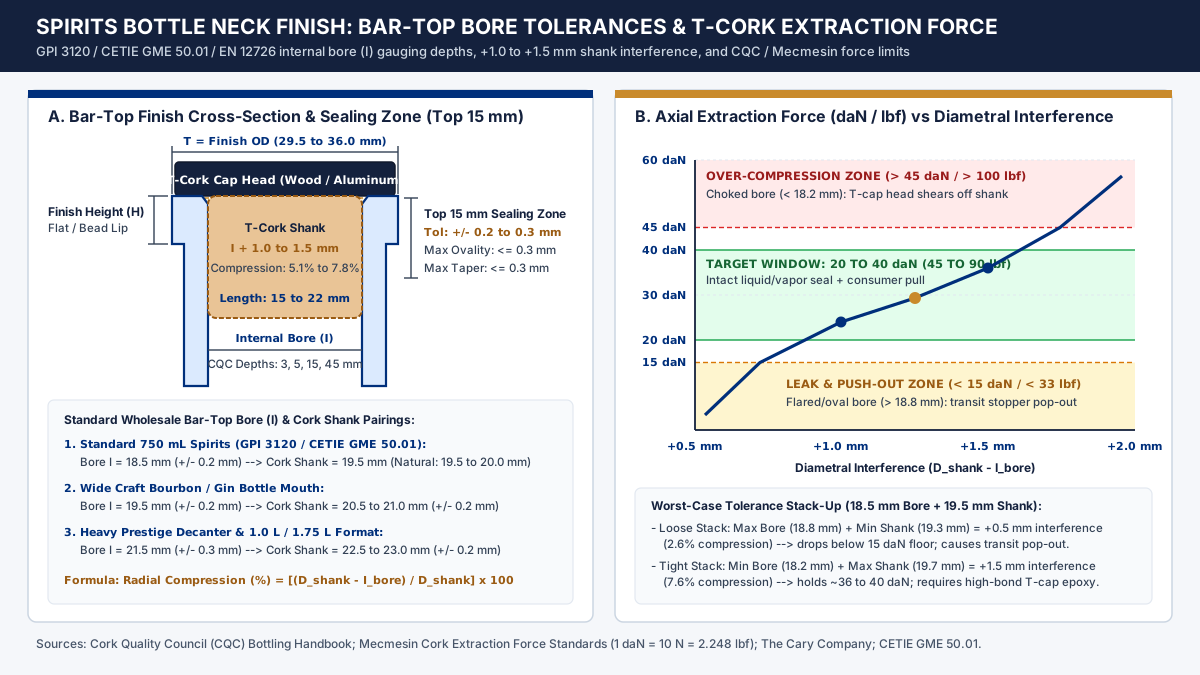
Unlike continuous-thread (28-400, 28-410) or roll-on pilfer-proof (ROPP / BVS) closures that seal by axial thread compression against the top lip of the finish (detailed in our guide to steam-vacuum lug, continuous thread, and ROPP glass bottle closures), a bar-top (T-cork) spirits bottle neck finish seals by radial interference inside the internal neck bore (I dimension). For general finish nomenclature (T, E, I, H, and S dimensions), consult our guide to bottle neck finishes and closure compatibility. Under North American GPI 3120 series conventions and European CETIE GME 50.01 / EN 12726 cork-mouth standards, the critical engineering interface is the internal bore profile across the top 15 mm below the mouth rim.
According to sizing standards documented by The Cary Company, O.Berk / BottleStore, and the Cork Quality Council (CQC) Bottling Handbook, the uncompressed T-cork shank diameter (D_shank) must exceed the glass internal bore diameter (I_bore) by +1.0 to +1.5 mm. Radial compression percentage is calculated from the uncompressed shank diameter:
Radial Compression (%) = [(D_shank - I_bore) / D_shank] * 100
For synthetic TPE/EVA shanks and micro-agglomerated cork shanks, the target interference sits between 5.0% and 7.8% radial compression. Natural one-piece colmated cork shanks tolerate slightly higher compression (+1.2 to +1.5 mm diametral interference) because natural lenticel cellular structure compresses more readily than solid elastomers.
Swipe or scroll horizontally to see all columns.
| Bar-top finish class | Nominal internal bore I |
Mouth bore tolerance (top 3 to 5 mm) |
Max bore ovality & taper (top 15 mm zone) |
Recommended T-cork shank diameter D_shank |
Diametral interference & radial compression | Target axial extraction force (CQC / Mecmesin) |
|---|---|---|---|---|---|---|
| Standard 750 mL Spirits Bar-Top (GPI 3120 / CETIE GME 50.01) | 18.5 mm |
+/- 0.2 to 0.3 mm (18.2 to 18.8 mm) |
Ovality <= 0.3 mm; taper <= 0.3 mm |
19.5 mm (+/- 0.2 mm) synthetic/agglom; 19.5 to 20.0 mm natural |
+1.0 to +1.5 mm (5.1% to 7.7% compression) |
20 to 40 daN (45 to 90 lbf); floor >= 15 daN, ceiling <= 45 daN |
| Wide Craft Spirits Bar-Top (Bourbon / Gin Cork Mouth) | 19.5 mm |
+/- 0.2 to 0.3 mm (19.2 to 19.8 mm) |
Ovality <= 0.3 mm; taper <= 0.3 mm |
20.5 to 21.0 mm (+/- 0.2 mm) |
+1.0 to +1.5 mm (4.9% to 7.3% compression) |
20 to 40 daN (45 to 90 lbf) |
Wide-Mouth Prestige Decanter & 1.0 L / 1.75 L Bar-Top |
21.5 mm |
+/- 0.3 mm (21.2 to 21.8 mm) |
Ovality <= 0.35 mm; taper <= 0.4 mm |
22.5 to 23.0 mm (+/- 0.2 mm) |
+1.0 to +1.5 mm (4.4% to 6.7% compression) |
22 to 42 daN (50 to 95 lbf) |
Heavy Large Decanter / 1.75 L Handle Jug Bar-Top |
22.5 to 23.0 mm |
+/- 0.3 mm |
Ovality <= 0.4 mm; taper <= 0.4 mm |
24.0 mm (+/- 0.2 mm) |
+1.0 to +1.5 mm (4.2% to 6.3% compression) |
25 to 45 daN (56 to 100 lbf) |
Worst-case tolerance stack-up and extraction force testing
Quality control laboratories measure T-cork pull-out resistance on motorized tensile stands in decanewtons (1 daN = 10 N = 2.248 lbf = 1.02 kgf), as detailed by Mecmesin spirit bar-top closure testing protocols and the Cork Quality Council Bottling Handbook. Both authorities place the optimal consumer hand-opening window at 20 to 40 daN (45 to 90 lbf), bounded by an absolute floor of 15 daN (33 lbf) and an upper ceiling of 45 daN (100 lbf).
Consider the worst-case mechanical stack-up on a nominal 18.5 mm bore paired with a 19.5 mm +/- 0.2 mm synthetic shank:
- Loose tolerance limit: If the glass neck ring wears or flares to its upper limit (
I_bore = 18.8 mm) or develops an inverse downward flare (“reverse taper”) while the cork shank sits at its lower limit (D_shank = 19.3 mm), diametral interference drops to+0.5 mm(2.59%radial compression). Extraction force falls below15 daN(33 lbf), causing liquid weeping during horizontal storage and stopper pop-out when palletized cases warm during road freight. - Tight tolerance limit: If a cold plunger produces a choked bore (
I_bore = 18.2 mm) paired with a maximum-diameter shank (D_shank = 19.7 mm), interference reaches+1.5 mm(7.61%radial compression). If the bore drops below18.1 mm, insertion heads on automated capping and corking equipment fold or tear the shank lip on entry, and consumer pull force exceeds45 daN(100 lbf), shearing the wood, aluminum, or glass T-cap head off the cork shank.
To prevent both failure modes, the bottle specification must mandate go/no-go plug gauging (18.2 mm Go pin / 18.8 mm No-Go pin) at 3 mm and 15 mm depths below the rim, plus two perpendicular bore measurements (D_max - D_min <= 0.3 mm) to reject oval necks.
Bulk tier-sheet pallets vs reshipper cases and wholesale truckload math
When purchasing glass liquor bottles wholesale, buyers must match the incoming pallet configuration to their depalletizer and line infeed equipment and calculate whether the shipment reaches the trailer’s volume limit or weight limit first. For complete vehicle payload formulas, see our guide on how many pallets of glass bottles fit on a truck.
Wholesale glass ships on 48 x 40 in (1,219 x 1,016 mm, ISO 6780) pallets in two primary formats:
- Bulk tier-sheet pallets: Loose empty bottles are stacked in
5 to 7layers (1,100 to 1,650bottles per pallet for750 mLcylinders) separated by corrugated or solid-fiber tier sheets, capped with a top frame, and secured with corner boards and stretch or shrink wrap. Bulk pallets minimize unit packaging cost and feed high-speed sweep-off depalletizers directly, provided the bottling plant sources its own printed shipping cases separately. - Partitioned reshipper RSC cases: Empty bottles arrive packed neck-up or neck-down in
12-pack(450 to 700 gbottles) or6-pack(850 to 1,150 gheavy decanters) Regular Slotted Cartons (ECT-32orECT-44double-wall) fitted with chipboard or corrugated box partitions (672 to 1,008bottles per pallet). Reshipper cases protect frosted, screen-printed, or spray-coated bottles from glass-to-glass scuffing and serve as the outbound finished-goods carton after filling.
Worked truckload example: 500 g standard bottle vs 950 g heavy-base decanter
Assume a 53 ft dry van with 26 straight-loaded 48 x 40 in floor positions and a carrier cargo weight allowance of 44,000 lb (19,958 kg). Compare a 500 g (0.50 kg) standard 750 mL bottle against a 950 g (0.95 kg) heavy-base Extra Flint bottle across empty bulk and filled cased shipments (assuming 750 mL of 40% ABV spirit at 0.95 kg/L density = 0.713 kg liquid + 0.025 kg bar-top closure and label = 0.738 kg non-glass mass per filled bottle; 29 kg CHEP pallet; 16 kg bulk tier-sheet dunnage; 0.65 kg per 12-pack RSC carton with partitions, 70 cases / 840 bottles per pallet):
- Load 1 (
500 gempty bulk,1,200bottles/pallet):1,200 * 0.50 kg + 29 kg + 16 kg = 645 kg(1,422 lb) per pallet. At26floor positions, total cargo is36,972 lb, so space binds first (26pallets,31,200bottles per truck). - Load 2 (
950 gempty bulk,1,200bottles/pallet):1,200 * 0.95 kg + 29 kg + 16 kg = 1,185 kg(2,612 lb) per pallet. Dividing the44,000 lbcargo allowance by2,612 lbcaps the load at16pallets (41,792 lb,19,200bottles per truck), leaving10floor positions empty even before a single drop of spirit is filled. - Load 3 (
500 gfilled in12-packcases,840bottles/pallet): Each filled bottle weighs0.50 + 0.738 = 1.238 kg;70cases weigh70 * (12 * 1.238 + 0.65) = 1,085.4 kg, plus35 kgpallet and wrap =1,120.4 kg(2,470 lb) per pallet. Weight binds at17pallets (41,990 lb,14,280bottles per truck). - Load 4 (
950 gfilled in12-packcases,840bottles/pallet): Each filled bottle weighs0.95 + 0.738 = 1.688 kg;70cases plus pallet and wrap weigh1,498.4 kg(3,303 lb) per pallet (which also exceeds a standard2,800 lbCHEP pallet rating unless reduced to4layers /56cases). At5layers, the trailer weights out at13pallets (42,939 lb,10,920bottles per truck).
Swipe or scroll horizontally to see all columns.
Shipment scenario (750 mL bottle, 53 ft van, 44,000 lb cargo limit) |
Bottles per pallet | Pallet gross weight | Max pallets per 53 ft truck |
Binding constraint | Total bottles per truckload |
|---|---|---|---|---|---|
500 g Standard Bottle, Empty Bulk (5 layers x 240) |
1,200 |
645 kg (1,422 lb) |
26 pallets |
Floor space (26 positions) |
31,200 bottles |
950 g Extra Flint Decanter, Empty Bulk (5 layers x 240) |
1,200 |
1,185 kg (2,612 lb) |
16 pallets |
Gross vehicle weight (41,792 lb) |
19,200 bottles |
500 g Standard Bottle, Filled 12-Pack Cases (70 cases) |
840 |
1,120 kg (2,470 lb) |
17 pallets |
Gross vehicle weight (41,990 lb) |
14,280 bottles |
950 g Extra Flint Decanter, Filled 12-Pack Cases (70 cases) |
840 |
1,498 kg (3,303 lb) |
13 pallets |
Gross vehicle weight (42,939 lb) |
10,920 bottles |
Stock molds vs custom tooling MOQs and ASTM C148 / C149 acceptance gates
Choosing between catalog molds and bespoke tooling follows the commercial framework in stock vs custom glass bottles and manufacturer production guidelines such as Rockwood Glass spirits manufacturing specifications. Wholesale spirits sourcing divides into three tooling tiers:
Swipe or scroll horizontally to see all columns.
| Wholesale sourcing route | Mold tooling investment | Typical production MOQ | Standard lead time | Engineering and commercial scope |
|---|---|---|---|---|
| Stock Catalog Mold (Distributor or Plant Stock) | $0 (glassmaker owns existing blank, blow, and neck-ring molds) |
1 pallet (672 to 1,440 bottles) from distributor; 1 truckload / 40 ft HQ (18,000 to 28,000 bottles) from plant |
1 to 3 weeks (warehouse stock) |
Fixed geometry and finish; fastest launch path for craft distilleries and glass wine bottles wholesale |
| Semi-Custom Mold Modification (Custom Punt Plate, Shoulder Embossing, or Neck Ring) | $2,500 to $8,000 for interchangeable bottom plates, baffle inserts, or finish rings |
10,000 to 15,000 bottles per run |
6 to 10 weeks including T1 trial samples |
Adds brand embossing on shoulder or base push-up while retaining proven stock body blank and blow molds |
| Full Custom Proprietary IS-Machine Mold Set | $3,500 to $6,000 pilot unit mold (1 to 2 cavities) + $15,000 to $45,000+ production cavity set |
15,000 to 30,000+ bottles (single-gob Extra Flint); 50,000 to 150,000+ (multi-gob commercial flint) |
12 to 20 weeks (3D CAD/FEA, unit trial, production mold cut) |
Full control of silhouette, weight distribution, custom bar-top finish, and exclusive mold ownership agreement |
Incoming lot acceptance: ASTM C148, ASTM C149, and ISO 2859-1 defect AQLs
Every wholesale purchase order should bind the supplier to three verifiable cold-end and receiving test standards indexed by ASTM International and Bucher Emhart Glass, alongside the receiving workflow in our glass container defects guide:
- Annealing residual stress (ASTM C148): Polariscopic examination measures optical retardation (
1tint fringe =565 nmin soda-lime glass) through the sidewall and heavy base slug. Require a Real Temper Number of<= Grade 2 to Grade 3. Heavy850 to 1,150 gbottles that pass through the annealing lehr too quickly retain residual tensile hoop stress at the heel-to-base transition, triggering spontaneous bottom separation (“ring-off”) during rinsing or filling. - Thermal shock resistance (ASTM C149): Sample bottles are transferred from a hot water bath to a cold water bath (
~21 deg C / 70 deg F) within15 +/- 2seconds. Specify zero breakage at a minimum temperature differential ofDelta T >= 42 deg C(75 deg F). - Dimensional and visual defect sampling (ISO 2859-1 / ANSI/ASQ Z1.4 General Inspection Level II): Set Critical defects (bird swings, internal glass spikes, sharp chipped finish, cracked or checked bore) at
AQL 0.01% to 0.065%(or zero acceptance); Major functional defects (choked bore< 18.2 mm, flared bore> 18.8 mm, bore ovality> 0.3 mm, overpressed finish, rocker bottom) atAQL 0.65% to 1.0%; and Minor cosmetic defects (small seeds, slight mold seam offset outside the label panel) atAQL 2.5% to 4.0%.
Frequently asked questions
What is the difference between extra flint and standard flint in glass liquor bottles wholesale?
Extra flint (also called super flint or cosmetic flint) restricts total iron oxide (Fe2O3) to 0.012 to 0.020 wt% (120 to 200 ppm) by melting acid-washed low-iron silica sand with zero post-consumer mixed cullet, achieving 90.5% to 91.5% visible light transmittance. Standard commercial container flint allows 0.040 to 0.080 wt% Fe2O3 (400 to 800 ppm) and 30% to 60% external cullet, which looks clear in a thin 2.8 mm sidewall but produces a noticeable bluish-green or grey tint across a 25 to 45 mm heavy spirits bottle base.
How do I size a bar-top cork stopper for an 18.5 mm or 19.5 mm spirits bottle neck finish?
Size the uncompressed T-cork shank diameter 1.0 to 1.5 mm larger than the bottle’s nominal internal bore (I dimension) so radial compression stays between 5.0% and 7.8%. A standard 18.5 mm (+/- 0.2 mm) bar-top bore pairs with a 19.5 mm synthetic or micro-agglomerated cork shank (19.5 to 20.0 mm for natural cork), while a 19.5 mm bore pairs with a 20.5 to 21.0 mm shank to maintain a 20 to 40 daN (45 to 90 lbf) extraction force.
Why do glass liquor bottles have knurling or stippling on the bottom standing ring?
Raised bar, crescent, or dot knurls (0.15 to 0.40 mm high) molded onto the outer annular bearing ring around the recessed base push-up reduce conductive contact area by over 70% when 550 to 600 deg C glass touches metal deadplates and annealing lehr bars, preventing thermal shock base checks. On the bottling line, knurling breaks capillary water suction on wet conveyors and shields the high-stress heel radius from contact flaws.
What is the minimum order quantity for stock vs custom wholesale liquor bottles?
Stock catalog bottles from a packaging distributor carry a minimum order quantity (MOQ) of 1 pallet (672 to 1,440 bottles) with $0 mold tooling cost, or 1 full truckload (18,000 to 28,000 bottles) direct from plant inventory. Semi-custom embossing via a custom base plate or neck ring requires 10,000 to 15,000 bottles and $2,500 to $8,000 in tooling, while a full custom IS-machine mold set requires 15,000 to 30,000+ bottles for single-gob Extra Flint runs and $15,000 to $45,000+ in mold tooling.
Method and sources
This specification guide compiles batch chemistry limits, dimensional tolerances, extraction force test parameters, and freight calculations from published regulatory, technical, and glass manufacturing references accessed in October 2026:
- European Commission Joint Research Centre (JRC), Best Available Techniques (BAT) Reference Document for the Manufacture of Glass: soda-lime-silica container glass composition, ferric (
Fe3+) and ferrous (Fe2+) optical absorption bands, and low-iron extra-flint batch controls. - 27 CFR 5.203, Standards of Fill (Distilled Spirits), Cornell Law School Legal Information Institute (eCFR Title 27): twenty-five authorized US metric standards of fill including
750 mLand700 mL. - Saverglass, Catalog Spirits: Extra-White (Extra Flint) and Select glass grades,
550 to 1,150+ gspirits bottle weight classes, and bar-top (Bague Liege) finish families. - Cork Quality Council (CQC) / Portocork America, Bottling Handbook: internal neck bore gauging depths (
3 mm,5 mm,15 mm,45 mm), ovality and taper limits, headspace pressure mechanics, and15 to 45 daN(20 to 40 daNoptimal) extraction force windows. - The Cary Company, Bar Top Closures: Finding the Right Fit and O.Berk / BottleStore, Choosing the Right Bar Top Cork for a Spirits Bottle: GPI 3120 bar-top finish tolerances (
18.5 mm,19.5 mm,21.5 mmbores) and+1.0 to +1.5 mmcork shank interference pairings. - Mecmesin (PPT Group), Cork Extraction Tester & Spirit Bar-Top Closure Force Measurement: axial pull-out force measurement in decanewtons (
1 daN = 10 N = 2.248 lbf) and T-cap head-to-shank torsional/tensile bond testing. - American Glass Research (AGR), Evaluation of Container Knurling and Bearing-Surface Stress Distribution (Glass Worldwide Issue 102) and Bucher Emhart Glass, Glass Container Defects: Causes & Remedies (BR0060RevA): container finish and base nomenclature, push-up geometry, bearing-surface knurling mechanics, and defect classifications.
- ASTM International, Glass and Ceramic Standards (ASTM C147, C148, C149) and CETIE Bottling Guides & Data Sheets (GME 50.01, DT02.00, DT12.00, DT30.00): polariscopic annealing temper numbers, thermal shock testing, and dimensional tolerance standards.
- Sustainable Wine Roundtable (SWR), Reducing Wine Bottle Weight (2023) and Rockwood Glass, Spirits Glass Bottle Manufacturing FAQ:
750 mLcontainer weight benchmarks, wall thickness controls, and custom IS-machine mold tooling MOQs.
Related guides
Spirits Bottle Checklist: Fill Size, Closure and Line Trial
Separate the US distilled-spirits sizes in 27 CFR 5.203 from brimful capacity, the neck finish, and the line trial. Unknown cells stay blank.
Read the guide
Bottle Neck Finishes and Closure Compatibility
How to read finish designations such as 28-400 and the T, E, I, H and S dimensions, and why a matching nominal diameter does not prove a closure fits.
Read the guide
How to Evaluate Glass Bottle Suppliers
A mismatched bottle order can stop a filling run. Compare supplier identity, product evidence, samples and delivery terms before committing to bulk glass.
Read the guide