
How to Evaluate Glass Bottle Suppliers
A mismatched bottle order can stop a filling run. Compare supplier identity, product evidence, samples and delivery terms before committing to bulk glass.
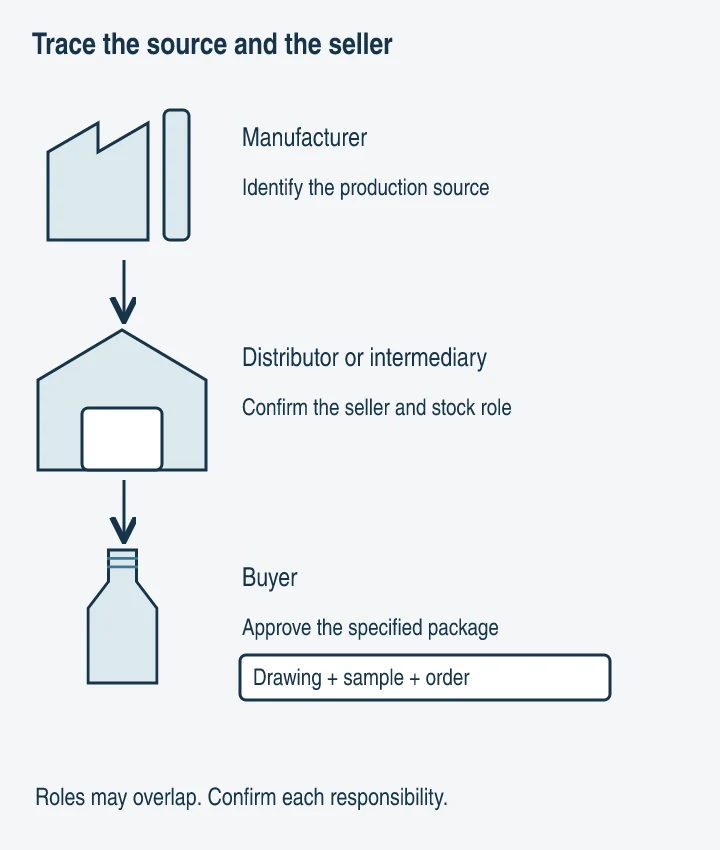
Illustration: identify the original source and legal seller. One business may perform several roles.
A bottle order that arrives with an unsuitable closure, undocumented substitution or wrong delivery arrangement can stop a filling run. Evaluate a glass bottle supplier by checking the legal seller, the exact package specification, product evidence and order responsibilities before comparing the quoted unit price.
Start with a shortlist of identifiable glassmakers or distributors, then send every candidate the same bottle-and-closure brief. Ask who makes the bottle, who holds stock, which documents cover the intended use, and how a sample relates to a production order. This is a procurement guide for evaluating sources, not a supplier directory or a ranking. SG Containers Review does not sell glass bottles.
Quick inputs for a comparable supplier response
Give candidates enough information to reject an unsuitable proposal early. A capacity and a reference photograph can start a conversation, but they cannot define the finish, closure or filling conditions. Use this input list with the buying-guides overview to keep bottle procurement distinct from equipment procurement.
| Input or item | Typical value or source | Why it matters |
|---|---|---|
| Product and intended use | Product brief and process owner’s requirements | Sets the application to be assessed |
| Bottle and closure | Controlled drawing, sample and finish reference | Identifies the package rather than a visual resemblance |
| Stock or custom requirement | Existing catalog item or new design brief | Changes sampling, tooling and supply questions |
| Order pattern | Initial order and expected repeat requirements | Distinguishes a one-off shipment from a supply arrangement |
| Delivery location | Address, receiving access and unloading method | Makes freight scope comparable |
| Required availability | Production plan and delivery deadline | Separates promised stock from production scheduling |
| Acceptance basis | Agreed specification and inspection plan | Defines what the buyer may accept or reject |
| Required documents | Market and customer requirements | Identifies evidence that must accompany approval |
For the detailed dimensional fields, use the bottle specification checklist. This page focuses on whether a supplier can substantiate and deliver that specification.
Takeaway: Send a defined package and intended use, rather than asking several vendors to guess what “a similar bottle” means.
Find candidates and establish who does what
An industry directory or a manufacturer’s website can identify possible sources, but it does not qualify them for your order. The Glass Packaging Institute’s North American sourcing initiative is one industry starting point. Once you find a candidate, establish the legal entity offering the goods and the source responsible for producing them.
The categories below are procurement roles. A business may combine them, so ask about the actual transaction instead of relying on the label on its homepage.
| Role in the transaction | What to establish | Question that exposes an unclear responsibility |
|---|---|---|
| Glass manufacturer | Production site, product reference and route for technical questions | Is the proposed bottle made at the identified site? |
| Stocking distributor | Seller identity, stock location and manufacturer traceability | Does the quoted availability cover this item and quantity? |
| Sourcing intermediary | Which work it performs and who contracts for supply | Who accepts a claim and authorizes a replacement? |
| Decorator or other processor | Operations performed after bottle manufacture | Who approves the final decorated pack and its documents? |
Check that the company name on the quotation, invoice and proposed payment details corresponds to the agreed seller. Resolve discrepancies through an independently established contact route before ordering. Ask which party supplies closures, which party arranges transport and which party can approve a product change.
The glass bottle types and sourcing guide helps connect the candidate’s offering with the required bottle family. Use stock versus custom bottles if a source proposes a new design when a catalog item was requested.
Common mistake: Treating the company that answers the inquiry as the manufacturer without asking. A distributor can be an appropriate source, but the buyer still needs traceability and a clear route for technical and quality questions.
Takeaway: Document the seller, original source and responsible contact for each part of the proposed package.
Check certification claims separately from bottle approval
A management-system certificate is evidence about an organization and its stated scope. It does not approve every bottle the organization offers. ISO’s joint explanation with IAF explicitly distinguishes ISO 9001 quality-management certification from product certification; it also cautions that certification does not guarantee perfect product conformity.
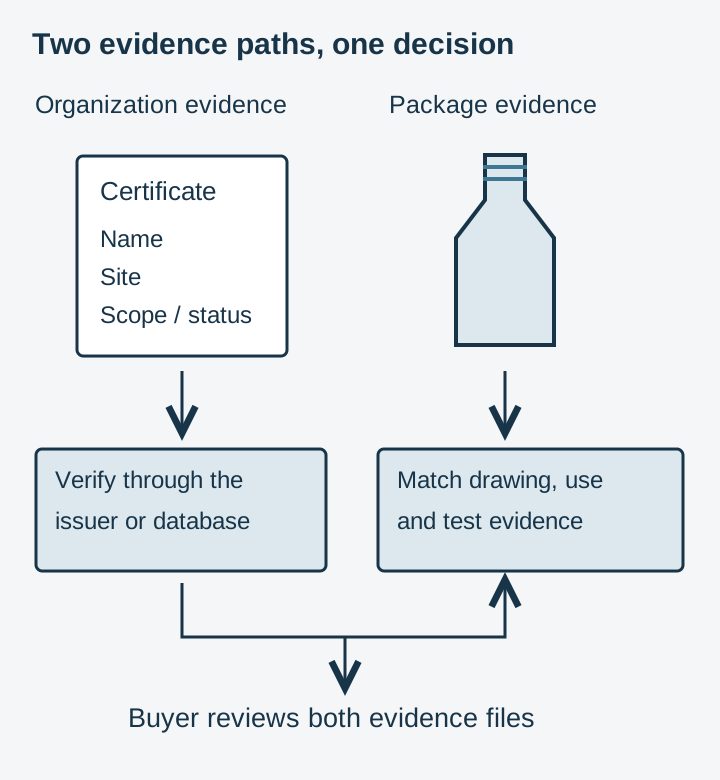
ISO states that it does not issue certificates. Its current certification guidance directs users to verification through the certification or accreditation bodies and available certification databases. Match the legal name, site, standard, scope and status to the organization being evaluated. Retain the result of that check with the supplier file.
Ask for the precise product documents required by your market and intended use. For US food-contact components, FDA’s guidance explains that authorization depends on the substance and conditions of use. The closure, liner, decoration and other relevant components need attention alongside the glass body. A general certificate logo does not answer those questions.
| Evidence | What it can help establish | What it does not settle by itself |
|---|---|---|
| Verified management-system certificate | Organization, covered activity and certification status | Suitability of the selected package |
| Controlled product drawing | Identity, dimensions and revision being proposed | Performance under the buyer’s filling conditions |
| Intended-use documentation | The application and components the statement covers | Unstated uses or later substitutions |
| Relevant test report | Results for identified samples and conditions | Every future batch without an acceptance arrangement |
| Traceability and complaint process | How a delivered lot can be investigated | A promise that failures cannot occur |
Berlin Packaging’s published supplier criteria include documented quality-improvement processes, samples, access to support personnel and delivery performance. That is a real buyer’s procurement policy, not a universal qualification standard. Use it as a prompt to ask for evidence proportionate to your own project.
Takeaway: Verify the organization and approve the package through separate, documented checks.
Connect the drawing, sample and first production order
A useful sample has an identity. Record the bottle reference, drawing revision, closure and the purpose of the sample before evaluating it. A display sample, an early prototype and a sample from the intended production source may answer different questions. Require the supplier to say which one it sent.
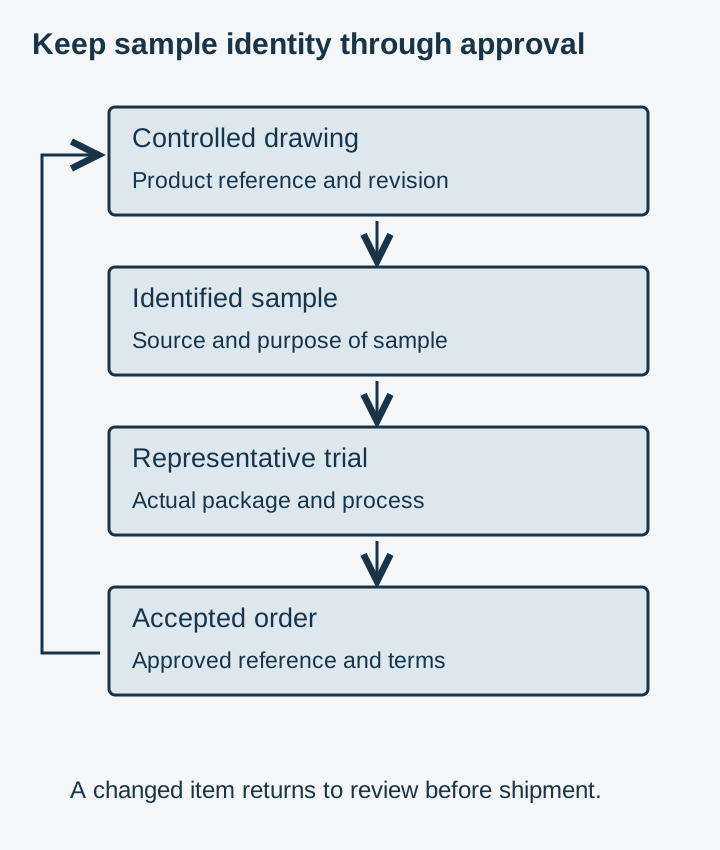
Use the neck finish and closure guide to prepare a complete closure question. Fit the actual closure and assess the package under the intended process rather than approving the bottle from its appearance. If filling, heating, pressure or repeated use is part of the application, give those requirements to the supplier and responsible process specialist explicitly.
Plan a representative equipment trial where the risk calls for one. The bottle changeover guide identifies where a different bottle can affect handling. The bottle inspection guide helps frame inspection questions, while capping equipment covers the closure application step. None of those checks establishes food-process safety by itself.
For a custom design, agree which stage authorizes tooling, sample approval and production. Identify who owns the drawing and tooling, how changes are approved, and whether an alternative production source requires a new review. A supplier’s ability to send an attractive prototype does not answer these commercial questions.
Common mistake: Accepting an undocumented equivalent after approving a specific sample. Require the replacement item and its differences to be reviewed before shipment, rather than discovering a change on the filling line.
Takeaway: Make the approved sample traceable to the drawing and the product reference on the purchase order.
Compare delivered scope, not just the bottle price
A usable quotation separates the goods from the services needed to receive them. Ask each candidate to identify the order increment, included components, packing method, dispatch location and delivery scope. A quote for loose bottles, a quote for divided cases and a quote including closures are different offers even if their unit prices look similar.
| Quote field | Question to resolve before comparing offers |
|---|---|
| Bottle and closure references | Are both identified, and are closures included or separate? |
| Quantity basis | Is the offer per bottle, case, pallet or scheduled release? |
| Packing arrangement | What separates and protects the bottles during the agreed journey? |
| Stock and replenishment | Is availability current, reserved or dependent on a future run? |
| Freight and unloading | Who arranges transport, and what receiving services are included? |
| Tooling and decoration | Which one-time and recurring items are separate? |
| Damage and rejection | What evidence, reporting process and remedy are agreed? |
| Changes and cancellation | Which stages create commitments, and how are changes authorized? |
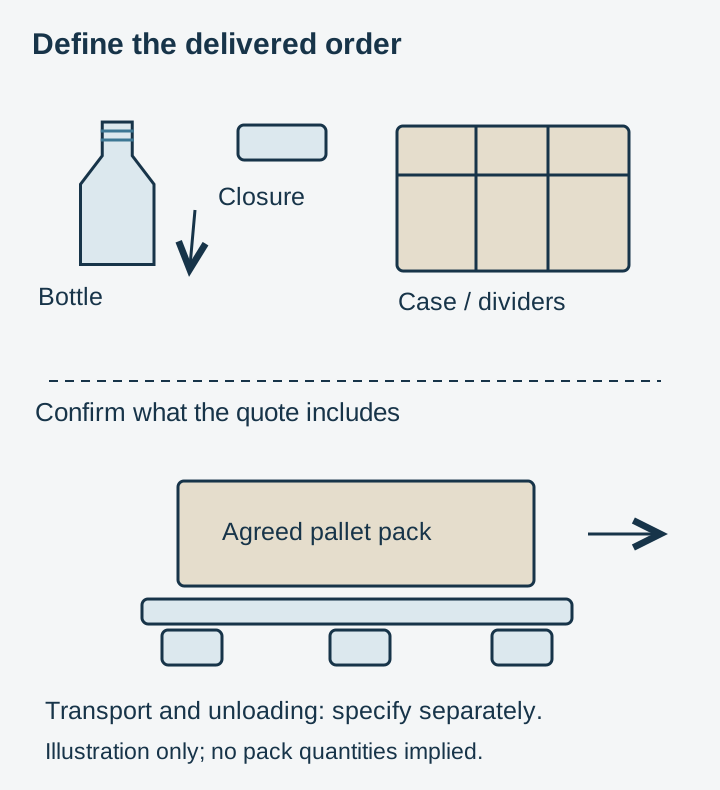
Record the delivery location and receiving restrictions with the quote. Do not infer transport capacity from a bottle count without the actual pallet and load information. The pallets-per-truck guide identifies those inputs. The case-packing and palletizing guide explains why pack handling remains part of the line decision.
Keep dispatch readiness separate from arrival. A statement that an item is in stock does not document that the required quantity is allocated to your order or that a carrier can meet the needed delivery date. Obtain the proposed schedule and any dependencies in the written response.
Takeaway: Normalize the delivery and component scope before deciding which quotation fits the project.
Keep a supplier decision record with explicit gaps
Use a short evidence matrix to compare finalists. Mark each requirement as documented, awaiting a response or unacceptable for the project, and name the person responsible for closing a gap. Avoid a numerical score that lets a low price cancel out missing product evidence or an unresolved supply responsibility.
| Requirement | Candidate response | Evidence reference | Decision or next action |
|---|---|---|---|
| Seller and original source identified | Record the entities and roles | Quote and correspondence | Resolve any mismatch |
| Package specification accepted | List exceptions rather than “complies” alone | Drawing and revision | Review deviations |
| Intended-use documents supplied | Identify covered components and use | Document version | Quality review |
| Samples and trial acceptable | Record the actual sample identity | Trial record | Approve or revise |
| Delivery and claim terms agreed | Record included services and procedure | Written terms | Purchasing review |
| Changes controlled | Record how substitutions are approved | Supply agreement | Assign owner |
This is an editorial worksheet, not an industry certification scheme. Your quality and purchasing teams should decide which requirements are mandatory. Use the bottling equipment RFQ checklist separately if the same project includes a new filling or capping line; bottle qualification does not approve equipment performance.
Takeaway: Make the final choice explainable through evidence and unresolved conditions, rather than a vendor’s ranking or a single weighted score.
When this does not apply
This guide does not certify a supplier, provide a directory, recommend a particular manufacturer or establish a glass-container test standard. It does not specify pressure resistance, thermal processing limits, tolerances or a bottle’s suitability for reuse. Those claims require applicable product documentation and qualified review.
Food, beverage, cosmetic and pharmaceutical projects can have different requirements. Do not treat the same capacity or finish name as proof of interchangeability. Returnable systems also need a defined recovery, inspection and washing process beyond buying a bottle. A supplier comparison cannot replace that system assessment.
Takeaway: Keep application-specific approval with the responsible specialists and use this guide to organize the procurement evidence.
FAQ: Questions before ordering wholesale bottles
Does a low order minimum let me buy individual bottles?
Not necessarily. Ask separately about the minimum transaction, full-case rules and pallet increments for the specific item. Published supplier FAQs distinguish these questions. Confirm that a sample order and a production order have the same product reference even when their packing arrangements differ.
Can samples establish what the production order will contain?
Only if their identity and relationship to production are documented. Request the source, revision and purpose of each sample. Ask whether decoration or a closure has changed since sampling. Keep the acceptance record with the order so later deliveries can be compared against the agreed reference.
Does a matching closure listing settle compatibility?
Treat a catalog match as a starting point for confirmation. Ask for the bottle finish, closure specification and intended-use basis, then evaluate the assembled pack. If a supplier changes the liner or closure source, review the effect instead of relying on an unchanged product photograph.
Can I collect a pallet with my own transport?
Ask the seller to confirm collection availability, appointment arrangements, load details and who performs loading. Check that your carrier can handle the agreed shipment. A collection option on a website does not establish that your particular vehicle or pickup schedule is suitable.
Is an expedited order the same as next-day arrival?
Separate order processing, goods availability and carrier transit. Ask which event the delivery estimate starts from and what service it includes. Resolve a production deadline before paying for expedited handling; a faster dispatch service alone may not meet the required arrival date.
Can unsuitable bottles always be returned?
Read and agree the return and rejection terms before ordering. Record authorization steps, deadlines, condition requirements and costs without assuming all suppliers use the same policy. Keep an agreed sample trial distinct from placing a large order that you hope to return if it fails.
Takeaway: Confirm transaction-specific terms in writing; general website help does not replace the agreed order.
Methods, sources and further reading
Updated October 2026. This guide organizes public industry and supplier material into an editorial procurement workflow. It reports no supplier audit, factory visit, product test or comparative vendor ranking. Original diagrams show roles and document relationships, not real factories or certified products.
- Glass Packaging Institute sourcing initiative provides an industry route for finding potential North American sources.
- ISO certification guidance explains certification and ways to verify claims. The ISO/IAF explanation of expected outcomes supplies the management-system versus product distinction; its older institutional details are not used as current information.
- FDA food-contact component guidance supports the intended-use documentation question.
- Berlin Packaging’s supplier criteria are a published procurement example, not an endorsement or mandatory industry checklist.
- Burch Bottle’s FAQ supplies real questions about cases, samples, closures, collection, delivery and returns. Answers here are cross-supplier purchasing guidance; that company’s commercial terms are not generalized.
Related reading: the stock-versus-custom comparison helps choose a sourcing route, and the bottle specification checklist helps turn an acceptable concept into a controlled drawing brief.
Takeaway: Use current supplier documents to close the gaps in the comparison before releasing an order.
Related guides

Glass Bottle Specifications: A Checklist for Supplier Enquiries
A checklist of what to state in a glass bottle enquiry: drawing dimensions, capacity and fill point, finish, color, strength, decoration, quality and packing.
Read the guide
Stock vs. Custom Glass Bottles: What to Compare Before Ordering
Compare stock and custom glass bottles on tooling ownership, minimum quantities, sampling, documentation, line trials and supply continuity before you order.
Read the guide
Bottling Equipment RFQ Checklist: Comparing Supplier Proposals
How to write a bottling equipment RFQ so suppliers quote the same inputs, scope and performance basis, with a matrix for FAT, SAT, spares and warranty.
Read the guide