
Choosing Capping Equipment for Glass Bottles and Jars
Prepare a capping requirement from finish and closure data: screw, ROPP, crown, lug, press-on and cork application, torque, and how to verify closures.

Prepare a capping requirement by starting from the glass finish and the closure, not from the machine. The finish and closure decide how the closure has to be applied: turned on with torque, formed onto the neck with rollers, crimped over the lip, seated by vacuum or inserted into the bore. Once the method is clear, the remaining questions are how the closure is fed and held, how seal quality is checked, and what the line needs around the capper.
This guide covers six application methods, explains why application torque and removal torque are different measurements, and shows how to turn finish and closure data into a request a supplier can answer. It is a selection aid. Torque windows, vacuum levels and inspection frequencies depend on the closure maker’s specification and the product, and no figure here replaces them.
A loose closure leaks. Too much application torque can damage the finish, crush a liner, or distort a tamper-evident band. Kanda Cork Closures states both of those outcomes. Either one rejects the package. The closure type decides the action, and the evidence you keep is not the same for a torque closure and a vacuum closure.
Swipe or scroll horizontally to see all columns.
| Closure | Application action | Evidence to keep |
|---|---|---|
| Screw | A chuck turns a pre-threaded cap | Removal torque on a tester, correlated to the head setting for that package |
| ROPP | Rollers form the thread and tuck the band | Cap height, band position, opening torque, leak check |
| Crown | A die crimps the skirt under the lip | Crown size, finish type, liner |
| Lug | Steam or vacuum, then a partial turn | Cold-water vacuum check where 21 CFR 113.60(a)(2) applies; closure-maker pull-up and security |
| Press-on | The closure is pushed on | Vacuum and a matched finish, confirmed with the closure maker |
| Cork | Jaws compress the cork and a plunger inserts it | Insertion depth and ullage |
Torque check: measure removal torque on the capped container with a torque tester. That reading is not, by itself, the torque the machine applied during the spin. Vacuum check: for low-acid foods in glass with vacuum closures, 21 CFR 113.60(a)(2) requires a recorded cold-water vacuum test of capper efficiency before filling. That test is not the four-hour double-seam teardown.
Start from the finish and closure data
A neck finish is more than a diameter. A designation such as 24-410 carries a nominal diameter and a thread style, and Propacks, a closure supplier, notes that a cap of one thread style may screw onto a finish of another far enough to feel secure although the geometry differs and the seal cannot be assumed. The closure’s material and liner matter as much as the diameter. Read the closure maker’s drawing and the glass maker’s finish drawing together; the guide to neck finishes and closure compatibility explains how.
For food jars, the same logic applies to the jar and lid pair; see glass jars for food for shapes, finishes and closures. Cornell University food scientists describe three general finish types for jars (lug, press-on/twist-off and continuous thread), each with its own closure design.
Gather the following before talking to capper suppliers:
Swipe or scroll horizontally to see all columns.
| Data item | Where it comes from | Why the capper supplier needs it |
|---|---|---|
| Finish designation and drawing | Glass supplier | Chuck, roller or head geometry, neck centering |
| Closure type, size and drawing | Closure supplier | Application method, feeding and sorting |
| Liner or gasket material | Closure supplier | Compression, torque and vacuum behavior |
| Application torque or head setting, and removal torque range | Closure supplier, then validated on the line | Clutch or head setting and acceptance limits |
| Product, fill temperature, headspace | Your process | Vacuum formation, purge, foaming |
| Vacuum or inert gas requirement | Product and closure | Steam or vacuum equipment, gas dosing |
| Tamper-evident or safety-button features | Closure design | Band forming, button check |
| Feed method | Closure supplier and capper supplier | Hopper, elevator, chute, orientation |
Closure application methods
- Screw capping. A rotating chuck applies torque to a pre-threaded cap.
- ROPP. Thread rollers and pilfer rollers form the aluminium shell onto the finish.
- Crowning. A die crimps the crown onto the bottle lip.
- Lug capping. Steam or vacuum, then a twist-on.
- Press-on or snap. The closure is pushed onto the finish.
- Corking. Jaws compress the cork and a plunger inserts it.
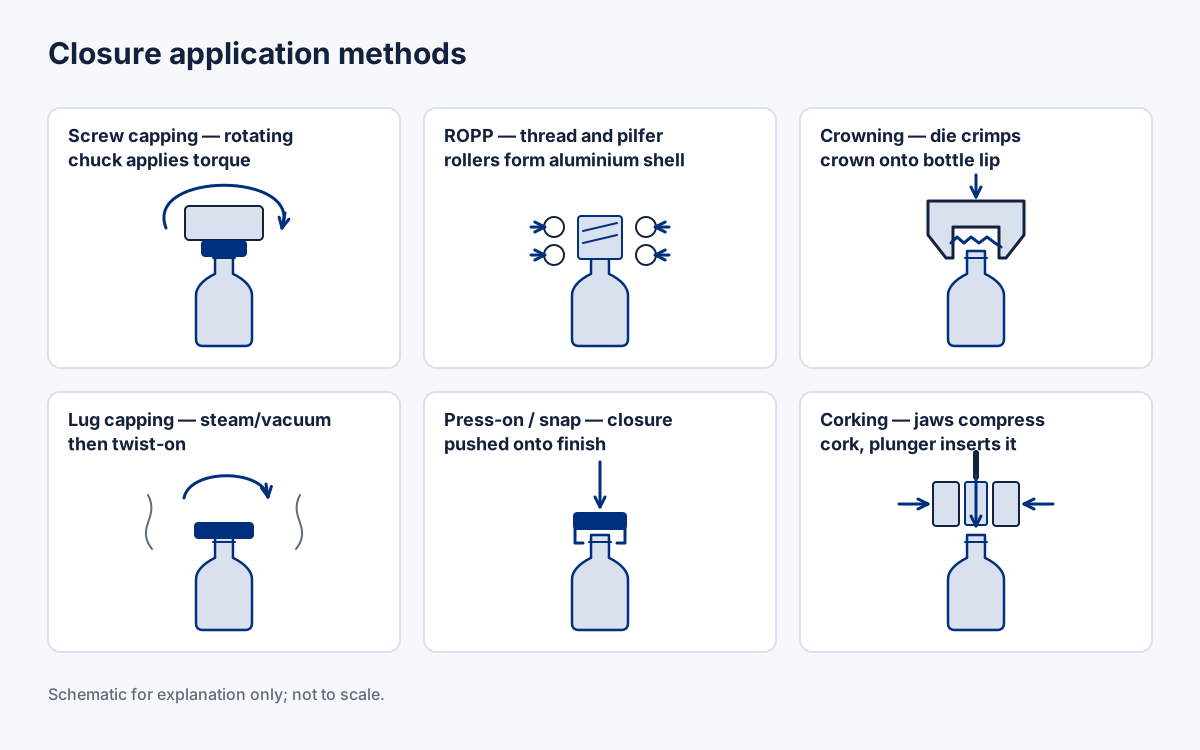
Screw capping
A pre-threaded screw cap is turned onto a matching thread, typically by a chuck that grips the cap and applies rotation until a set torque is reached. A ROPP machine supplier’s guide describes the pre-threaded screw cap as one where the threads are already formed and the machine applies tightening torque, so torque control is critical.
ROPP (roll-on pilfer-proof)
A ROPP closure is an aluminum shell with a liner and a perforated lower band. According to the same ROPP guide, the capping head applies top pressure to seat the liner, thread rollers press the aluminum into the glass thread, and pilfer rollers tuck the band under the neck bead. The guide lists cap height, thread detail, band position, opening torque and leak performance among the checks, and notes that ROPP needs a matching cap, bottle finish, roller setup and torque testing.
Crowning
A crown cap is a metal shell with a corrugated edge that is crimped around the bottle lip over a liner. The crown cork was patented by William Painter in 1892, and ASME describes the original as a thin steel cap with 24 pleats crimped under the bottle lip. A supplier guide describes 26 mm as the most common size and 29 mm for some larger or higher-pressure bottles, and notes that twist-off crown caps rely on shallow glass threads while pry-off caps do not. A crowner needs the crown size, the finish type and the liner type specified.
Lug capping with steam or vacuum
Lug closures are used widely for jars because they need only a partial turn, according to the Cornell paper. They are lined with plastisol to hold a vacuum, and the vacuum is central to the seal. Cornell lists the factors affecting vacuum formation as headspace, product sealing temperature, air in the product, and capper vacuum efficiency where cappers are used. Hot filling is one source of vacuum. A steam flush capper is another: a supplier page describes an automated steam capper injecting hot steam into the headspace of a cold-filled package. Equipment for steam or vacuum application should be matched to the product, the headspace and the closure, and suppliers should state which they provide.
Press-on and snap
Press-on twist-off closures are applied by pressing straight down rather than rotating; the seal commonly relies on vacuum, as with lug closures. This description is editorial and should be confirmed with the closure maker. Cornell identifies press-on/twist-off as one of the three general finish types, which means the finish and closure are a matched pair.
Cork insertion
AWRI describes a corker that compresses the closure between jaws, pushes it into the neck and, on some machines, extracts air from the neck during insertion. It lists insertion depth (a stopper should not protrude above the rim or be over-inserted by more than 1 mm), fill height and ullage, and recovery time upright after insertion among the things to control. Corks are a bore seal, so the finish bore dimensions, not the thread, are the critical data.
Application torque versus removal torque
Application torque is the rotational force used to put a cap on. Removal torque is the force needed to start opening it after it has settled. Propacks and Kanda Cork Closures both stress that the two are related but not interchangeable, and that a complete closure specification should define both.
The two are also tested differently. ebottles, a closure distributor, says in its application and removal torque guidelines that the torque a capping machine applies cannot be measured directly, and that its routine check is the removal torque of caps the machine has applied, with a correlation worked out for each bottle and closure. That is that distributor’s inspection context, not a rule that cap torque cannot be measured.
Kinex Cappers, a capping-machine maker, explains a related limit on its own machines: placing the cap in a torque tester and then letting the capper tighten it does not reliably report the machine’s output, because the tester samples too slowly for the spin, and torque at the motor shaft is not the torque at the cap. The measurement it describes is a torque tester used on the capped container. Enercon, writing about induction cap sealing, also describes measuring removal torque after the capped container has rested, and checking that closures leaving the capper heads are consistent. Neither page publishes a glass-bottle torque you can copy onto a specification. The acceptance range still comes from the closure maker for your package. Propacks says many packaging programs check removal torque shortly after capping and again after a defined hold period, with 24 hours common, because closures relax, and that the right hold time and acceptance range should be documented for the package. It also reports that many references use removal torque of about 40% to 60% of application torque, and calls that a screening guideline, not a substitute for a package-specific range.
Published torque charts are mostly written for plastic closures. For glass, validate your own bottle, closure and liner combination. Over-tightening can damage the closure or finish, and under-tightening can leave the closure loose or leaking; Kanda says high torque can crush the liner or distort a tamper-evident band.
Verification and inspection
Ask what is checked, how often and by whom. Examples from the sources:
- Lug closures: Cornell food scientists recommend that an inspection program for glass jars include a visual examination at intervals of no more than 30 minutes and a destructive (teardown) examination at intervals of no more than 4 hours. Visual checks look for defects, misapplication, lid concavity indicating vacuum, and pull-up. Destructive checks include vacuum, removal torque and security. Adequate pull-up and security values are specified by the closure manufacturer. Treat these intervals as a published recommendation, not as a legal frequency for glass.
- What the FDA regulation itself says: for thermally processed low-acid foods in hermetically sealed containers, 21 CFR 113.60(a) requires regular observation for gross closure defects and a recorded visual examination of the closure at intervals that should not exceed 30 minutes. The 4-hour teardown interval in 113.60(a)(1) is written for double-seam cans, not glass. For glass containers with vacuum closures, 113.60(a)(2) requires capper efficiency to be checked by a cold water vacuum measurement before filling starts, with the result recorded. Part 113 covers low-acid canned foods; acidified foods fall under Part 114, and other products may fall under neither.
- Your own inspection plan: the frequencies and limits you actually run come from your process authority, the closure maker’s specification and the product. Keep the regulation, the Cornell recommendation and your plan as three separate lines in the specification.
- ROPP closures: cap height, thread detail, band position, opening torque and leak performance are checked before production sign-off, according to the ROPP guide.
- Cork closures: insertion depth and protrusion are checked, along with extraction force as an indirect measure of performance.
Inline inspection of closure presence and position is covered in the bottle inspection systems guide.
Questions to send suppliers
- Which application method do you propose for my finish and closure, and what closure drawings did you base it on?
- How is the head setting or torque controlled and recorded, and how do you recommend I correlate it with removal torque for my package?
- What closure feeding method is proposed, and what closure tolerances does it need?
- For vacuum closures, how is vacuum produced (hot fill, steam flush, mechanical vacuum), and how is it checked?
- What inline checks are included (closure present, height, cocked), and how are rejects handled?
- What gas purging or dosing does the proposal include for my product?
- What change parts and adjustments are needed for a second closure or finish?
- How does the capper connect to the filler for synchronization and handling of stops?
- What acceptance testing, documentation and spare parts are in scope?
The wine bottling equipment guide shows how these questions apply to cork and screwcap lines. The Bottling Lines section covers related stations.
Evidence and limitations
The methods above are described from public explanations by equipment and closure makers, a peer-reviewed food-protection paper, a wine research institute and a mechanical engineering society. Machines for the same method differ by maker. Torque windows, vacuum levels and inspection rules depend on the closure, the glass, the product, and regulations that apply to the product. Several sources are supplier-written, and some torque guidance is oriented to plastic closures. No application or removal torque values are given here because none apply across closures; the 40% to 60% ratio quoted above is a screening ratio from one source, not a torque value. SG Containers Review analyzes sources and does not test machines.
- 21 CFR 113.60 Containers (April 1, 2025 edition), U.S. Government Publishing Office: closure observation, double-seam teardown interval and the cold water vacuum check for glass containers with vacuum closures. Accessed October 2026.
- New Aluminum Lug Closure Reduces Removal Torque while Ensuring Hermetic Seals in Glass Jars, Food Protection Trends (Cornell University authors): lug closures, vacuum formation, steam flush cappers, closure inspection. Accessed October 2026.
- ROPP Capping Guide, ropp.co.uk (UK supplier of ROPP capping machinery): ROPP anatomy, head sequence and comparison with other capping methods. Accessed October 2026.
- Applying cylindrical closures, Australian Wine Research Institute: corker operation, insertion depth, fill height and ullage. Accessed October 2026.
- Closure Torque Guide: Application, Removal, and Testing, Propacks: application versus removal torque, hold period and the 40% to 60% screening guideline. Accessed October 2026.
- Screw Cap Torque Guide for Leak-Proof Bottle Closures and Testing, Kanda Cork Closures: effects of too much or too little torque and what a closure specification should define. Accessed October 2026.
- Application and Removal Torque Guidelines, ebottles: the distributor’s routine check uses removal torque because it says machine-applied torque cannot be measured directly. Accessed October 2026.
- Measuring the Torque Output of a Capping Machine, Kinex Cappers: why a reading taken during the spin is not the machine output, and that a torque tester is used on the capped container. Accessed October 2026.
- Understanding application and removal torque, Enercon Industries: measuring removal torque after capping and checking consistency off the capper, in an induction-sealing context. Accessed October 2026.
- One Cap to Bottle Them All, ASME: history and construction of the crown cap. Accessed October 2026.
- Crown Bottle Caps: Pry-Off vs Twist-Off Caps Explained, nwbottlecaps.com (crown cap supplier): crown cap sizes, pry-off and twist-off types, liners. Accessed October 2026.
- Gold Metal Lug Caps with Safety Button, Berlin Packaging (supplier page): hot fill and steam capper vacuum generation for safety-button lug caps. Accessed October 2026.
Related guides

Bottle Neck Finishes and Closure Compatibility
How to read finish designations such as 28-400 and the T, E, I, H and S dimensions, and why a matching nominal diameter does not prove a closure fits.
Read the guide
Glass Bottle Filling Machines: How to Compare Filling Principles
Compare gravity, vacuum, counter-pressure, piston and flowmeter filling for glass bottles by product, container and line fit, and learn what to ask suppliers.
Read the guide
Bottle Inspection Systems: Comparing What Each System Checks
Compare empty bottle, fill level, closure, label and code inspection by scope and limits, and ask for reject verification, test bottles and validation records.
Read the guide