
Glass Bottle Filling Machines: How to Compare Filling Principles
Compare gravity, vacuum, counter-pressure, piston and flowmeter filling for glass bottles by product, container and line fit, and learn what to ask suppliers.
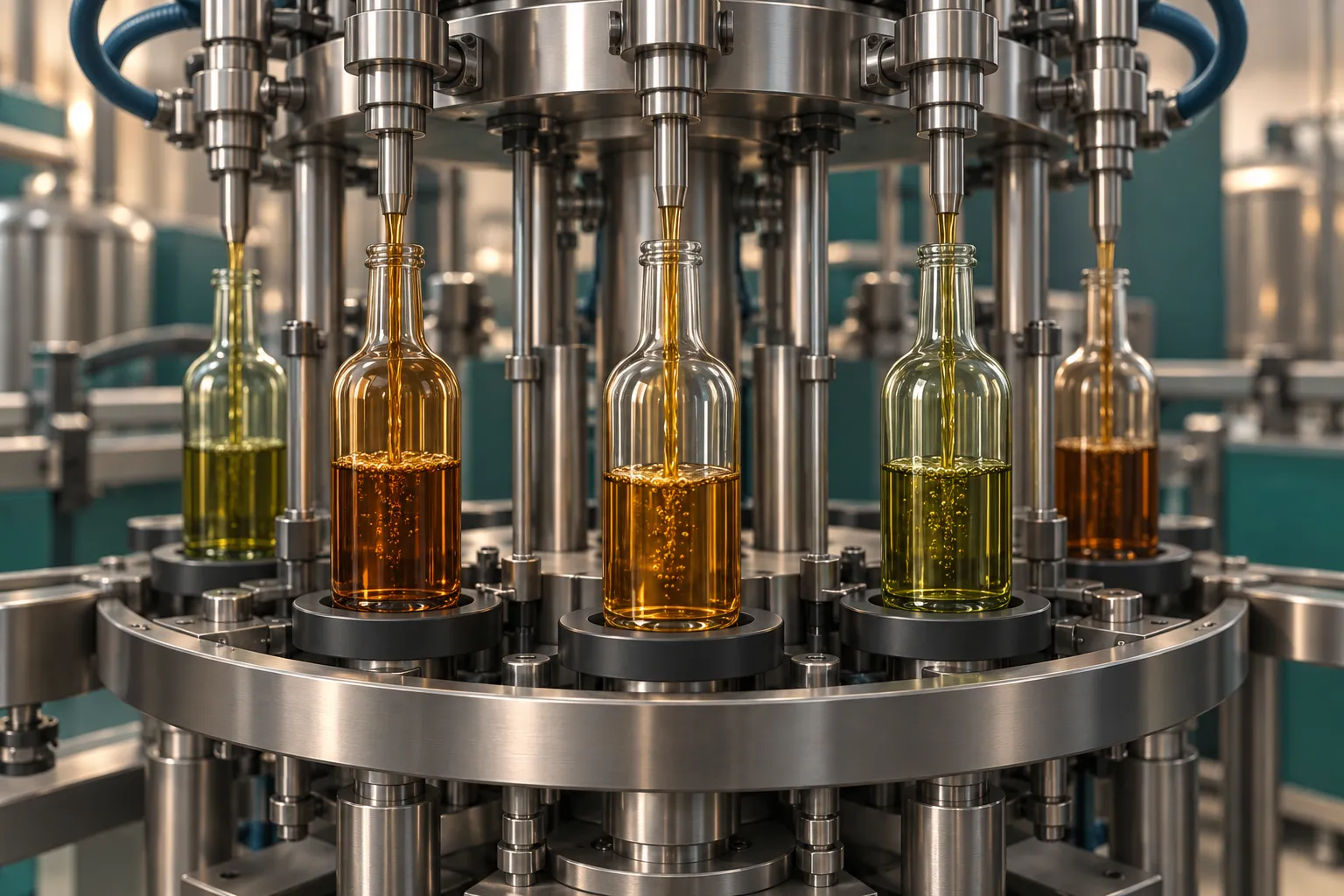
A filling principle that does not match the product or measurement requirement can create foam, fill variation or an unusable line. First screen the product and bottle, then compare the process drive and the endpoint that stops the fill as separate choices.
Swipe or scroll horizontally to see all columns.
| Screening input | Evidence / decision |
|---|---|
| Still or carbonated | Product gas and pressure specification; pressure-control candidates |
| Viscosity and particles | Sample at filling temperature; passage and handling trial |
| Target level, volume or mass | Acceptance basis, agreed tolerance and measurement method |
| Bottle and closure | Finish, capacity tolerance, fill point and headspace specification |
This comparison uses public material, not machine tests. Check the written specifications and bottle specification checklist before comparing supplier claims.
What are you filling?
The product decides which principles are candidates. Write down the following before you contact a supplier:
- Still or carbonated. Carbonated products need the bottle held under pressure during filling so dissolved gas stays in solution. IC Filling Systems, an Italian filler maker, explains that any pressure variation in a carbonated product during filling expands the gas and creates foam, and that warmer product foams more.
- Viscosity and particulates. Several equipment makers’ guides treat viscosity as the main driver of filler choice. They describe gravity-type fillers as suited to free-flowing liquids and piston or pump fillers as better for thick products or those with particles, such as sauces and dressings.
- Foaming tendency. Protein content is one factor IC Filling Systems names for beer.
- Oxygen sensitivity. The Australian Wine Research Institute (AWRI) notes that headspace oxygen can be reduced through counter-pressure fillers, vacuum or inert gas application. Whether that matters depends on the product’s shelf-life requirements.
- Temperature. Hot filling, cold filling and ambient filling make different demands on valves, seals and the bottle.
- Volume claim. If the label declares a target volume or weight, the filler’s measurement basis matters more.
Applications are covered in the guides to wine bottling equipment, beer bottling equipment and sauce and dressing bottling lines.
Which bottle and closure will you use?
The container is the other half of the specification. The filler has to seal against the bottle finish, center on it and, depending on the principle, fill to a point on the bottle or deliver a measured amount into it.
Collect the finish designation, the fill point or fill height, the brimful capacity and its tolerance, and the closure type, then compare them with what the filler supplier expects. Neck finishes and closure compatibility explains how to read finish designations. The glass bottle specifications checklist lists the dimensions worth putting on a drawing. The closure matters at this stage because it affects headspace. For wine, AWRI states that standard screw-cap finish bottles need more ullage (empty space) than cork-finish bottles, and that screw-cap headspace oxygen is generally higher because of this; the headspace and fill height you specify therefore depend on the closure you choose. The capping equipment guide covers the closure side.
How filling principles differ
Separate the process drive from the dosing endpoint. A gravity, vacuum or counter-pressure design may use the endpoint specified by its maker; the process name alone does not establish the measurement basis. In its public guide, CFT distinguishes level, volumetric, meter and weight control and says isobaric designs can stop by level or meter.
What is filled volume?
Filled volume is the quantity of liquid delivered, rather than the visible height it reaches. CFT notes that bottle-capacity variation can produce different volumes at an equal level. Specify the target quantity, allowable variation and test conditions; meter or piston control does not establish zero error.
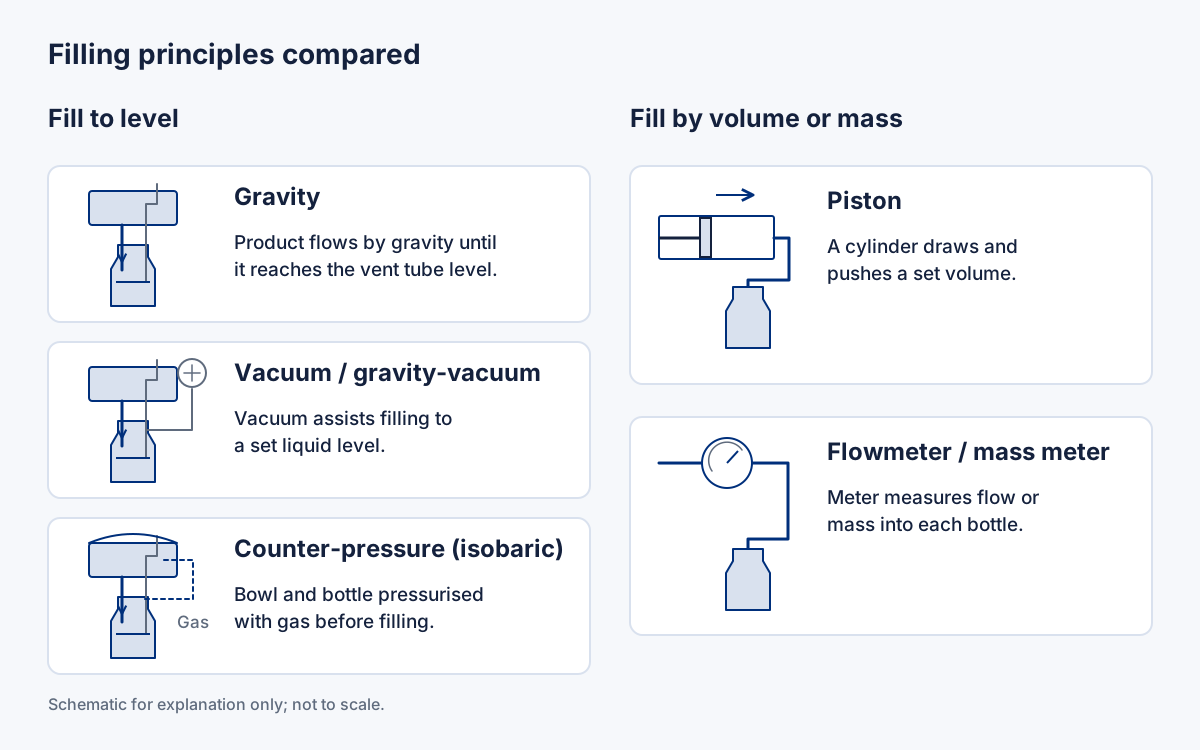
The following groups keep the process, endpoint and verification questions together. Terminology varies by maker; ask which combination the proposal uses.
Gravity
Swipe or scroll horizontally to see all columns.
| Specification | What to confirm |
|---|---|
| Process | Product flows from a raised tank |
| Endpoint | Level or timed/set volume, by design |
| Confirm | Foam, oxygen exposure and measurement basis |
Equipment guides describe a gravity filler as a tank above the fill heads that lets product flow into the container with no other force. Volumetric Technologies, a filler supplier, associates gravity fillers with low-viscosity, free-flowing products. A wine-production textbook lists gravity, counter-pressure, and vacuum with counter-pressure as the three classes used in wine bottling and calls gravity the simplest.
Vacuum and gravity-vacuum
Swipe or scroll horizontally to see all columns.
| Specification | What to confirm |
|---|---|
| Process | Bottle vacuum draws or assists product |
| Endpoint | Level in the described designs; confirm |
| Confirm | Vacuum, gas return and product carried back |
Vacuum filling lowers the pressure in the bottle before or during the fill. In the usual description, which you should confirm with each supplier, the filling element’s return tube sets the level and any excess is drawn back. Public AWRI guidance describes vacuum or inert-gas treatment for headspace oxygen control. Verify the method and measured result for the actual wine and package.
Counter-pressure (isobaric)
Swipe or scroll horizontally to see all columns.
| Specification | What to confirm |
|---|---|
| Process | Bottle and tank pressure are matched |
| Endpoint | Level or meter, by design |
| Confirm | Evacuation, gas, depressurization and foam |
IC Filling Systems describes the cycle: the bottle is sealed by the filling valve, optionally evacuated of air (a step it says is a must for beer, cider and some delicate wines), pressurized with CO2 to the tank pressure, filled while gas escapes through a controlled vent, then depressurized and capped. Beer and some other products may be foamed slightly before capping to push air out of the neck. For specification, the gas supply, evacuation steps and foam control all depend on the product.
Piston
Swipe or scroll horizontally to see all columns.
| Specification | What to confirm |
|---|---|
| Process | Cylinder draws and pushes a set dose |
| Endpoint | Piston stroke targets volume |
| Confirm | Particle passages, shear and cleaning |
Piston fillers draw a fixed volume into a cylinder and push it out. CFT groups them under volumetric filling and describes a range from thin liquids to dense pastes or products with solid particles, used for sauces, jams and spreads. LPS says piston fillers may include heating for hot products and may fill thinner products when particulates are present, such as salad dressings or sauces. Ask about particle size limits and valve design.
Flowmeter and mass meter
Swipe or scroll horizontally to see all columns.
| Specification | What to confirm |
|---|---|
| Process | Flow through a valve is measured |
| Endpoint | Meter reading reaches target quantity |
| Confirm | Meter type, product suitability and calibration |
CFT describes flowmeter filling as using electromagnetic or mass flow meters to measure the volume dispensed, targeting a quantity independently of the visible level. Agree a product-specific tolerance and verify it under the quoted operating conditions. Electromagnetic meters need a conductive liquid; mass (Coriolis) meters measure mass directly. CFT also lists load-cell (net weight) filling as a separate technology that measures mass inside each container. Ask how the meter is calibrated.
Manual, semi-automatic or automatic
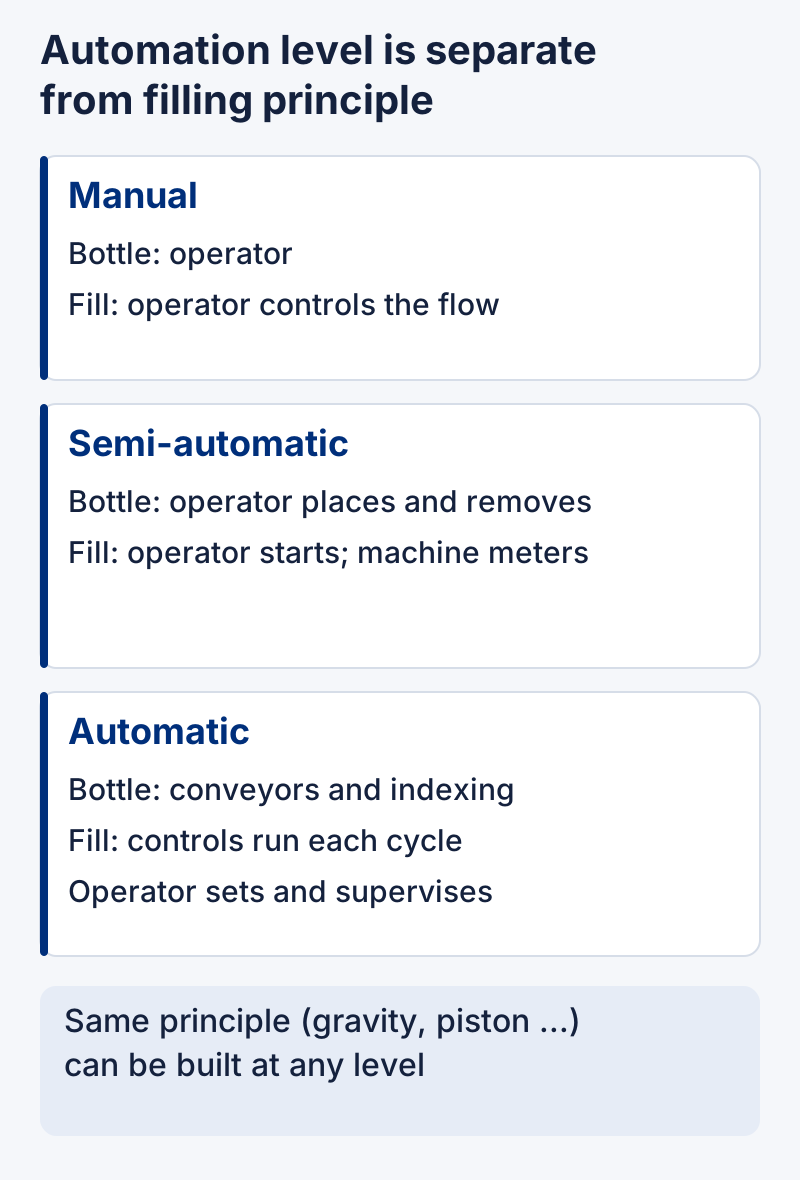
Automation level is a separate choice from filling principle. The same principle, for example gravity or piston, can be built as a tabletop unit, a semi-automatic machine or an automatic filler, so decide both and state both in the enquiry. The level decides who moves the bottle, who starts the fill and how the filler connects to the rest of the line.
Swipe or scroll horizontally to see all columns.
| Level | Who moves the bottle | Who starts and ends the fill | What to confirm |
|---|---|---|---|
| Manual | The operator | The operator controls the flow | Fill consistency between operators, and how the fill point is judged |
| Semi-automatic | The operator places and removes bottles, on a slide track or table | The operator starts the cycle with a switch or pedal; the machine meters the fill | Number of heads, height adjustment for a new bottle, and whether conveyors can be added later |
| Automatic | Conveyors and an indexing system | The controls run each cycle; the operator sets parameters and supervises | How the filler is synchronized with the capper and labeler, and how it stops |
Equipment makers describe the levels in similar terms. E-PAK Machinery describes a semi-automatic filler as metering and dispensing the product while relying on the operator for container placement, cycle initiation or indexing, and calls it a step up from manual filling. It describes an automatic filler as indexing containers, measuring product, dispensing and advancing containers downstream without operator intervention during the run, often connected directly to downstream machines. Liquid Packaging Solutions describes the steps in between: tabletop fillers with a few heads, full-frame semi-automatic machines to which heads can be added up to the frame’s maximum, and automation added later with a power conveyor, PLC and indexing system. These are makers’ descriptions of their own ranges, so ask each supplier which features its quoted machine actually includes.
If labor, product variety or the number of bottle formats is likely to change, ask whether the quoted frame can be upgraded and what an upgrade would include. Small-scale and hand-filling setups have their own constraints; small-scale bottling equipment compares published rates and bottle limits for manual, semi-automatic and compact machines and the signs that it is time to move up a step.
Commercial specifications to get in writing
A supplier’s brochure figures are claims made under conditions the supplier chose. Before comparing commercial filling machines, ask each supplier to state the following in the quotation or on a datasheet for the configuration it proposes:
Swipe or scroll horizontally to see all columns.
| Item | What the written specification should state |
|---|---|
| Filling principle and measurement basis | Level, volume or mass, and how the fill is set and adjusted |
| Rated output | Bottles per unit time, with the test product, bottle, fill volume and number of heads it was measured on |
| Fill performance | How fill variation is defined (level or volume), measured and reported |
| Product range | Viscosity, particulates, carbonation and temperature the machine is designed for |
| Bottle range | Finishes, heights, diameters and fill points covered, and the change parts each needs |
| Product contact parts | Materials, seals and the cleaning method |
| Utilities | Electrical supply, compressed air, vacuum, gases and water, with quality requirements |
| Controls and interfaces | Signals to and from conveyors, capper and inspection |
| Documentation | Operating and maintenance manual, electrical and pneumatic drawings, and spare parts list |
Ask for the operating manual for the model before you order, not only at delivery. It shows how setup, cleaning and changeover are actually done, which is often clearer than the brochure. To convert a quoted bottles-per-minute figure into bottles per hour and calculate good-bottle shift output after Planned Production Time and stop, speed and reject losses, use the filling-line output and OEE worksheet. If the filler is used or comes from another plant, the same items apply, and you also need the original datasheet, the manual and the change-part list for the model, and a check that the product contact parts and seals suit your product. The bottling equipment RFQ checklist covers documentation and acceptance testing in detail.
What must match the rest of the line?
The filler is where bottle, closure and product meet, so most line interfaces touch it. The guide to planning a glass bottling line explains how to set speeds and buffers around the pacing machine; for the filler specifically, confirm these:
- Infeed and rinsing: the bottle must arrive in the orientation, spacing and condition the filler expects.
- Closing: the time between filling and capping, any foaming or purge step, and whether the filler and capper are synchronized. See capping equipment.
- Closure feed: closure type and size decide what the capper needs, so settle them before the filler order.
- Cleaning: product contact parts and cleaning method between products.
- Format changes: which valves, centering bells or starwheels change with a new bottle.
- Utilities and gases: CO2, nitrogen, compressed air, vacuum and water supplies and their quality.
Questions to send suppliers
- Which filling principle do you propose for my product, and why does it suit the viscosity, particulates, carbonation and foaming I described?
- Does the machine fill to level or by volume or mass, and what is the measurement basis for the fill I need to declare?
- What bottle data do you need (finish, fill point, capacity tolerance, weight) and what tolerances do you assume?
- What are the rated speed and the fill performance, and on what test product, bottle and conditions were they established?
- What gases, vacuum, water and compressed air does the filler need, and at what quality?
- How are product contact parts cleaned, and what is the cleaning cycle between products?
- What change parts are needed for a new bottle, and what is documented for changeover?
- How does the filler communicate with the capper, conveyors and inspection, and what happens to the line when the filler stops?
- What is included in the quote: valves, tank, controls, guarding, spares, installation, acceptance testing?
Use the answers with the bottling equipment RFQ checklist so quotes can be compared on the same basis.
Evidence and limitations
Filling principles are described here in general terms from published explanations by equipment makers and an industry research institute. Where a source describes a principle with a particular product (still wine, beer, sauce), that does not mean it applies to your product. Machine designs combine these principles in different ways, terminology varies between makers, and the same maker may place a technology in a different group than another. No source in this list gives a head-to-head comparison, so no principle is presented as better than another. Speeds and accuracies are omitted because they are configuration-specific and supplier-stated. SG Containers Review analyzes sources and does not test machines.
- Types of filling machines, CFT Food Machinery: flowmeter, level, weight and piston (volumetric) filling and what each measures. Accessed October 8, 2026.
- Counter Pressure (Isobaric) Filling, IC Filling Systems: the counter-pressure cycle, pre-evacuation and foaming behavior. Accessed October 8, 2026.
- The Most Commonly Manufactured Liquid Filling Machines, Liquid Packaging Solutions: gravity, overflow, piston and pump fillers and level versus volume filling. Accessed October 8, 2026.
- Understanding the Four Main Types of Liquid Filling Machines, Volumetric Technologies: product viscosity and filler type. Accessed October 8, 2026.
- Oxygen pick-up during packaging: understanding total package oxygen, Australian Wine Research Institute: headspace oxygen, counter-pressure fillers and screw-cap ullage. Accessed October 8, 2026.
- Automatic vs. Semi-Automatic Liquid Filling Machines, E-PAK Machinery: what automatic and semi-automatic fillers do and what the operator does. Accessed October 8, 2026.
- Small Scale Bottle Filling Machines for Any Liquid, Liquid Packaging Solutions: tabletop and full-frame semi-automatic fillers and adding heads or automation. Accessed October 8, 2026.
- Wine Bottling Operations, Apex Learning (Wine Production textbook site): gravity, counter-pressure and vacuum filling classes. Accessed October 8, 2026.
Related guides
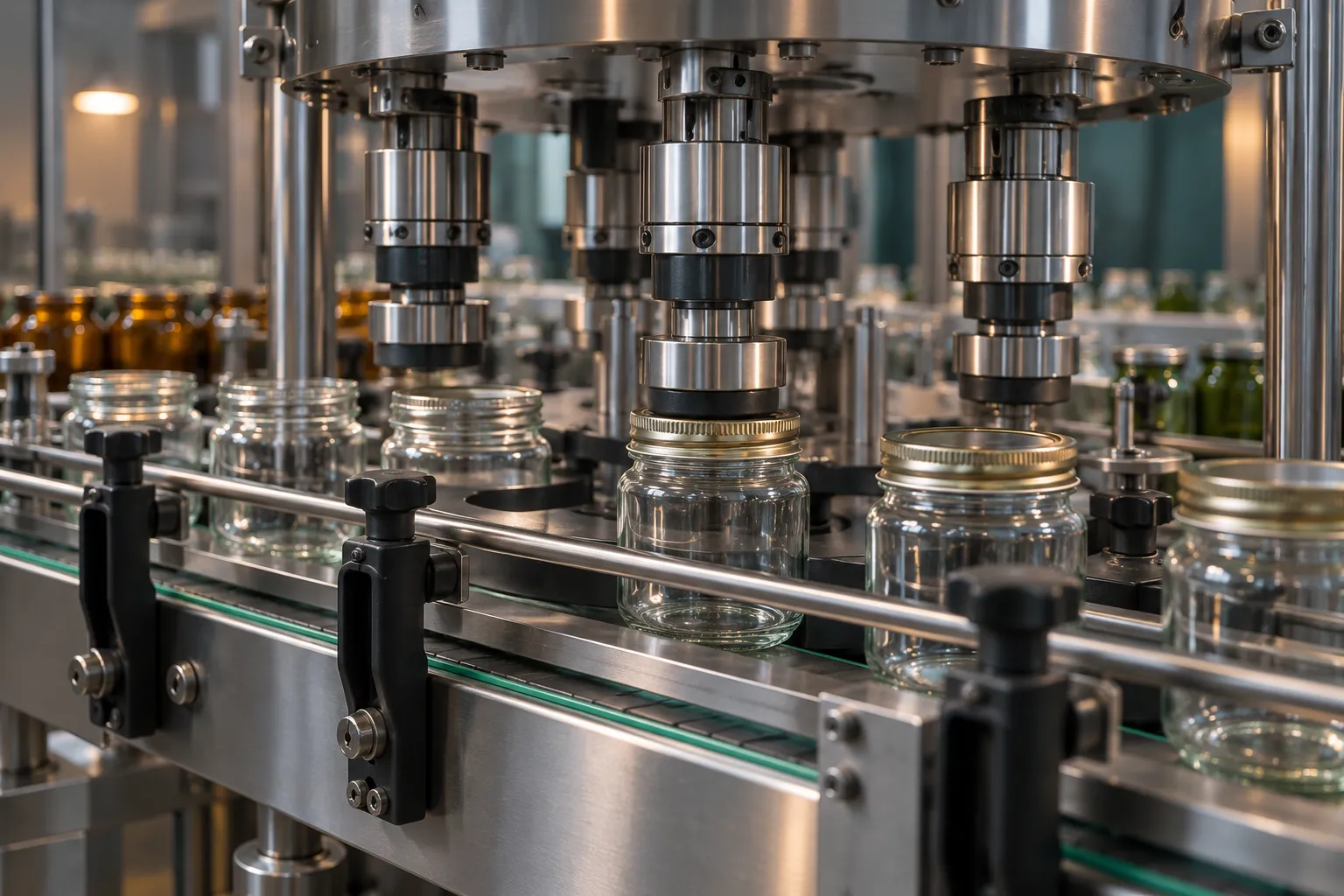
Choosing Capping Equipment for Glass Bottles and Jars
Prepare a capping requirement from finish and closure data: screw, ROPP, crown, lug, press-on and cork application, torque, and how to verify closures.
Read the guide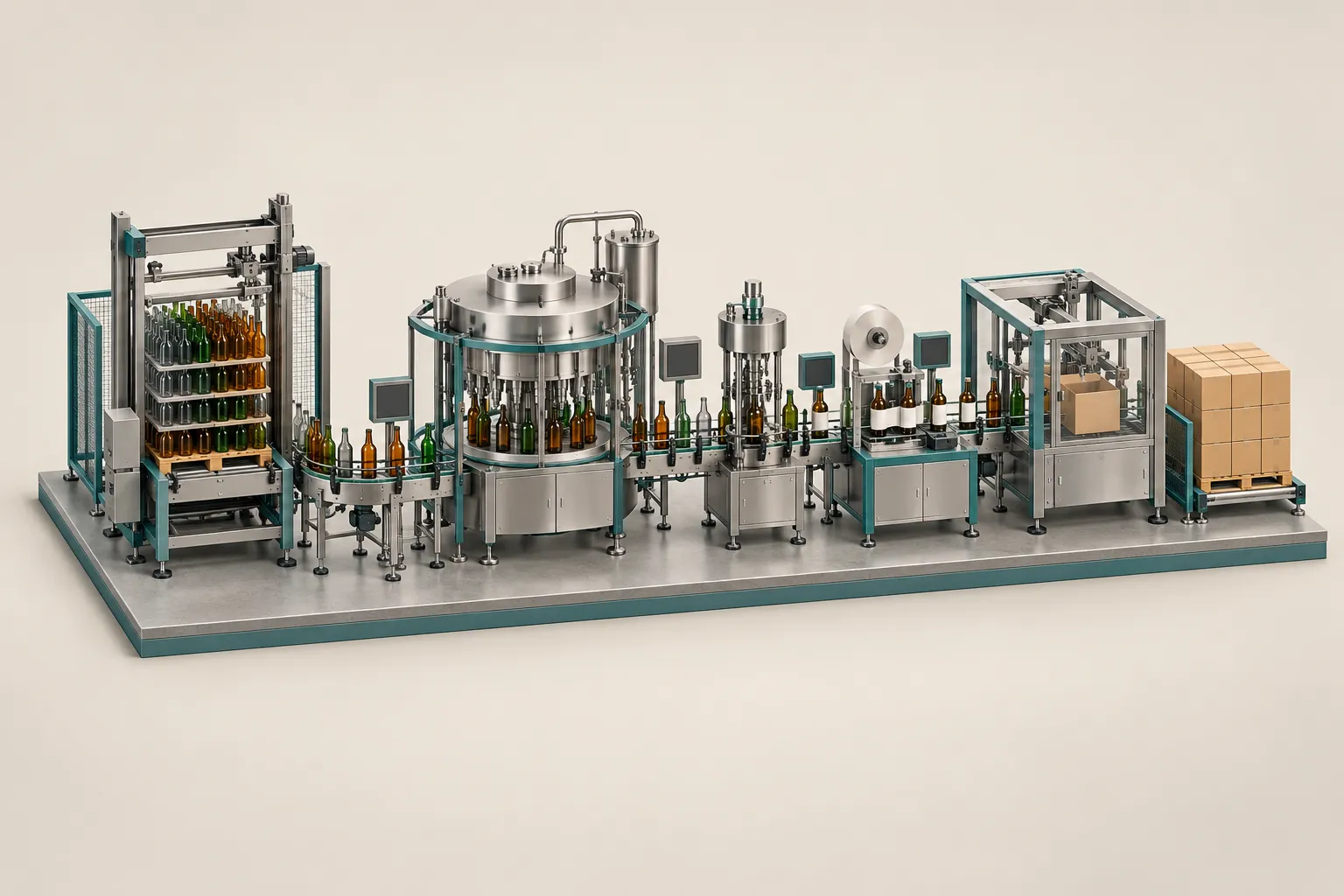
Planning a Glass Bottling Line: From Empty Bottles to Packed Cases
How to divide a glass bottling line into stations, size buffers around the bottleneck machine, and confirm machine interfaces before requesting quotes.
Read the guide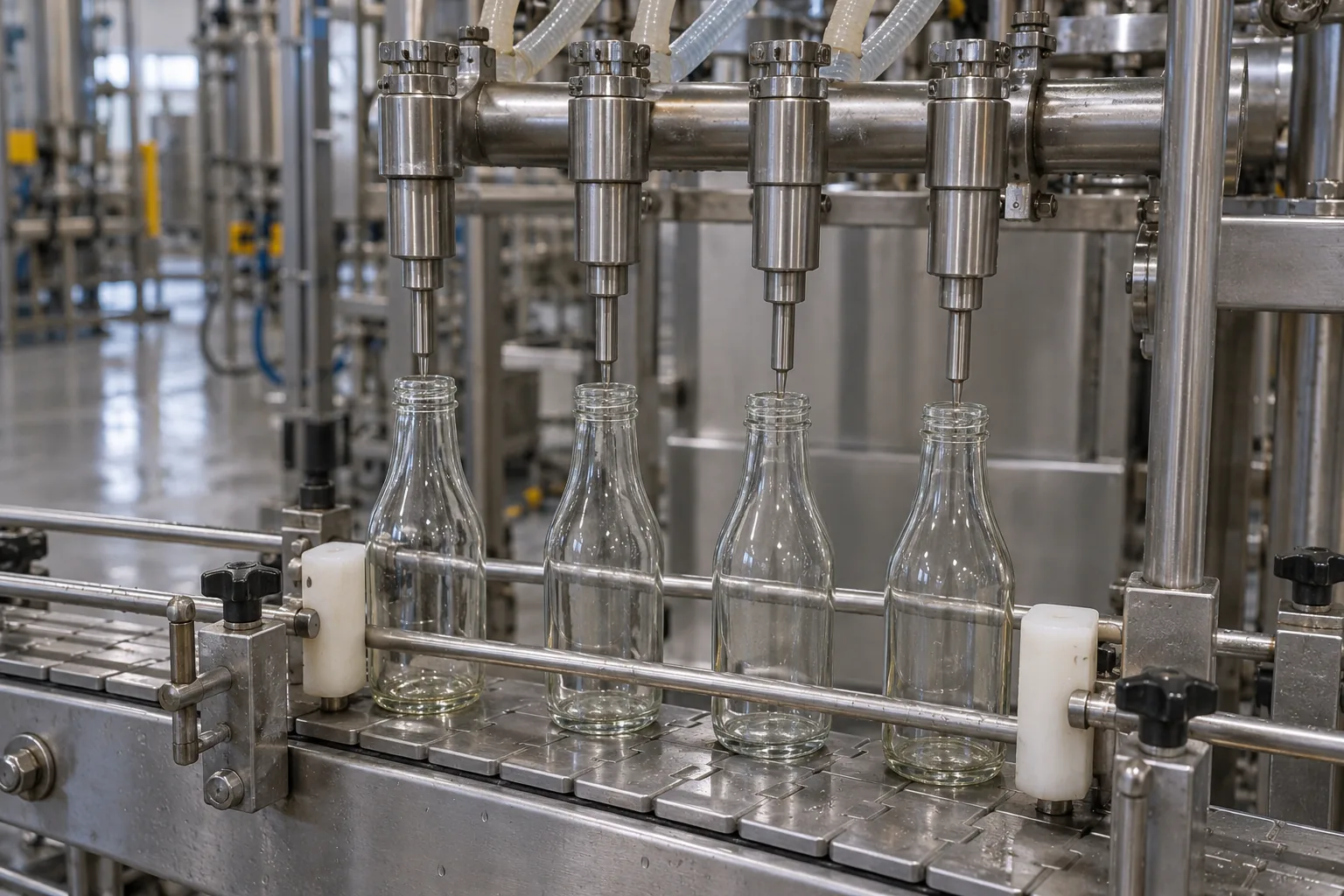
Filling-Line Output: Rated Speed, Good Bottles and Shift Time
Convert bottles per minute to bottles per hour, separate planned production time from stop, speed and reject losses, and calculate shift good-bottle output.
Read the guide