
Small-Scale Bottling Equipment: Manual, Semi-Automatic or a Compact Line?
How small glass-bottle producers can choose between manual fillers, semi-automatic machines and compact lines, using published rates and bottle-fit limits.
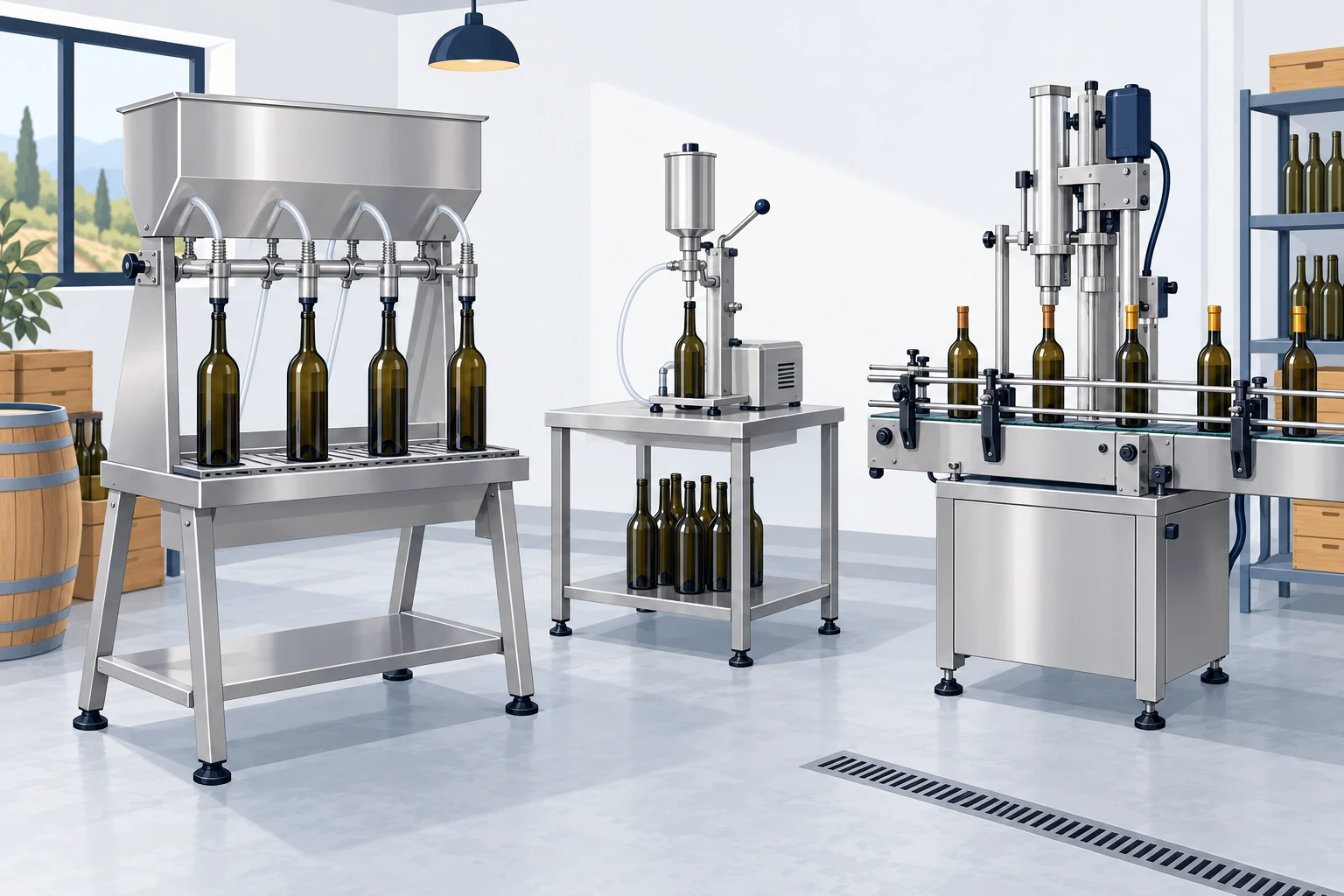
For a small producer filling glass bottles, the choice between a manual filler, a semi-automatic machine and a compact automatic line depends on three things: how many bottles a bottling day must fill, how many people can work it, and whether your bottles fit the machine. Makers publish rates for small fillers that run from a few bottles a minute to a few hundred bottles an hour, so a first estimate is quick once you know your volume. This guide gives that arithmetic, the checks that are specific to glass, and the signs that it is time to move up a step.
Start with the lowest step whose filling time fits the people and hours you have, and move up when it stops fitting. Makers’ published figures give a first estimate. Tenco lists about 180 bottles per hour of 750 ml for its single-spout Enolmatic, and XpressFill lists 240 and 450 bottles per hour of 750 ml for its two- and four-spout level-sensing fillers (both accessed October 7, 2026). E-PAK Machinery gives 100 to 200 bottles per hour for manual wine fillers and 200 to 500 for semi-automatic ones, without stating bottle size or conditions. These figures cover the filling step only. Rinsing, closing and labeling need people or machines of their own, and a compact line makes sense when those steps, not the filler, hold you back.
Key points:
- Divide the bottles you fill in a bottling day by a machine’s published bottles per hour for a first estimate of filling time, then confirm it with a trial on your own bottle.
- Check your glass against the machine before speed: neck bore, bottle height, product type and how the fill level looks in clear glass.
- The filler is rarely the only bottleneck. Time the rinse, the corker or capper and the labeling as well.
- If you expect to link machines later, ask whether the model you buy can take a conveyor, indexing and line controls.
What does each step on the ladder do for a glass bottle?
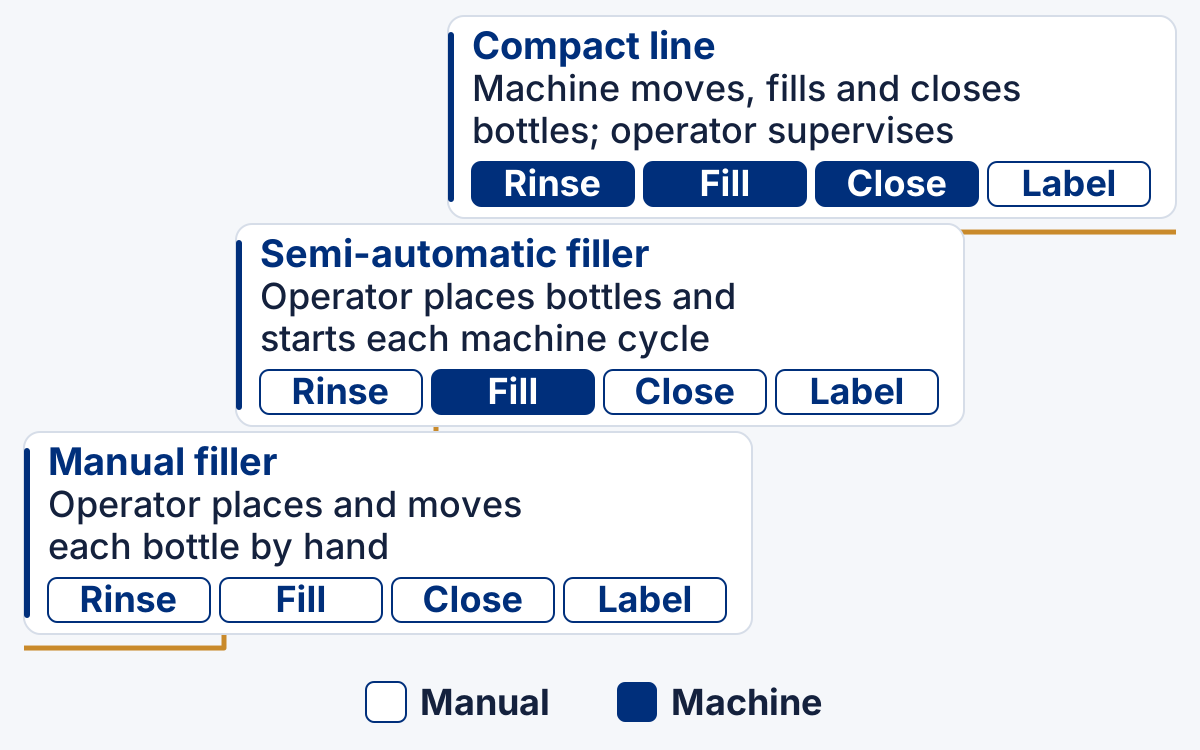
The steps differ in who places, starts and moves each bottle. At a manual filler the operator places, fills and moves every bottle by hand. At a semi-automatic filler the operator still places and removes bottles and starts each cycle, and the machine runs the fill. A compact automatic configuration also moves the bottles between stations. The filling principle (gravity, siphon, vacuum, piston) is a separate choice: Accutek’s manual siphon filler, for example, stops its flow by itself when the levels balance. The levels and principles are defined in glass bottle filling machines; the tables below add published examples.
| Step | Operator’s tasks | Stations that stay manual or need their own machine | Published example and rate |
|---|---|---|---|
| Manual filler | Places, fills and moves each bottle | Rinse, close and label | Accutek Siphon Filler (non-electric, four spouts as standard): 3 to 30 containers per minute, from Accutek’s test on a five-spout machine; container size not stated |
| Semi-automatic filler | Places and removes bottles, starts each cycle | Rinse, close and label | Tenco Enolmatic (single spout, vacuum): about 180 bottles per hour of 750 ml on its datasheet, up to 250 depending on format. XpressFill XF2100 / XF4100 (level sensor): 240 / 450 bottles per hour of 750 ml. XpressFill XF2500 / XF4500 (counter-pressure): 200 / 400 bottles per hour of 12 oz bottles |
| Compact automatic configuration (monobloc example) | Loads the infeed, sets up and supervises | Depends on the configuration; confirm whether rinse, close and label are included | Accutek Mini Mono Block (fill, place and cap in one rotary frame): 35 containers per minute for its two-nozzle configuration; container size and fill not stated, so it cannot be applied to 750 ml bottles |
| Machine | Neck opening | Bottle height | Fill range | Products |
|---|---|---|---|---|
| Accutek Siphon Filler | At least ½ in | 4 to 15 in | 4 oz to 2.5 gal | Free-flowing, low-viscosity liquids |
| Tenco Enolmatic | Inside diameter 16 to 28 mm | 180 to 330 mm with the standard spout | To be confirmed | Clear, low-viscosity liquids only; not creams, jams, honey or products with particles |
| XpressFill XF2100 / XF4100 | To be confirmed | To be confirmed | 50 ml to 1.5 l | Wine, distilled spirits, juice |
| Accutek Mini Mono Block | To be confirmed | To be confirmed | To be confirmed | Tooled for one container; listed for pharmaceutical, food, cosmetic and chemical products |
Sources for both tables: Accutek siphon filler and Mini Mono Block pages, Tenco Enolmatic page and technical sheet, and XpressFill comparison chart; dates are listed under Sources below. All figures are the makers’ statements under their own conditions, not measurements of your bottle and product, and not a ranking. Accutek’s siphon filler page also describes containers from 2 oz to 1 gal, a narrower range than its specification list, so confirm the range for your bottle.
Other makers offer the same steps in other forms. Accutek sells a foot-pedal semi-automatic piston filler (SVF) and a semi-automatic vacuum filler (AccuVac) for small volumes from 2 ml to 6 oz. E-PAK shows a six-head automatic gravity filler with an air rinser. Packaging Digest describes a monobloc as one machine that combines two or more functions, so ask which stations a “compact line” quote actually includes.
How many bottles can each step fill in a bottling day?
Divide the bottles you need to fill in a bottling day by the machine’s published bottles per hour. The result is a first estimate of filling time at that step, which you then compare with the hours and people you can give to bottling. Setup, cleaning and breaks come out of the same day, and a trial on your own bottle is what confirms the figure.
Filling hours = bottles per bottling day ÷ published bottles per hour
Example, assumed inputs: 1,500 bottles of 750 ml in one bottling day, with about six hours of the day available for filling. Both figures are assumptions; use your own.
| Machine | Published bottles per hour | Condition stated by the maker | Filling hours for 1,500 bottles | Within six hours? |
|---|---|---|---|---|
| Tenco Enolmatic (one spout) | About 180 | 750 ml, datasheet | About 8.3 | No |
| XpressFill XF2100 (two spouts, level sensor) | 240 | 750 ml | About 6.3 | No, just over |
| XpressFill XF4100 (four spouts, level sensor) | 450 | 750 ml | About 3.3 | Yes |
E-PAK’s ranges, 100 to 200 bottles per hour for manual wine fillers and 200 to 500 for semi-automatic ones, would give 7.5 to 15 hours and 3 to 7.5 hours for the same 1,500 bottles. E-PAK does not state the bottle size, model or conditions behind them, so treat that as arithmetic on a rule of thumb, not as a 750 ml comparison.
Using the published figures in the table, the single-spout and two-spout machines would not finish 1,500 bottles in six hours, and the four-spout machine would, if it held its published rate on your bottle. Two cautions apply. A published speed is the maker’s figure under its own conditions, so ask what bottle, product and fill size it refers to, as the bottling equipment RFQ checklist recommends for any speed figure. And the filling time covers one station only: E-PAK notes that the filler sets the pace and every downstream station has to keep up, so time the rinse, the corker or capper and the labeling before you decide the filler is the problem.
Will your glass bottle fit the machine?
Check fit before speed. A small filler is built around a range of neck bores, bottle heights and products, and a glass bottle outside that range will not fill well at any rate. Ask the maker to confirm each item below against your bottle drawing.
| Check | Why it matters for glass | Published example | What to send or ask |
|---|---|---|---|
| Neck bore | The spout must enter the neck and seal or vent correctly | Enolmatic: neck inside diameter 16 to 28 mm. Accutek siphon filler: opening at least ½ in | The finish drawing; see neck finishes and closures |
| Bottle height | Tall wine or spirits bottles and short flasks may fall outside the stand or spout range | Enolmatic: 180 to 330 mm with the standard spout. Accutek siphon filler: 4 to 15 in | Your tallest and shortest bottle |
| Fill level in clear glass | Customers see the fill line through clear glass | E-PAK: level (overflow) fillers make bottles look consistent even when internal volume varies. XpressFill states 0.3% accuracy or better, assuming bottles have the same internal volume | Whether you need a constant level or a constant volume |
| Product type | Each filler is built for a range of liquids; carbonated products raise separate questions of pressure, foaming and gas retention | Enolmatic: clear, low-viscosity liquids only, not creams, jams, honey or products with particles. XpressFill offers separate counter-pressure models for carbonated products | Product viscosity, particles, carbonation and fill temperature |
| Closing and breakage | Bottles are held and pressed at the closing step | WineMaker magazine notes that with a hand corker bottles can slip and break and describes a floor corker as more stable; it also describes semi-automatic pneumatic corkers | The closure type and the closing machine you will use; see capping equipment |
| Rinsing | Dust from new glass and residue in reused glass must come out before filling | WineMaker advises a quick sanitizer rinse for new bottles and full cleaning and sanitizing for reused ones. Accutek lists washers and rinsers as separate support equipment | Whether bottles arrive ready to fill or need a rinse station |
When is it time to move up a step?
Move up when one of the signs below shows up on bottling days, and match the upgrade to the sign. Buying a faster filler fixes only the first one. The others call for a level filler, a closing machine, a rinser or a frame that can be linked.
- Filling time no longer fits the day. The calculation above exceeds the hours and people you have. Next step: a filler with more spouts or a semi-automatic machine.
- Fill levels vary from bottle to bottle or operator to operator. In clear glass this is visible on the shelf. Next step: a level, vacuum or overflow filler, whose principle is explained in glass bottle filling machines.
- The corker or capper sets the pace. Bottles wait after filling. Next step: a better closing machine before a faster filler.
- Rinsing and carrying bottles take more labor than filling. Next step: a rinse station, or a monobloc that rinses, fills and closes in one frame.
- You want machines to hand bottles to each other. Accutek describes its SVF as meant to operate on its own and its automatic AVF as the one to build into a line, and says semi-automatic machines may not reach the rate of a fully automatic line when linked. Next step: ask whether the frame can take a conveyor, and plan the stations with planning a glass bottling line.
- You add bottle formats. Each new bottle may need change parts or a new setup. Next step: check the bottling line changeover guide before buying, so the machine you choose can take the formats you plan.
E-PAK offers an annual rule of thumb for wine: many winemakers move from manual to semi-automatic at around 5,000 bottles a year and consider full automation above 9,000 to 10,000. Our reading is that annual volume is a weak trigger on its own, because the same yearly total can be bottled in two long days or in twenty short ones. The bottling-day calculation, plus the signs above, says more about whether your current step still fits.
When a machine is not the answer
Some small producers should not buy the next step at all. A mobile bottling service brings the equipment and an operator to the winery; the wine bottling guide covers what the producer still has to supply. Home bottling kits (a siphon or gravity wand and a hand corker) serve hobby volumes and are outside the scope of this guide. Used equipment can be a route to a larger step, with its own inspection points in the used bottling equipment checklist.
What to bring to a trial fill
Run a trial with your own bottles and product before you buy, and time the whole sequence, not just the fill. A maker can only confirm fit and speed for the bottle and liquid it has actually run.
- Bring the bottle drawing and samples of your tallest, shortest and lightest bottles.
- Bring the product, or a stand-in with the same viscosity, carbonation and temperature at filling.
- State your fill target as a level or a volume.
- Time the filler on its own, then time a full sequence from empty bottle to labeled bottle, including rinsing, closing and labeling. We suggest at least a few dozen bottles for a first look; that is not an acceptance test.
- Note how many people each station needs and which stations can run at the same time, so you can turn machine hours into staff hours.
- Time setup, cleaning and any changeover, which come out of the same bottling day.
- Record fill levels, drips on the neck, foaming and any chipped or broken bottles.
- Ask what changes for your other bottle formats, and how the machine is cleaned between products.
Bring the results into a written request so that quotes cover the same scope; the bottling lines section holds the guides for each station.
Method, limitations and sources
This guide compiles makers’ published specifications and guides, and two trade-media articles, into a comparison by automation step. It is not a test, and no machine was run for it. All rates and limits are the makers’ own statements under their conditions, and some are rules of thumb without stated conditions. The bottling-day example uses assumed inputs. The guide does not rank machines, give prices, cover certifications, or assess home bottling kits, machines listed for sale or spirits-specific requirements. Filling principles are covered in glass bottle filling machines.
Sources (pages fetched on October 7, 2026, or read from copies retrieved on October 6, 2026, as marked):
- Siphon Filler, Accutek Packaging: construction, container range, bottle height and opening, and rated containers per minute (fetched October 7, 2026).
- SVF Series and Semi-automatic Vacuum Filler, Accutek Packaging: foot-pedal piston and vacuum fillers (copies of October 6, 2026).
- Mini Mono Block and Mono Block, Accutek Packaging: fill-place-cap monoblock speed and rotary rinser-filler-capper monoblocks (copies of October 6, 2026).
- Automating a Bottling Line for Cosmetics and Cost of Automatic Bottling Line, Accutek Packaging: semi-automatic versus automatic machines in a line (copies of October 6, 2026).
- Enolmatic and Enolmatic technical sheet (Italian), Tenco: rated bottles per hour, neck diameter, bottle height and product limits (fetched October 7, 2026).
- XpressFill comparison chart, XpressFill Systems: bottles per hour, fill range, accuracy and product types by model (fetched October 7, 2026).
- How to Find the Best Wine Bottle Filler Machine, E-PAK Machinery: rate ranges by automation level and an upgrade rule of thumb (copy of October 6, 2026).
- Filling Line Integration and Gravity Bottle Filling Machine & Pressure Fillers, E-PAK Machinery: line pacing and a gravity filler with air rinser (copies of October 6, 2026).
- Bottling Basics, WineMaker magazine (2024): bottle cleaning and sanitizing, and corker types (copy of October 6, 2026).
- 4 Truths About Monobloc Packaging Machines, Packaging Digest (2020): what a monobloc combines (copy of October 6, 2026).
Related guides
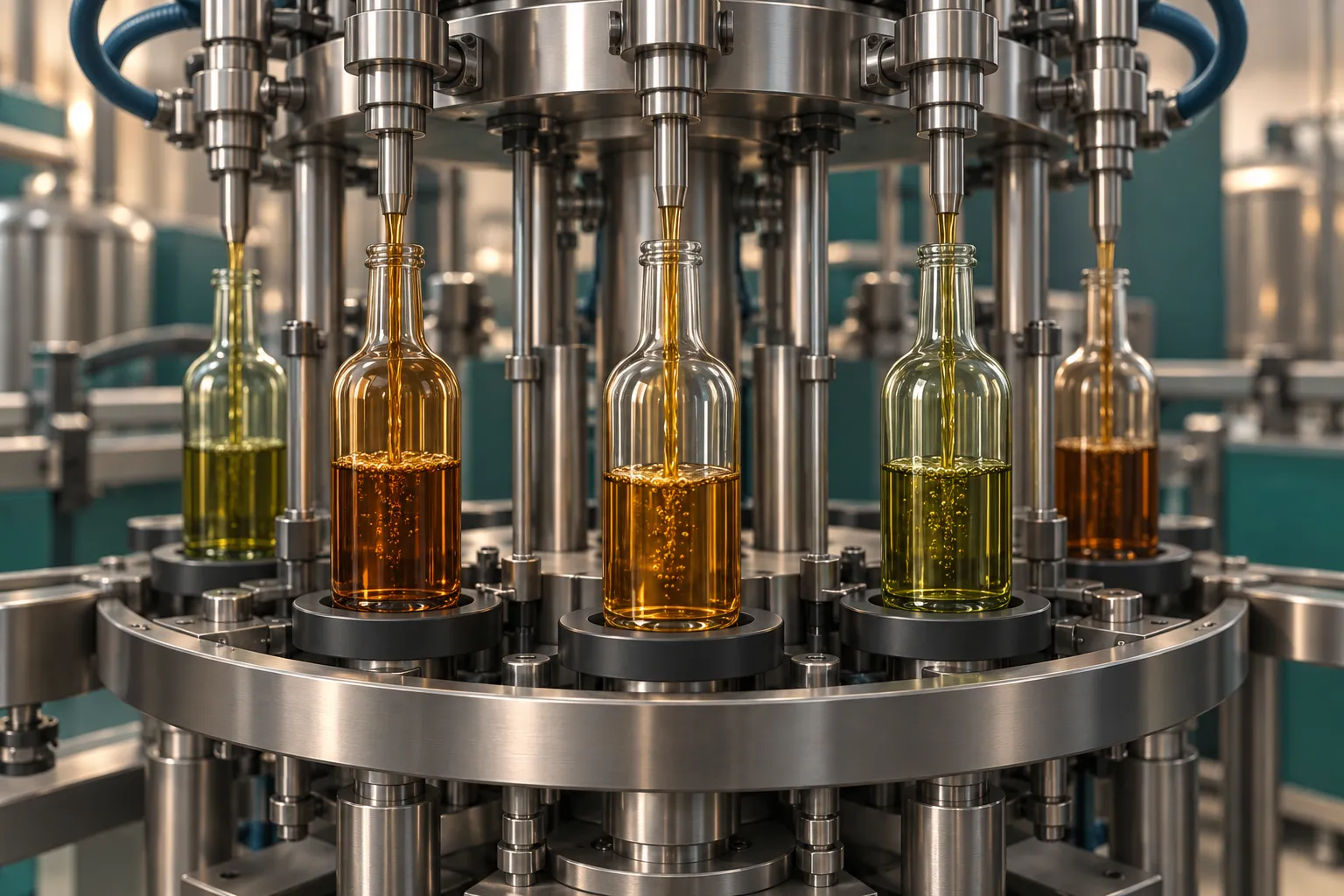
Glass Bottle Filling Machines: How to Compare Filling Principles
Compare gravity, vacuum, counter-pressure, piston and flowmeter filling for glass bottles by product, container and line fit, and learn what to ask suppliers.
Read the guide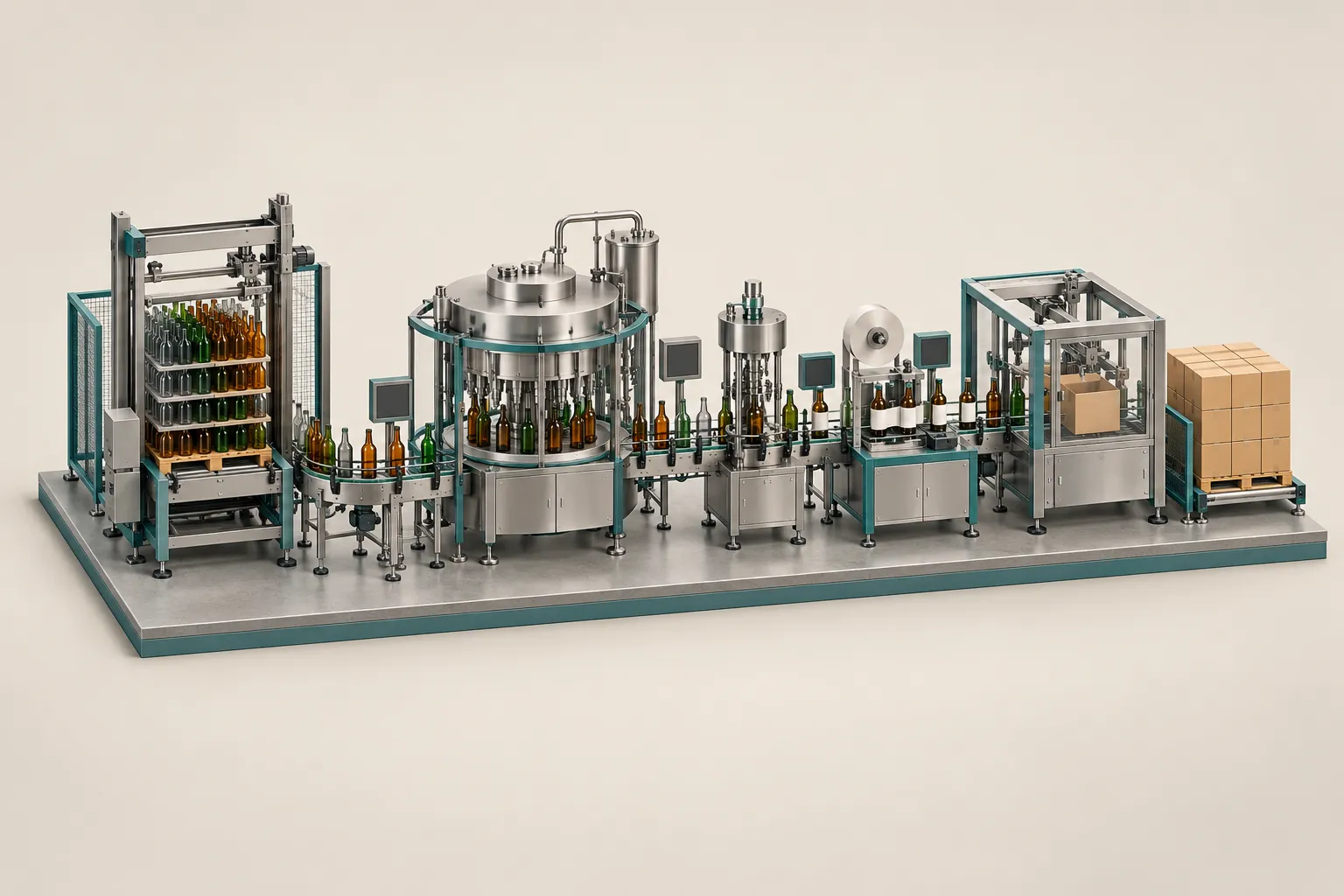
Planning a Glass Bottling Line: From Empty Bottles to Packed Cases
How to divide a glass bottling line into stations, size buffers around the bottleneck machine, and confirm machine interfaces before requesting quotes.
Read the guide
Choosing Capping Equipment for Glass Bottles and Jars
Prepare a capping requirement from finish and closure data: screw, ROPP, crown, lug, press-on and cork application, torque, and how to verify closures.
Read the guide