
Bottle Neck Finishes and Closure Compatibility
How to read finish designations such as 28-400 and the T, E, I, H and S dimensions, and why a matching nominal diameter does not prove a closure fits.

In the distributor terminology explained here, a continuous-thread designation such as 28-400 has two parts. The first number is the nominal neck diameter in millimeters (the T dimension, measured across the threads). The second number identifies the thread style under the Glass Packaging Institute (GPI) and Society of the Plastics Industry (SPI) convention. Use both parts for the initial match, then obtain the actual drawing. A matching diameter alone does not prove closure compatibility. These definitions explain distributor terminology; they are not a reproduction of a GPI standard drawing.
Even a matching designation does not prove the package works. Liner, sealing surface, closure material, fill temperature, product and capping process all affect whether the closure seals and opens as intended. Treat the designation as a first screen, then confirm with drawings, samples and application tests. The sections below cover how to read finish documents and how compatibility is checked.
Swipe or scroll horizontally to see all columns.
| Check | Evidence to record | Action |
|---|---|---|
| Code | Bottle and closure designation | Check the full code, not diameter alone |
| Original drawing | Supplier or standard drawing and revision | Confirm dimensions, tolerances and sealing surface |
| Liner | Exact liner or gasket specification | Check against the product and process |
| Operating conditions | Fill temperature, pressure/vacuum and capper setup | Agree the conditions for acceptance |
| Samples | Identified bottle–closure pair and test record | Verify fit, seal and opening on the intended line |
Reading a finish designation
For continuous-thread finishes, two distributors’ guides describe the same convention. The Cary Company explains that the neck width (T) and the thread style are the two critical factors, written as a two-digit number and a three-digit number separated by a dash or slash, such as 28-410. Paramount Global gives the common thread styles: 400 is one thread turn, 410 is one and a half turns, and 415 is two turns with thinner threads and a typically taller neck. Both guides state that GPI and SPI created the guidelines for threading on glass and plastic containers respectively.
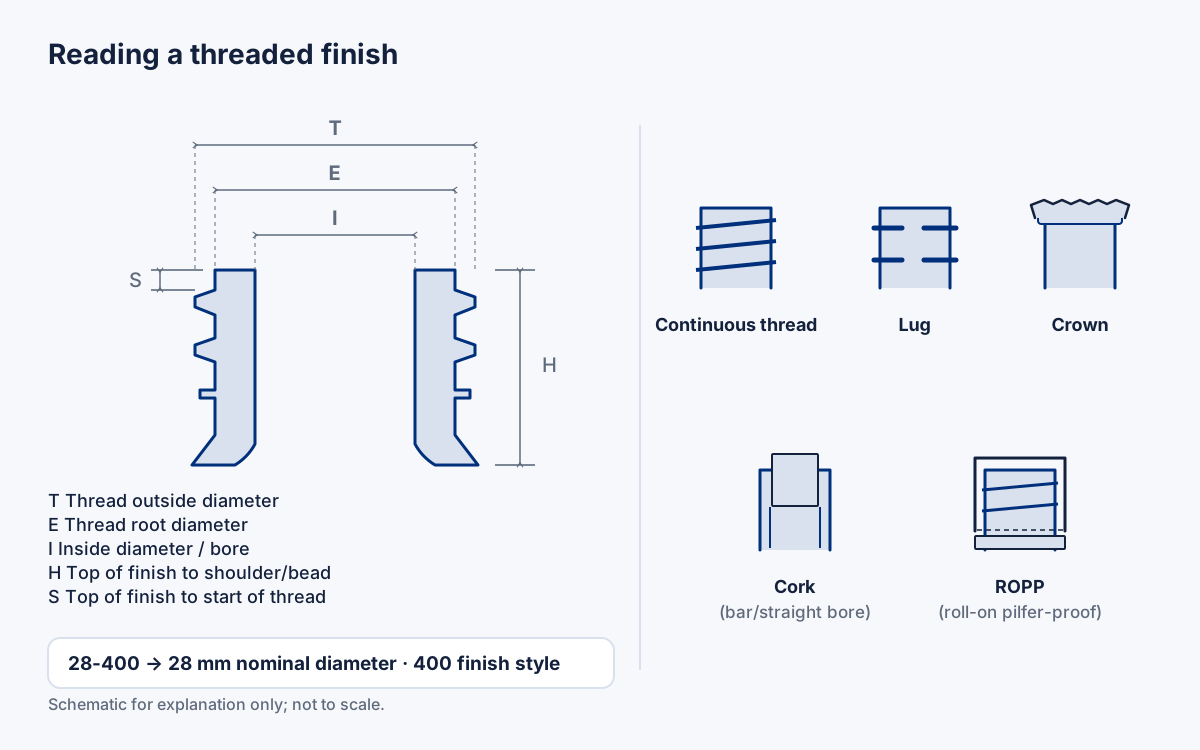
What T, E, I, H and S mean
Both guides define the same five dimensions, which you can use to read a drawing or to ask a supplier for one.
Swipe or scroll horizontally to see all columns.
| Dimension | Definition | Why it matters |
|---|---|---|
| T | Outside diameter including the thread | The nominal size in the designation; determines the closure counterpart |
| E | Outside diameter of the neck without the thread | The difference between T and E, divided by two, gives thread depth |
| I | Inside diameter of the neck | Needed for filling-tube clearance, plug seals, orifice reducers and fitments |
| S | From the top of the finish to the top edge of the first thread | Sets closure orientation and the amount of thread engagement |
| H | Finish height, from the top of the neck to where T extended down meets the shoulder | Separates finishes with similar diameters |
Distributor tables differ in H and I and in tolerances, so use the current drawing from the glass maker or the standard itself for numeric values.
Finish families
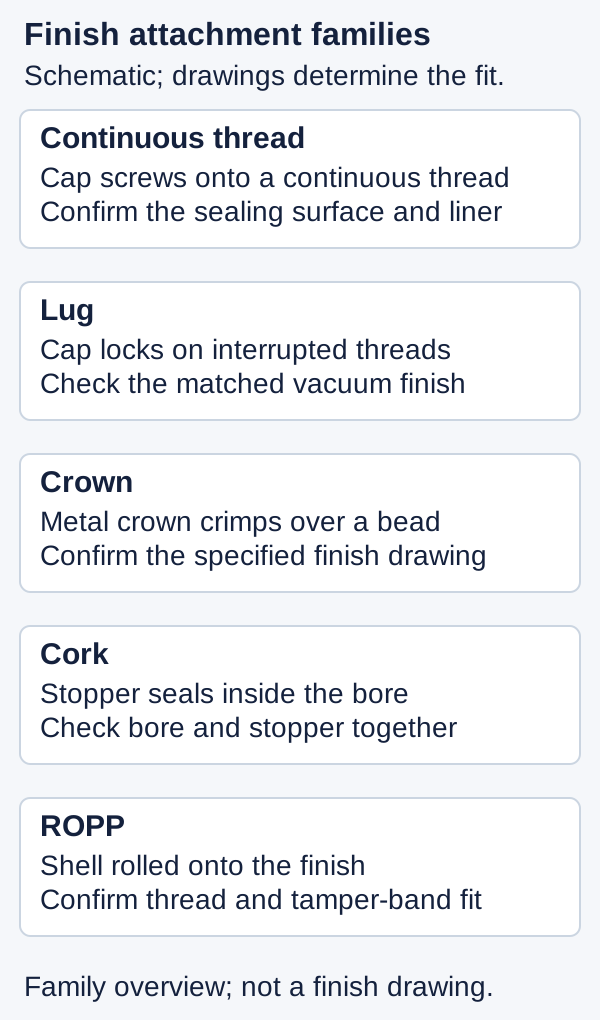
Finishes are grouped by how the closure attaches and seals. The table lists the families most buyers meet.
Swipe or scroll horizontally to see all columns.
| Family | How it attaches and seals | Documents to ask for |
|---|---|---|
| Continuous thread (CT) | Closure screws on a continuous thread; seal is usually on the top of the finish through a liner | GPI finish designation, or a Cetie data sheet such as the one for continuous-thread finishes from 43 to 90 mm |
| Lug | Short interrupted threads; vacuum lug finishes give a vacuum seal on food jars | Cetie lists vacuum lug finishes for wide-mouth containers, plus a fact sheet on glass manufacturing controls for vacuum lug and press-on finishes |
| Crown | Metal crown crimped over a bead; common for beer | ISO 12821 (26 H 180) and ISO 12822 (26 H 126), with Cetie data sheets; Cetie Guide No. 4 covers 26 mm crown capping |
| Cork | Stopper seals inside the bore | A cork mouth finish under EN 12726 (18.5 mm bore) for still wines, per Cetie Guide No. 1 |
| ROPP (roll-on pilfer-proof) | Aluminum shell is rolled onto the finish to form thread and tamper band | Cetie lists these finishes by names such as BVP, BVS and MCA, each tied to a standard, such as EN 15543 for BVP and EN 16293 for deep BVS finishes |
Cetie notes that closures are often delivered in an intermediate state, so the bottle finish acts as the template for the final closure shape. Cetie also says the finish standards for the major systems are applied by all glass makers, with each cap maker tailoring closures to them.
Why nominal diameter alone is not enough
Several checks go beyond the diameter number.
- Thread style. Propacks notes that a 24-410 cap may thread onto a 24-400 bottle far enough to feel secure, but the thread geometry is different and the seal cannot be assumed.
- Different standards, same diameter. A GPI continuous-thread finish and a European ROPP-type screw finish can be close in nominal size yet belong to different standard families (Cetie’s finish list includes a 28 mm screw finish tied to its MCA series). Confirm the finish name, not just the millimeter size.
- Sealing surface. Cetie describes closures that seal inside the neck, on the top lip, or on a mixed area including part of the inside or outside. The finish must provide the surface the closure is built to seal on.
- Additional components. The Cary Company notes that liners, sifter fitments, dip tubes, plug seals and shrink bands can change how a closure sits or engage the thread.
- Maker variation. The same guide adds that manufacturers’ designs and materials vary, and that some child-resistant caps have shorter threads and narrower fit tolerances.
- Application conditions. Fill temperature, pressure and the capping process all affect fit, according to the same guide.
For a refillable personal-care example, the L’Occitane glass-bottle and 24/410 pump review separates the announced finish and dose from the bottle–pump checks a different brand still needs.
Why test even when the diameter and code match? They do not establish that the liner, sealing surface and operating conditions are suitable together. The drawing narrows the candidates; samples and a line trial check the actual package.
How closure compatibility is verified
Verification combines documents, samples and tests on the actual line, and no single step is enough.
Swipe or scroll horizontally to see all columns.
| Step | What it checks | Notes |
|---|---|---|
| Drawing and standard review | Finish designation, T/E/I/H/S, sealing surface, tolerances | Ask both the bottle and closure supplier to confirm the same finish |
| Liner review | Liner type against product, temperature and seal type | Liner changes the torque window, per Propacks |
| Sample fit | Thread engagement, orientation, seating | Cary recommends requesting a sample of each and testing the fit |
| Torque study | Application and removal torque | See below |
| Seal and leak tests | Leak, vacuum, pressure or pull-up checks suited to the closure | For vacuum lug closures, Cetie assigns fill level and vacuum responsibility to the filler and cap supplier |
| Line trial | Behavior at the actual capping speed, fill temperature and product | Treat any change in closure, liner, finish or product as a changed package |
Torque and liners
Application torque is the force used to put the closure on. Removal torque is the force to open it after settling. Propacks states they are related but not interchangeable, and that a capper dial or recipe is a process input, not a verified torque result. In the conventional inspection method described by the cited eBottles distributor guide, removal torque from machine-capped closures is measured and correlated with application settings. That method does not establish a measurement limit for every capping machine; ask which measurement and calibration method your equipment supports.
Agree the hold time, test method and acceptance limits for the actual bottle, closure, liner and product. Do not substitute a generic removal-to-application percentage or a torque table for that agreed test.
Standards and guides to cite
Cetie publishes bottling guides for specific closures, including crown capping, metallic screw capping on BVP and BVS finishes, and a guide to ROPP defects. Cetie Guide No. 9 states that for pressurized products both cap and bottle must be foreseen for the application, subject to a written agreement among the cap supplier, bottle supplier and filler. Propacks refers to ASTM D2063 (torque retention), ASTM D3474 (torque meter calibration) and ASTM D7860 (automated torque testing) for continuous-thread packages. Ask which of these the supplier uses.
Questions to send suppliers
- What is the exact finish designation or standard of this bottle, and can you send the drawing with T, E, I, H and S and tolerances?
- Which closure and liner do you recommend for this finish, and which finish drawing does the closure maker use?
- What sealing surface does the closure rely on, and what controls on planarity or finish quality apply?
- Do you hold application and removal torque data for this combination, and under what conditions (liner, product, temperature, hold time)?
- What fill temperature, pressure or vacuum condition has this bottle-closure pair been validated for?
- Can you provide samples of the bottle and closure for a fit and line trial?
- What happens to the validation if the liner, closure maker or product changes?
Closure application is covered in capping equipment for glass bottles and jars. For a list of data to send with these questions, use the bottle specification checklist. Shape and sourcing context is in glass bottle types and sourcing. Application-specific closure choices are discussed in wine bottling equipment and beer bottling equipment. When a new bottle joins an existing line, see bottling-line changeovers.
Evidence and limitations
The T, E, I, H and S definitions and GPI conventions here come from distributors’ explanatory guides, not from GPI’s own drawings, which were not available for review. European finish and closure information comes from Cetie’s public data-sheet listings, whose full documents require a free account. No generic torque range or retention ratio is specified here. This guide cannot confirm that a given bottle and closure are compatible. That depends on the finish drawing, closure design, liner, product, line and supplier, and it must be confirmed by testing.
- Guide to Neck Finishes, The Cary Company: T, E, I, H and S definitions, designation format, and additional fit factors (distributor guide). Access attempted October 8, 2026; full text unavailable on this review.
- Guide to Bottle Neck Finishes, Thread Sizes, & Dimensions, Paramount Global: GPI/SPI thread styles (400, 410, 415) and dimension definitions (distributor guide). Accessed October 8, 2026.
- Closure Torque Guide: Application, Removal, and Testing, Propacks: torque concepts, hold-period testing and the limits of torque tables (supplier guide). Accessed October 8, 2026.
- Application and Removal Torque Guidelines, eBottles: the removal torque method for verifying machine-applied closures (supplier guide). Accessed October 8, 2026 via public browser retrieval.
- Cetie finish data sheets (GME), Cetie: crown, lug, continuous-thread, BVP and BVS finish specifications. Accessed October 8, 2026.
- Cetie bottling guides, Cetie: guides for cork, ROPP, crown and screw capping and written agreement for pressurized products. Accessed October 8, 2026.
- Cetie also gives guidance for metal caps, Cetie: how closures and finishes are defined together, sealing areas and finish standards. Accessed October 8, 2026.
- Cetie recommendation data sheets (FS), Cetie: fact sheets on vacuum lug manufacturing controls and headspace responsibility. Accessed October 8, 2026.
Related guides

Choosing Capping Equipment for Glass Bottles and Jars
Prepare a capping requirement from finish and closure data: screw, ROPP, crown, lug, press-on and cork application, torque, and how to verify closures.
Read the guide
Glass Bottle Specifications: A Checklist for Supplier Enquiries
A checklist of what to state in a glass bottle enquiry: drawing dimensions, capacity and fill point, finish, color, strength, decoration, quality and packing.
Read the guide
Glass Bottle Types and Sourcing: A Buyer’s Reference
How glass bottle shapes, finishes, colors and capacities are described, how to search for stock and unusual shapes, and what to send suppliers.
Read the guide