
Glass Refill Bottles and 24/410 Pumps: L'Occitane Notes
Use Aptar's L'Occitane pump announcement to review glass refill bottles: 24/410 finish, dose, orientation and the bottle-pump checks still needed.
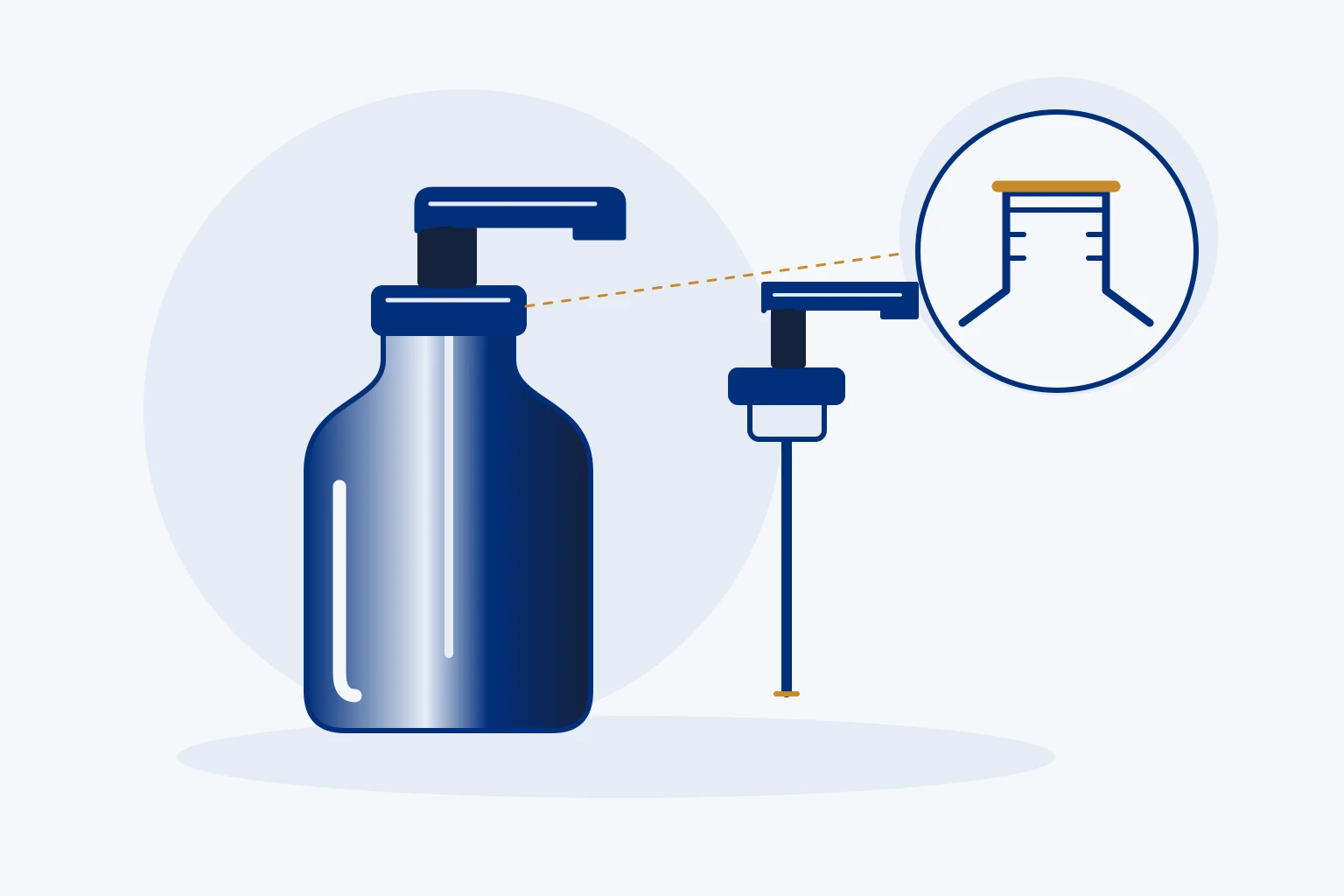
Choosing a glass refill bottle from a pump’s neck designation alone risks rework when the assembled package is reviewed. Aptar’s L’Occitane announcement identifies a 24/410 screw-on pump, but another brand still needs to qualify its own bottle, pump and formula together.
Cover illustration: generic bottle and pump components, not the announced branded package or a dimensioned fit drawing.
The announced package is a useful example of a custom pump built on an existing platform, rather than proof that any nominally matching glass bottle will work. Aptar describes a refillable hand-care collection with glass and plastic bottle options. For a glass-bottle project, separate neck fit, dispensing dose, actuator orientation and the refill process. This article turns the announcement into a bottle–pump review checklist; it does not establish recyclability, US availability or another project’s development cost.
- The neck designation concerns the connection, not the bottle’s fill volume.
- The stated pump dose and stated bottle capacities use different units.
- The unlocked actuator’s orientation is part of the announced custom design.
- Refillability leaves questions about the complete package and its intended reuse process.
What did Aptar announce about this package?
On August 26, 2026, Aptar Beauty announced custom dispensing pumps for L’Occitane-En-Provence’s redesigned hand-care collection. Its full announcement names its Satine platform, a 24/410 screw-on connection and a 500 μl dose. It also describes refillable bottles in glass and plastic, in 350 ml and 500 ml sizes.
The published text does not map every capacity, formula and material into a complete SKU specification. Ask for that mapping before treating the range description as a bill of materials. Nor does this announcement establish that the custom assembly is offered as a stock pump to other brands.
For readers using our Buying Resources, the relevant news is the relationship between the bottle silhouette and the dispensing assembly. The brand example does not replace the documentation normally needed when choosing a glass-bottle supplier.
Takeaway: Read the range description as an attributed announcement, then request a specific package specification.
What does 24/410 tell a glass-bottle buyer?
It identifies the announced screw-on connection; it does not provide a complete bottle-finish drawing or a fit approval. For your glass-bottle project, start by asking the bottle and pump suppliers to confirm the same finish drawing, its tolerances and the intended seal. A matching designation is the beginning of that review.
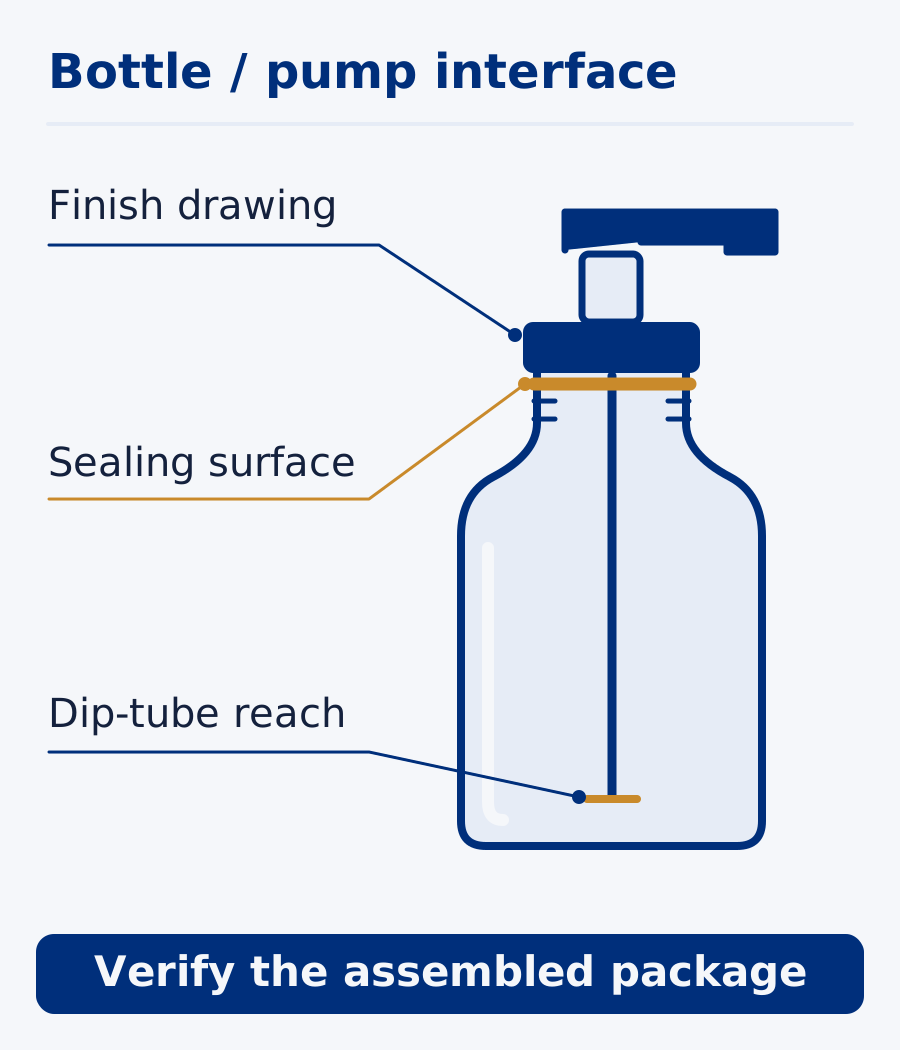
Our neck-finish and closure guide explains the drawing vocabulary. Keep that drawing attached to the bottle specification checklist so a purchasing description, sample and supplier revision remain traceable to each other.
For a new glass shape, we recommend a sample review with the actual pump assembly. Record seating, engagement, sealing and dip-tube reach separately. If the actuator or collar is part of the aesthetic decision, review it on the finished bottle rather than on a neck sample alone.
The stock-versus-custom bottle guide addresses the sourcing decision. A standard finish on a custom bottle does not remove the need to check the assembled package.
Common mistake: Using “24/410” as a substitute for a drawing, seal definition and physical fit review.
Takeaway: Match the controlled drawings and assembled samples, not just the label in a catalog.
How should dose and bottle capacity be recorded?
Keep them in separate fields. Aptar’s announced 500 μl is a dispensing dose, whereas 350 ml and 500 ml describe bottle capacities in the range. Unit conversion gives 500 μl = 0.5 ml. That conversion does not establish actual delivered dose with another formula, or the usable contents of a bottle.
Swipe or scroll horizontally to see all columns.
| Field | Announced value or required input | Why it belongs in a separate record |
|---|---|---|
| Pump dose | Aptar: 500 μl, equivalent to 0.5 ml | Dispensing quantity, not bottle capacity |
| Bottle capacity | Aptar: 350 ml and 500 ml range | Container size; exact material/SKU mapping needed |
| Formula | Your intended hand-care product | Basis for the proposed dispensing evaluation |
| Pump and tube assembly | Supplier-controlled specification | Links the tested assembly to the purchased one |
| Dispensing conditions | Agreed sample-test procedure | Makes dose observations interpretable |
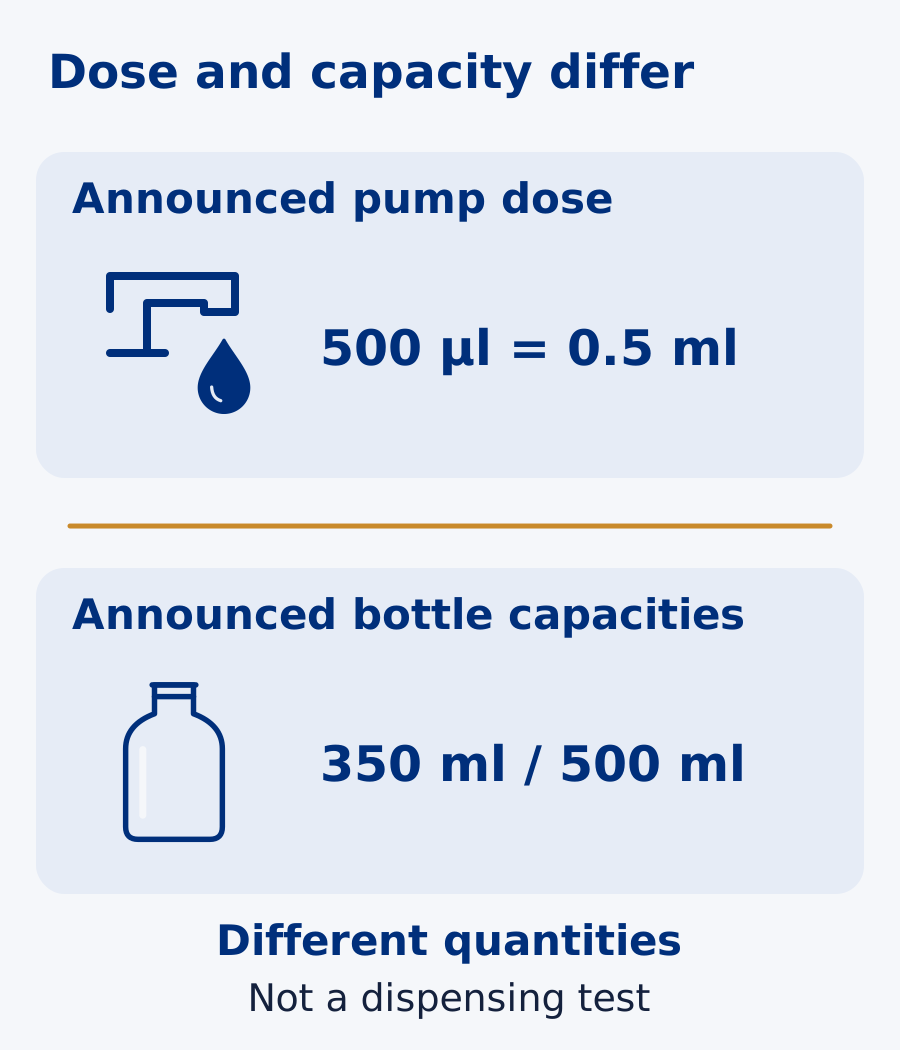
We recommend asking the dispensing supplier to define priming, actuation and dose checks for the intended formula. Retain the method alongside the observations. Avoid calculating a guaranteed number of usable actuations by simply dividing the catalog bottle capacity by the announced dose; the release does not give the test conditions or usable residual volume.
For production, distinguish product filled into the bottle from product dispensed by the consumer. The glass-bottle filling guide covers the former. If closure application is being automated, the capping-equipment guide provides the separate line-planning context.
Takeaway: Use the correct units and keep a stated dose separate from a measured dispensing result.
What does the custom platform example change?
Aptar says the assembly is based on Satine, with a large actuator, oversized collar, glossy black decoration and a technical orientation system for alignment when unlocked. These are stated features of this project. They identify useful review questions for another glass package without establishing which components or tooling could be reused.
Swipe or scroll horizontally to see all columns.
| Design decision | What to ask for in another project |
|---|---|
| Platform choice | Which pump assembly is being proposed for the formula? |
| Collar and actuator | Which dimensions and parts are stock, modified or custom? |
| Unlocked orientation | What is the reference direction on the bottle, and how is it verified? |
| Decoration | What sample represents the agreed appearance and handling condition? |
| Package change | Which fit and dispensing checks are repeated after a revision? |
These are our editorial questions, not a description of Aptar’s internal design process. Compare actuator direction with the bottle’s presentation face and label before approving appearance. The bottle-labeling guide helps record that separate presentation requirement.
If a new package enters an existing line, include pump application and bottle presentation in the changeover review. A catalog platform name alone does not tell the production team which adjustments are required.
Takeaway: Ask what is custom and verify the finished assembly in both its locked and dispensing states.
What should a glass refill-bottle review include?
Review the complete package and the intended refill process. The following checklist is our proposed decision record, not a hygiene standard, durability qualification or instruction for refilling the announced product. Use supplier and product-owner instructions for the actual refill operation and agree the evidence needed for the intended reuse claim.
Swipe or scroll horizontally to see all columns.
| Review item | Record to request | Decision it supports |
|---|---|---|
| Bottle and pump fit | Finish drawings, assembly revision and representative samples | Whether the proposed components fit and seal |
| Dispensing | Intended formula and agreed evaluation method | Whether the observed dose suits the product |
| Refill method | Product-owner instructions and refill format | Whether the consumer can follow the intended process |
| Reuse claim | Project-defined refill count or use period, reuse of the pump, instructions and post-evaluation observations | What can be stated about repeated use |
| Decoration and orientation | Approved assembled-package samples | What the finished package should look like |
| Production and shipping | Closure application and distribution assessment | What remains to be evaluated beyond the tabletop sample |
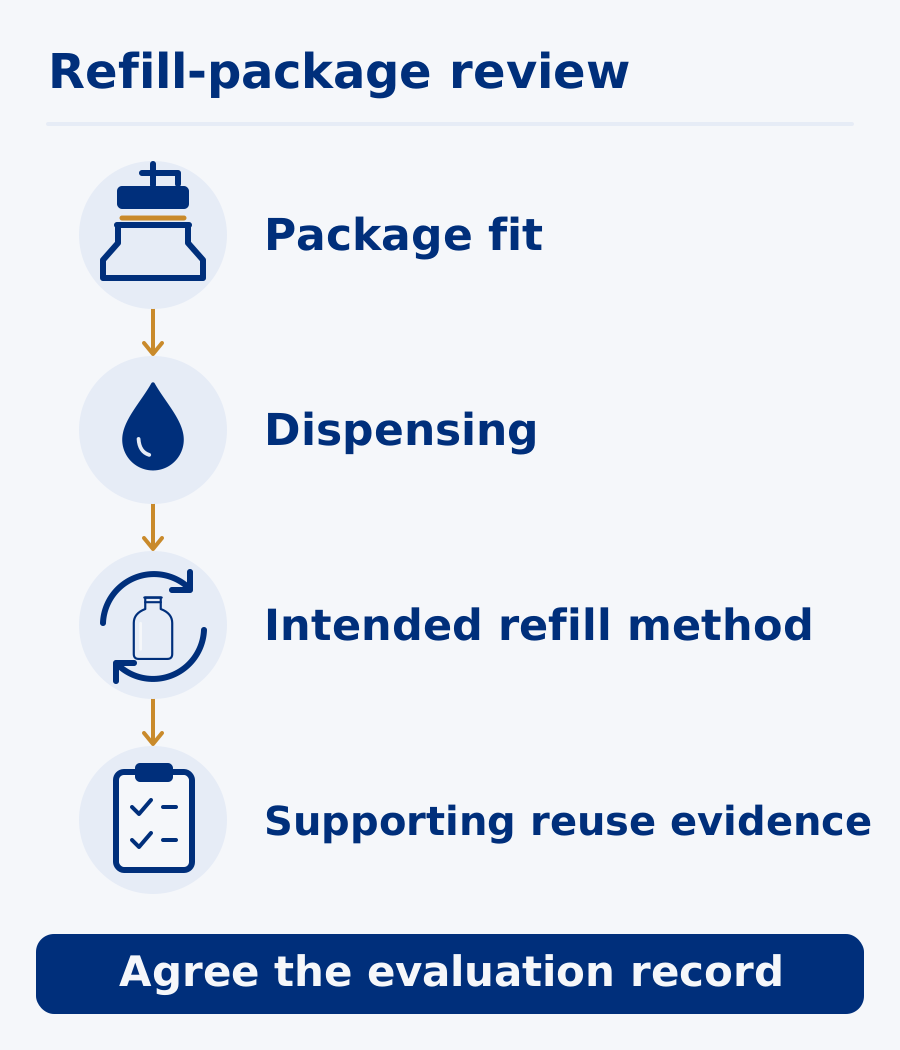
Our suggestion is to agree the evaluation record before choosing a bottle solely for appearance. Ask the product owner to define the intended refill count or use period, whether the pump is reused, and the applicable refill and cleaning instructions. Record seal and dispensing observations after evaluation and who accepts the results; these are project-defined inputs, not universal thresholds. Include the packed package when considering case packing and distribution; a fitted tabletop sample does not answer the shipping question. This keeps glass selection connected to the full bottling-line planning process.
Takeaway: Evaluate refillability as a complete intended-use process, with evidence for the claims you plan to make.
When does this example not establish suitability?
It does not establish fit for an unrelated bottle, another formula, or a different reuse process. It also does not establish recyclability of the pump or quantify an environmental saving. Treat the following as questions for the proposed project, rather than benefits transferred from this announcement.
- Custom cost, minimum order quantity and the availability of this design to other brands.
- The applicable development schedule and what work it includes.
- US availability, procurement channel and support arrangements.
- Refill format, use instructions and evidence for repeated-use claims.
- Material-specific recyclability and environmental assessment of the complete package.
The full Aptar release also states that this pump was molded/decorated in Oyonnax and assembled in Le Neubourg, and describes the project’s delivery in under a year. These are supplier statements about that project, not a development-time promise for another brand or a US launch date.
Common mistake: Treating a refillable bottle announcement as proof that its pump is recyclable, or borrowing recyclability claims from a different pump launch.
Takeaway: Keep project-specific availability, reuse evidence and recycling claims separate.
Common questions
What does 24 410 mean?
In this announcement, 24/410 is the pump’s screw-on neck-finish designation. It is not a dose or bottle-capacity value. Request the corresponding bottle and pump drawings before approving a combination; the designation alone does not establish assembled compatibility.
How to measure bottle neck size?
Begin with the supplier’s controlled finish drawing and its stated measurement points. A single external measurement does not replace the finish profile and tolerances. The neck-finish guide explains the dimensions to discuss with the supplier.
How to refill soap dispenser?
Follow the product owner’s instructions for the specific package and refill product. Aptar’s announcement describes refillability but does not provide a consumer refill procedure. It therefore cannot support a generic instruction for cleaning, dilution or replacement of this pump.
Method, limitations and sources
This article interprets public material checked on October 8, 2026 and supplies an editorial bottle–pump review checklist. It contains no physical fit test, dispensing measurement, recyclability certification or independent lifecycle assessment. The unit conversion is arithmetic. The generic questions use observed Google autocomplete wording, with only capitalization and punctuation adjusted.
- Aptar’s original announcement, dated August 26, 2026: platform, connection, dose, bottle options, custom features and project manufacturing description.
- Packaging Europe’s account, dated August 26, 2026: media retelling of the same supplier announcement, not independent verification. The glass/plastic and location details were cross-checked against Aptar’s full original text.
Change note: Added a source-based package interpretation, unit distinction and glass refill-bottle review checklist.
Related guides

Bottle Neck Finishes and Closure Compatibility
How to read finish designations such as 28-400 and the T, E, I, H and S dimensions, and why a matching nominal diameter does not prove a closure fits.
Read the guide
Glass Bottle Specifications: A Checklist for Supplier Enquiries
A checklist of what to state in a glass bottle enquiry: drawing dimensions, capacity and fill point, finish, color, strength, decoration, quality and packing.
Read the guide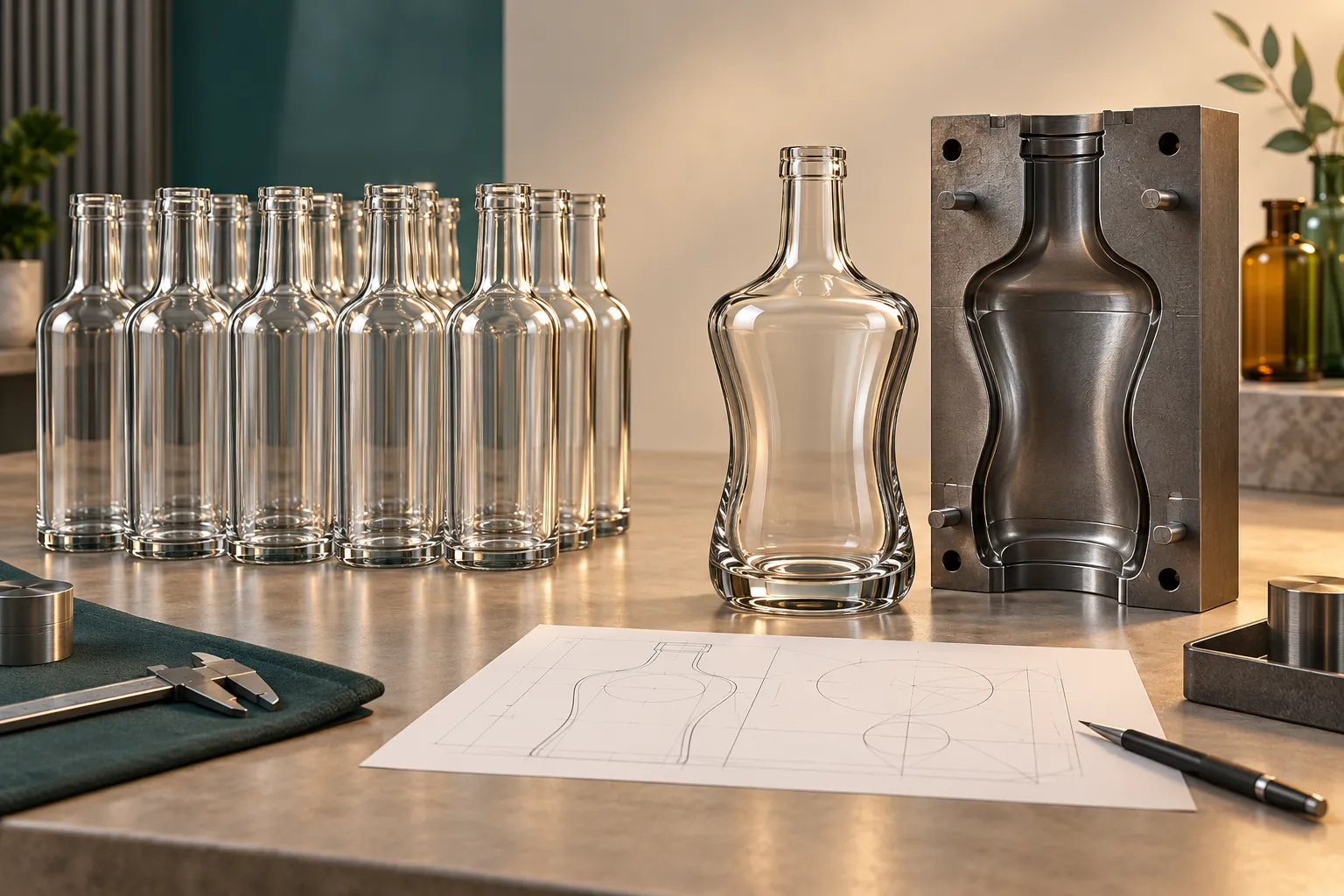
Stock vs. Custom Glass Bottles: What to Compare Before Ordering
Compare stock and custom glass bottles on tooling ownership, minimum quantities, sampling, documentation, line trials and supply continuity before you order.
Read the guide