
Stock vs. Custom Glass Bottles: What to Compare Before Ordering
Compare stock and custom glass bottles on tooling ownership, minimum quantities, sampling, documentation, line trials and supply continuity before you order.
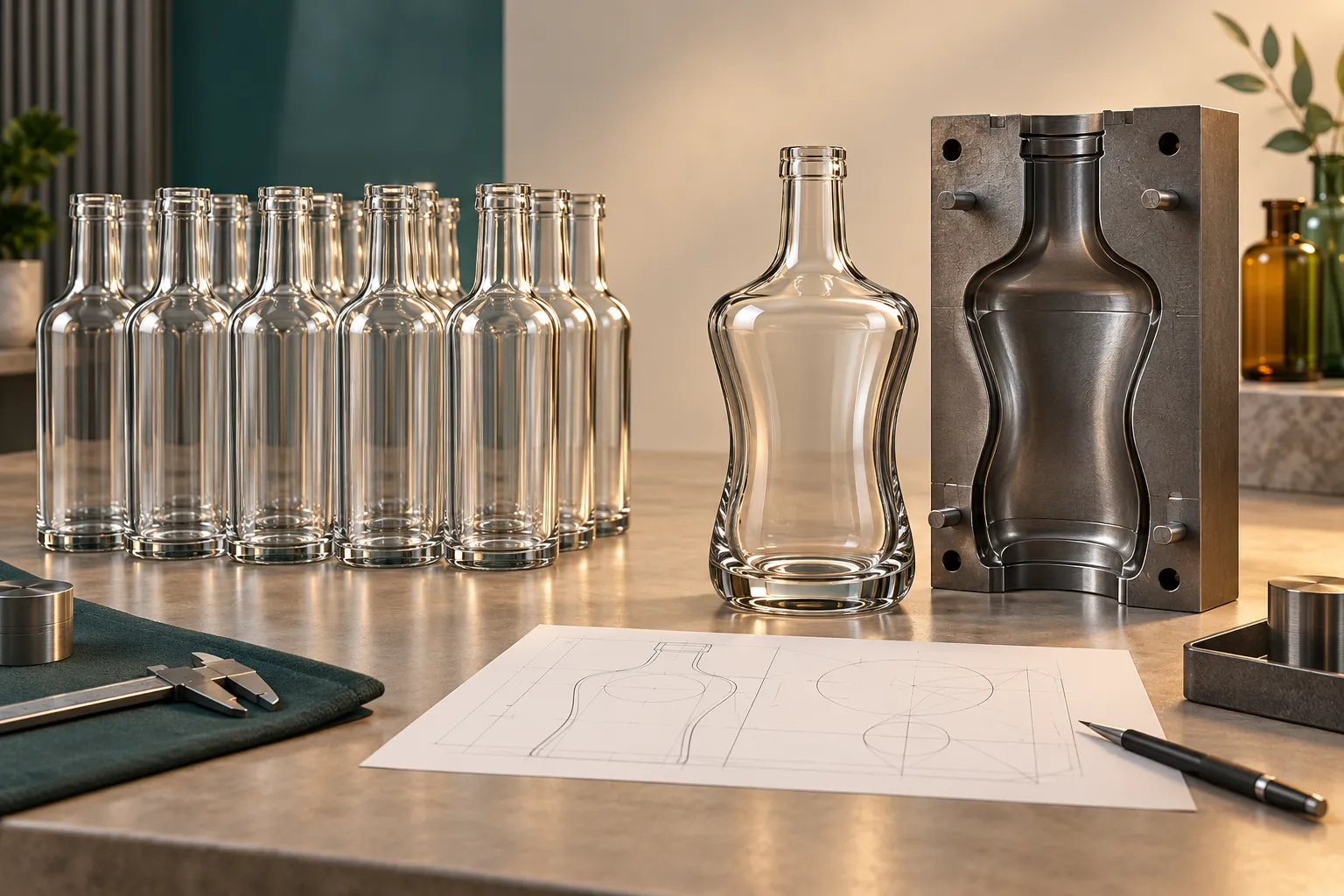
A stock bottle is a design the glassmaker already tools, runs and catalogs. A custom bottle is a design built for one brand, which means a new mould set, a development program and a commitment on quantity. The choice is about more than appearance. It decides who owns the tooling, how much you must order, how many approval steps come before the first pallet, and how exposed you are if production stops.
Start with stock if an existing drawing meets your shape, finish and process needs. Enter custom development when those requirements cannot be met by an available design and the supplier’s tooling, sample and quantity terms are acceptable. Neither route removes the need for a line trial on an unfamiliar bottle.
Swipe or scroll horizontally to see all columns.
| Decision | Stock route | Custom route |
|---|---|---|
| Tooling / ownership | Confirm catalog drawing and change policy | Agree ownership, design rights and transfer terms |
| Quantity | Confirm orderable unit and availability | Confirm per-order, run and annual commitments |
| Samples | Identify the catalog article and production source | Record prototype, trial-glass and production stages |
| Documentation | Obtain the exact current drawing | Approve the master drawing and revision control |
| Line trials | Test an unfamiliar bottle on the intended line | Agree trials and criteria before production approval |
| Continuity | Verify alternatives by drawing and sample | Agree tooling transfer, storage and discontinuation terms |
Verify amounts and timing in the supplier’s quotation. This comparison draws on published supplier descriptions. Copy the bottle quote record before comparing offers.
The two development paths
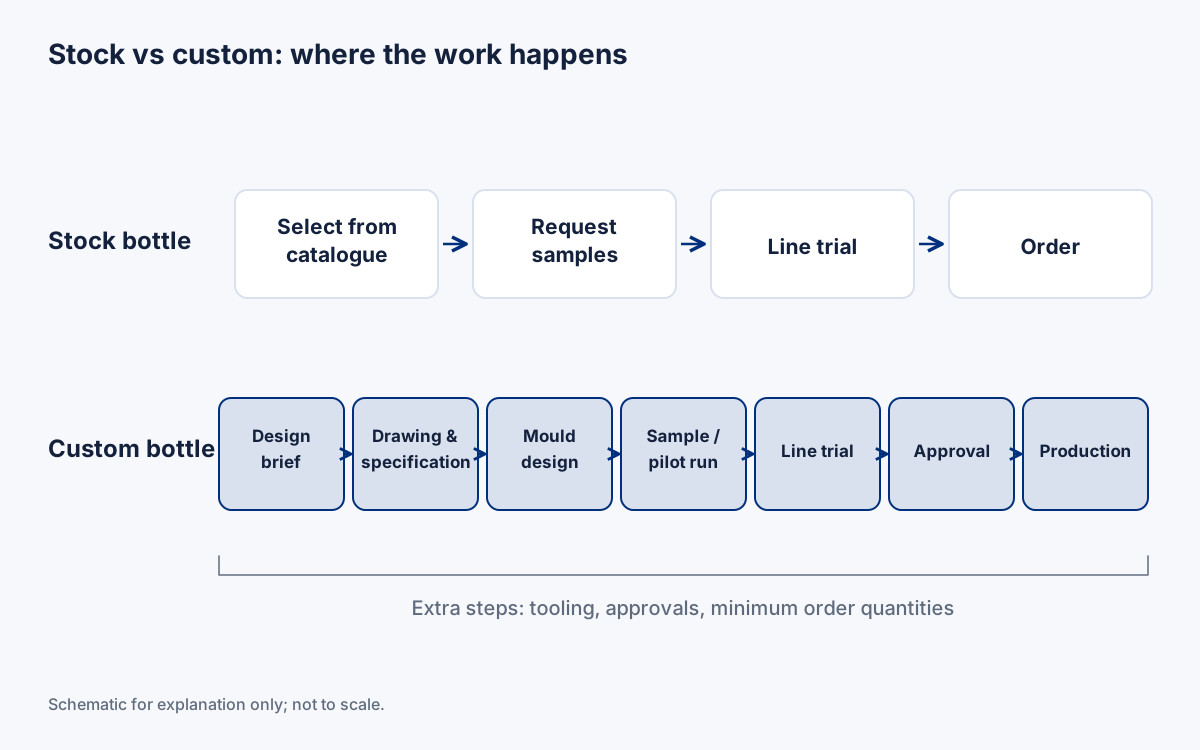
The stock path is shorter because the shape, finish and tooling already exist. The custom path adds a drawing and mould-design stage and one or more rounds of samples. The line trial and the approval are the steps people most often compress, and they are the ones that protect your filling line.
Glassmakers describe both routes. Verallia states that it offers a standard catalog and also develops customized bottles with specific shapes and colors. Ardagh describes a design process in which concepts are built in 3D modeling software and the approved concept becomes a fully detailed technical drawing, and it also has a large stock catalog of shape, size, closure and color combinations. These are the manufacturers’ own descriptions of their offers, not independent comparisons.
1. Tooling and mould ownership
For stock bottles the glassmaker keeps the tooling, and many customers buy the same design. For custom bottles, the key question is what your payment buys.
Published policies differ. Rockwood Glass, a custom bottle supplier, states that each prototype and mould becomes the property of the client and that moulds are replaced when worn. That is one supplier’s stated policy. Do not assume it is typical.
Get these points in writing before you pay a tooling fee:
- whether a mould fee buys ownership, exclusive use or only a development charge;
- when ownership transfers (on order, on full payment, after a volume threshold);
- who pays for repair, refurbishment and replacement of worn parts;
- whether the mould can be moved to another producer, and how;
- whether the shape is exclusive to you, and for how long;
- where the mould is stored and for how long if you stop ordering.
Treat the physical mould separately from the design rights, drawings and files, because contract terms can handle them differently.
2. Minimum quantities
Ask the supplier to quote its custom production commitment for the specified bottle, color and plant. A published minimum from one supplier does not establish a general minimum or the current terms for your project.
For stock bottles, minimums depend on the supplier’s pallet, layer or truckload rules and on whether the item is warehoused. Ask for the smallest orderable unit (a layer, a pallet, a truckload) and what changes if you want a split delivery.
For either route, settle these:
- Is the minimum per order, per run or per year?
- What happens if you order below it or reorder late?
- Does the supplier schedule the bottle in campaigns by color, and how does that affect your ordering rhythm?
3. Sampling and approval steps
Do not approve a bottle from a photograph. For custom projects, glassmakers describe stages such as design, tooling, trialling and production. Verallia describes trialling as the step in which you see the bottle refined in sample form before final production begins. Ardagh describes prototype models, glass performance simulation using finite element analysis (stresses from internal pressure, vertical load and impact), and a development machine that makes bottles under production-like conditions with inspection.
For both routes, ask what samples are provided and what each sample represents:
Swipe or scroll horizontally to see all columns.
| Sample type | What it can show | What it cannot show |
|---|---|---|
| Catalog drawing or 3D model | Dimensions and shape | Glass distribution or real fit on your line |
| Prototype or resin model | Look and hand-feel | Glass behavior in your process |
| Glass sample from a trial run | Real shape, finish and closure fit | Variation across a full production campaign |
| First production lot | Normal production quality | Seasonal or repeat-order variation |
Write down the acceptance criteria before samples arrive: dimensions, capacity, finish gauging, defect classification, color and any cosmetic limits, and who signs.
4. Documentation
Whichever route you choose, the bottle needs a drawing and a specification you can point to later. The bottle specification checklist lists the fields to request and to confirm: finish designation, brimful capacity, fill height, weight, color, tolerances, label panel and more.
For custom bottles you will normally approve a drawing that becomes the master reference. For stock bottles the catalog drawing plays that role, so check its revision and ask how changes are communicated. Finish designations deserve extra care: many finishes follow numbered standard drawings from the Glass Packaging Institute, and a closure maker will specify a finish, not just a diameter.
If weight is part of your brief, ask how it is verified. Lightweight wine bottles: what buyers should verify covers the verification evidence to request when a bottle is being optimized for lower weight.
Also request food-contact and quality documentation appropriate to your market, plus the supplier’s defect classification and inspection approach.
5. Line trials
A bottle that meets its drawing can still behave badly on your line. Stock does not exempt you: a catalog bottle is new to your equipment if you have not run it before. Plan a line trial that covers filling, closing, labeling, conveying, inspection and packing, and agree in advance what counts as a pass.
Involve the people who run the line when you write the plan. If a new bottle will replace or join an existing one, bottling-line changeovers lists the change parts and checks to cover before you add a format. For hot-filled or thermally processed products, ask the supplier what temperature conditions the bottle is designed for, and see the thermal shock note from one UK supplier cited below.
6. Supply continuity
Continuity differs by route. A stock design may be sourced from more than one plant or producer in some markets, but equivalence is not automatic: different producers’ bottles with the same name can differ in weight, tolerance and finish detail. Confirm equivalence by drawing and sample, not by catalog name.
A custom bottle depends on the producer who holds the mould, unless the mould can be transferred. Ask about moving the tooling, repairs, storage and what notice the supplier gives about production changes.
For both routes, ask about colors scheduled in campaigns, safety stock, allocation rules in tight markets, and how the supplier communicates the discontinuation of a catalog item. For general background on bottle types and how to describe a special shape to a supplier, see the buyer’s reference on glass bottle types and sourcing.
What makes up a glass bottle quote
Glass bottle costs are rarely one number. A quote for glass bottles and containers usually combines a unit price, one-off charges, quantity terms, decoration, packaging and delivery terms, and two quotes with the same unit price can cost very different amounts once the other lines are added. This section names the parts of a quote and what changes each one; actual prices depend on the bottle, the quantity, the plant and the date of the quote.
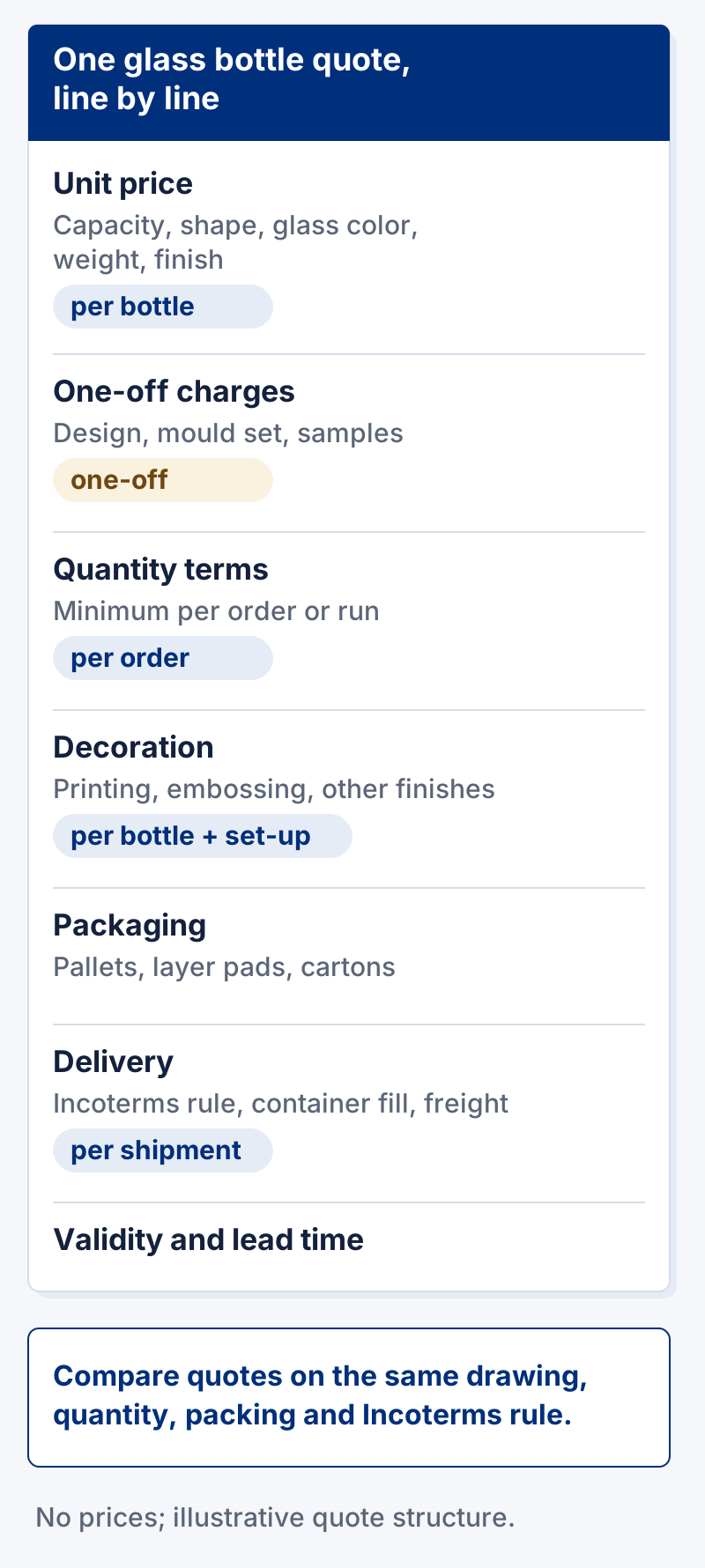
Supplier pages show how the parts are built up. Rockwood Glass, a custom bottle supplier, says its price estimate starts from the brief, including branding requirements, bottle capacity, originality, quantities and delivery location, and that the exact unit cost is set once the prototype is finalized. It publishes minimum order quantities that differ by bottle size and by glass type, lists decoration such as screen printing, embossing, engraving and spray painting as options, and offers multi-bottle cartons designed for filling lines. It also says it states how many bottles fit in one shipping container before an order and recommends full containers to save on repeat transport costs. These are one supplier’s terms, not an industry standard.
Swipe or scroll horizontally to see all columns.
| Quote line | What usually changes it | What to ask |
|---|---|---|
| Unit price | Capacity, shape, glass color or type, weight and finish | Which drawing revision and glass type the price is based on |
| One-off charges | Design work, mould set, samples or trial runs (custom bottles) | What each charge buys, and whether it is refunded or credited against orders |
| Quantity terms | Minimum per order or run, campaign scheduling | The price at your real volume, and the price below the minimum |
| Decoration | Printing, embossing, coating or other finishing processes | Whether decoration is quoted per unit, with its own minimum or set-up charge |
| Packaging | Pallets, layer pads, cartons, shrink wrap and returnable items | Pack pattern and whether it suits your depalletizer or case unpacker |
| Delivery | Incoterms rule, container or truck fill, freight and insurance | Which rule applies, where risk passes and how many bottles fit per load |
| Validity and lead time | Quote date, plant schedule and the supplier’s revision terms | How long the price holds and what triggers a revision |
Delivery terms deserve the most care when comparing suppliers in different countries. The International Chamber of Commerce describes its Incoterms rules as allocating cost, risk and obligations between buyer and seller, and Incoterms 2020 lists all costs for each rule in one article (A9/B9). Two quotes on different rules are not comparable until you add the costs one of them leaves to you.
To compare quotes, send every supplier the same drawing or catalog reference, glass color, annual and per-order quantity, decoration, pack pattern, delivery point and Incoterms rule, and ask for each line above to be priced or marked as excluded. The bottling equipment RFQ checklist uses the same method for equipment proposals.
Copy this blank record for offers based on the same bottle specification. Enter a document reference beside each answer; a blank remains pending confirmation.
Swipe or scroll horizontally to see all columns.
| Quote field | Supplier A / evidence | Supplier B / evidence |
|---|---|---|
| Article / drawing revision / color | ||
| Unit price and quantity basis: order / run / year | ||
| Design and sample charges | ||
| Mould ownership and ownership-transfer point | ||
| Mould movement / transfer conditions | ||
| Sample stage and acceptance criteria | ||
| Trial, decoration and packaging scope | ||
| Delivery term / named place / freight scope | ||
| Lead-time start point / quote validity |
Questions to send suppliers
- Is this a stock item or a custom design, and what is the item or drawing revision number?
- Who owns the tooling, from what point, and under what terms can it be moved?
- Who pays for repair and replacement of worn mould parts?
- Is the bottle shape exclusive to us, and for how long?
- What is the minimum order and the run structure (per order, per run or per year)?
- What samples will you provide, at what stage, and from which equipment?
- What acceptance criteria and defect classification apply to samples and production?
- Can you support a line trial on our equipment, and what conditions should it cover?
- Which finish designation does the bottle use, and which closures have been verified on it?
- What happens to supply if the producing plant changes color, schedules a campaign or stops the item?
Evidence and limitations
Terms for tooling, minimums and approval differ by glassmaker, country, bottle size and project. The sources below are manufacturers’ public pages describing their own offers and processes, so they show how suppliers describe the options rather than how an independent test would rank them. Use them to draft your questions, then get commitments in writing in the quotation or supply agreement.
- Verallia Group - Bottles, Verallia: describes a standard catalog and development of customized bottles. Accessed October 8, 2026.
- Your First Bespoke Design, Verallia UK: design, tooling, trialling and production stages, and a stated minimum for bespoke designs. Accessed October 8, 2026.
- Design Process, Ardagh Group: design stages, technical drawings, performance simulation, development machine and stock catalog. Accessed October 8, 2026.
- Project phases, Rockwood Glass: example of one supplier’s stated mould ownership, sampling and minimum-order terms, price-estimate inputs, decoration options and filling-line cartons. Accessed October 8, 2026.
- Pricing & lead times, Rockwood Glass: one supplier’s statement that unit cost is set after the prototype, minimum quantities by size and glass type, and container-based shipping. Its prices are not used here. Accessed October 8, 2026.
- Incoterms 2020, International Chamber of Commerce: Incoterms rules allocate cost, risk and obligations; costs for each rule are listed at A9/B9. Accessed October 8, 2026.
- Thermal Shock in Glass Bottles and Jars, Glassworks International: thermal shock resistance depends on design, weight and geometry, and suppliers and fillers should discuss the application. Accessed October 8, 2026.
Related guides
Glass Bottle Specifications: A Checklist for Supplier Enquiries
A checklist of what to state in a glass bottle enquiry: drawing dimensions, capacity and fill point, finish, color, strength, decoration, quality and packing.
Read the guide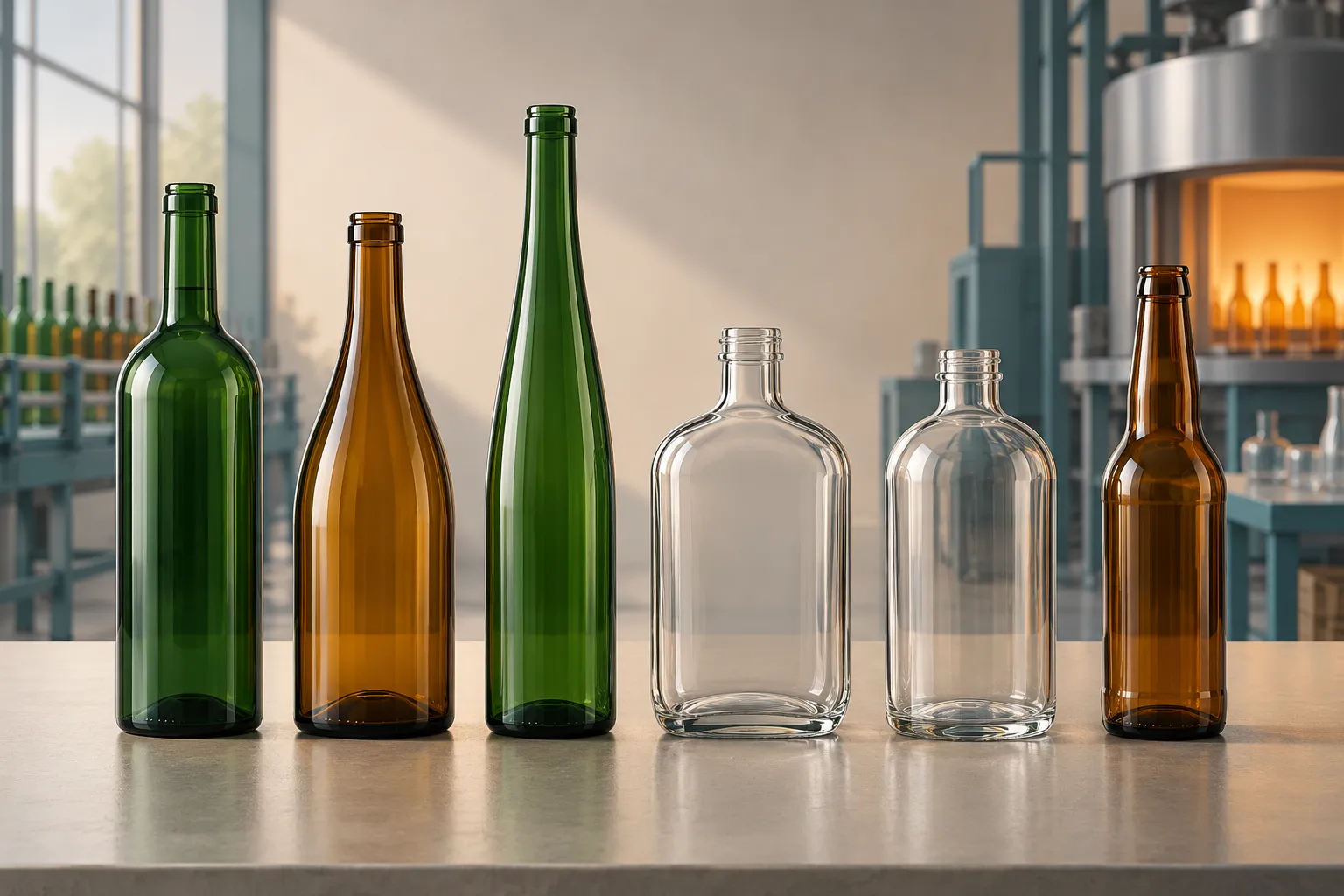
Glass Bottle Types and Sourcing: A Buyer’s Reference
How glass bottle shapes, finishes, colors and capacities are described, how to search for stock and unusual shapes, and what to send suppliers.
Read the guide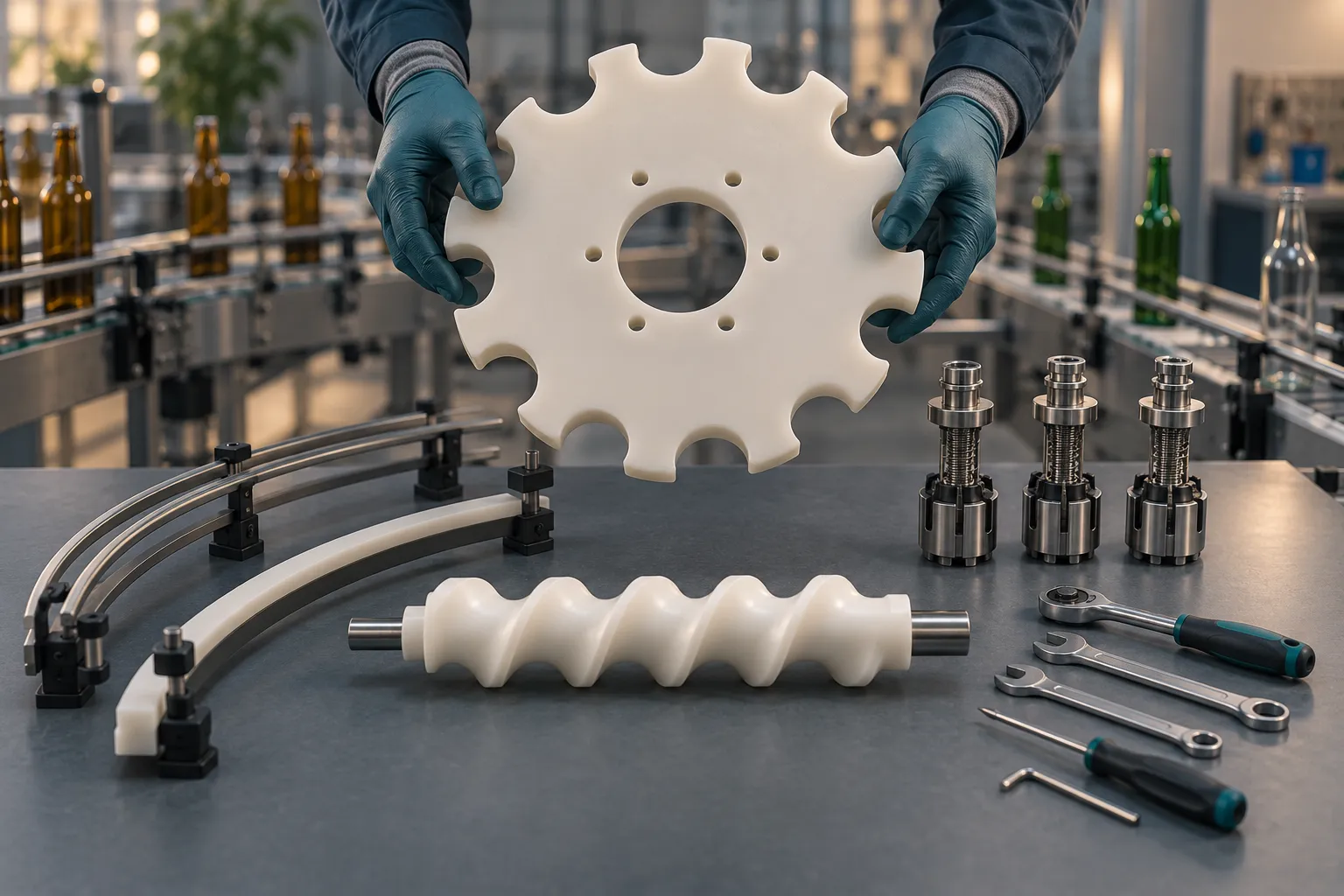
Bottling-Line Changeovers: What to Check Before Adding a New Bottle
Which change parts a new glass bottle touches, which bottle data to check, and how to run and document a trial before the bottle goes into production.
Read the guide