
Lightweight Wine Bottles: What Buyers Should Verify
Beyond the gram count: glass distribution, strength test evidence, finish fit, line trials and how to read weight and carbon claims on light wine bottles.
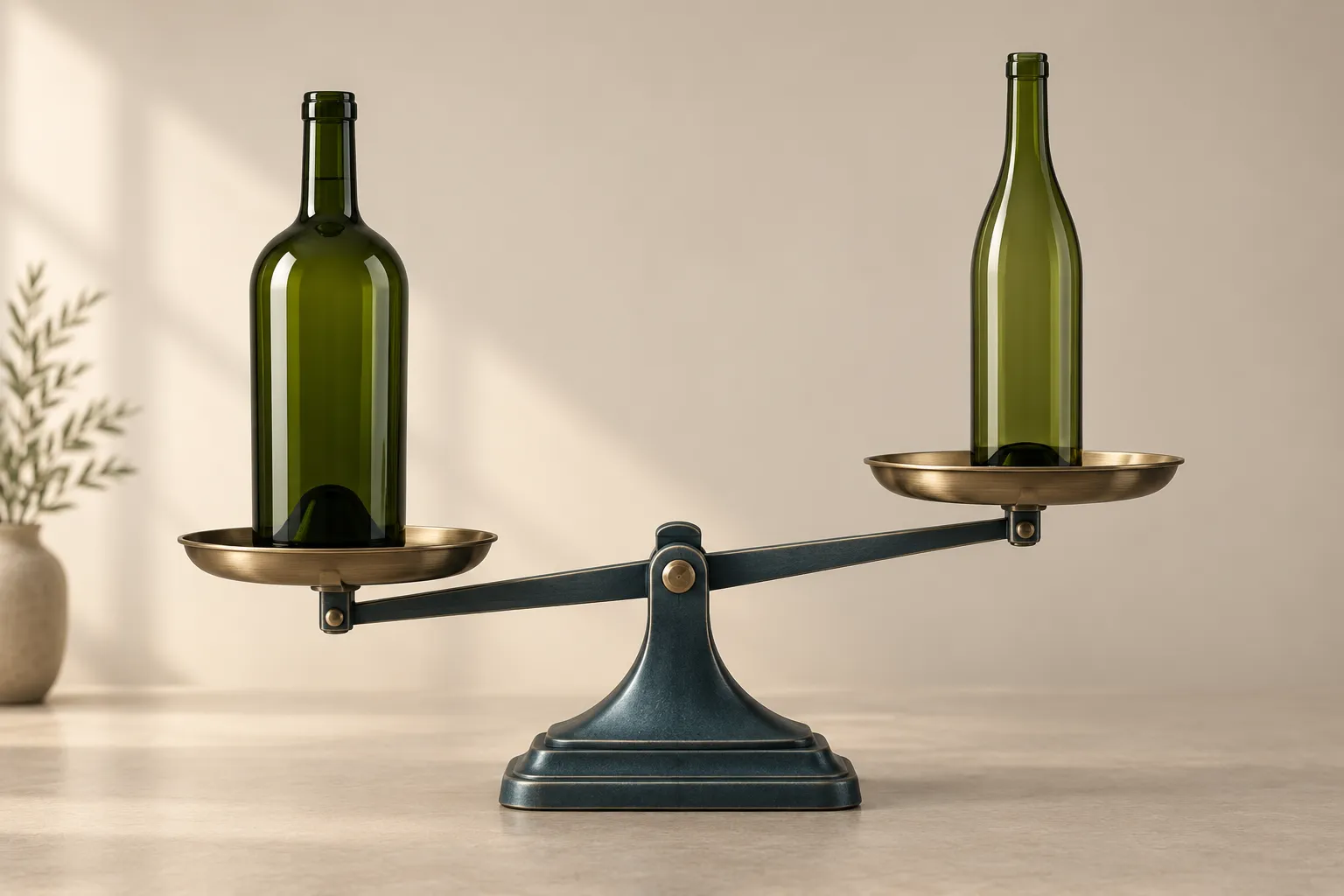
Weight alone does not tell you whether a lightweight wine bottle will survive your filling line, your supply chain and your customer’s table. A report prepared for the Sustainable Wine Roundtable (SWR) quotes WRAP, the UK waste-reduction body, saying that good glass distribution and few surface defects are more important strength determinants than the weight of the container. So the useful question is not “how many grams?” but “what evidence shows this bottle is engineered, tested and compatible with my line at that weight?”
This guide lists what a buyer can reasonably ask a glass supplier to show. That covers where the glass sits in the bottle, which strength tests were run and on what sample, whether the finish suits your closure, how to run a line trial, and how to read weight and carbon figures in a quote. It is editorial analysis of published sources, not a test report. For how glass is formed, see How Glass Bottles Are Made: From Batch Materials to Inspection.
Start with the weight figure, then ask what it means
Published reference points differ, so always ask what a supplier is comparing against. The SWR report (prepared by Dr. Peter Stanbury, 2023) found that 750 ml wine bottles in members’ stores averaged in the mid-500s grams and described a figure of 420 g as widely regarded as a “lightweight” bottle. The same report records producers using 390 g bottles on a mobile filling line and quotes one wine company executive who considered 330 g the lowest achievable weight for still wine at the time. This is a 2023 interview opinion, not a current technical minimum.
Retailer rules add another reference. The LCBO Lightweight Glass Bottle Program lists maxima of 420 g for 750 ml non-hock bottles and 460 g for hock bottles, each with a 15 g tolerance. Scope note (accessed October 8, 2026): these are Ontario retailer requirements for covered LCBO and Vintages Essentials wines, including 750 ml glass bottles below the listed retail-price threshold, with exemptions for specified Vintages offerings and sparkling/effervescent wines. Check the program’s application and exemption sections for your listing; these weights are not universal engineering limits. Ask for nominal empty-bottle weight, tolerance and measurement method.
Weight also depends on bottle type. SWR notes that Burgundy-style bottles can be lightened more straightforwardly than Bordeaux styles with pronounced shoulders, and that sparkling wine is outside its still-wine scope because pressure changes the strength requirement. If your product is sparkling, do not apply still-wine weight benchmarks.
What to verify beyond weight
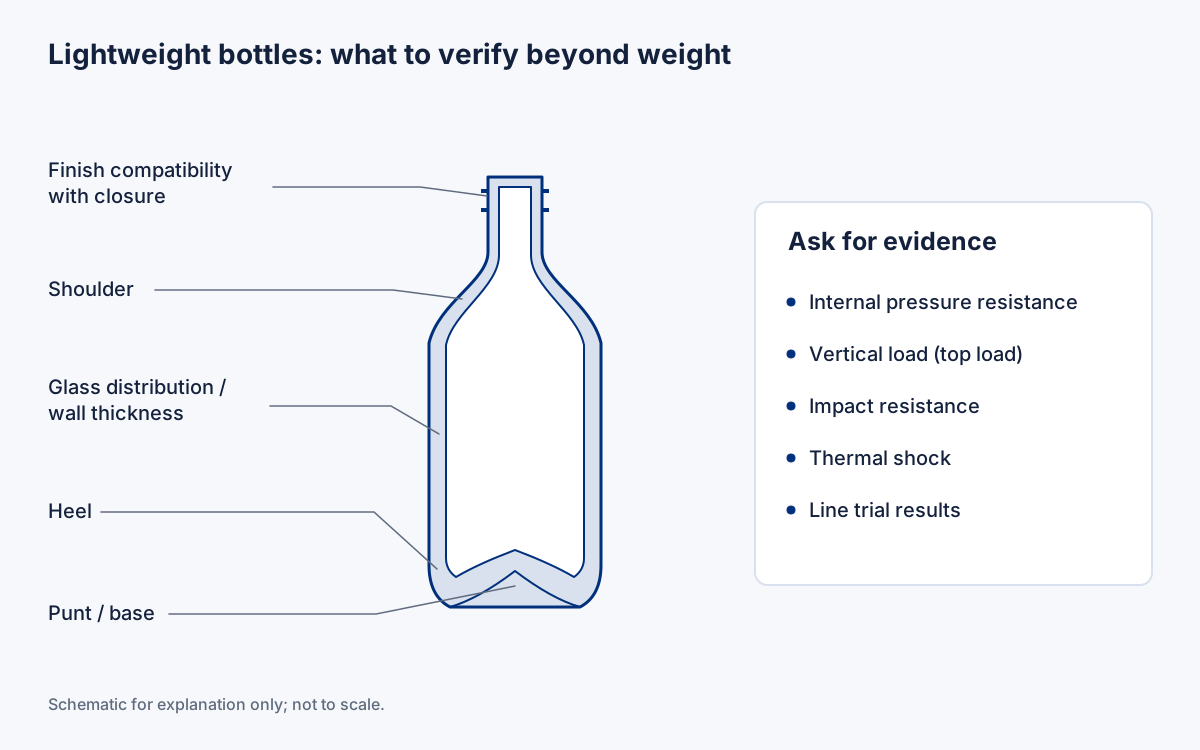
Glass distribution and wall thickness
SWR reports that lightweight bottles cannot simply be made by putting less glass in an existing mold; they need to be designed for the purpose. According to the report’s interviews with manufacturers, lightweight molds aim for an even distribution of glass down the sidewall, with slightly thicker glass at contact points such as the shoulder and heel, and small nodules under the base to help the bottle sit flat where the punt is much reduced.
What to ask for:
- A bottle drawing that shows nominal and minimum wall thickness at stated heights, plus the heel and base sections.
- How the supplier checks wall thickness in production (sampling frequency, method, and what happens to out-of-tolerance bottles).
- Whether the weight reduction came from a new mold design or from changing the process on an existing design.
Strength testing evidence
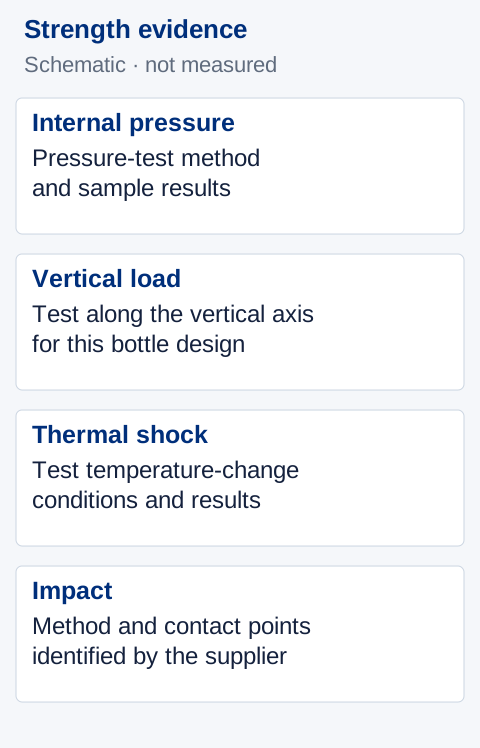
Strength is not one number. Four test families come up in glass-container practice, and each answers a different question. Ask which were run on this bottle design, on how many samples, and whether results are available for your lot rather than for a similar bottle.
Swipe or scroll horizontally to see all columns.
| Question | Test family | Public reference | Where it matters |
|---|---|---|---|
| Will the bottle hold internal pressure? | Internal pressure strength | ASTM C147 (two methods: sustained pressure and constant rate increase) | Primarily sparkling and pressurized products; ASTM describes the methods as intended for containers expected to develop a sustained pressure of 138 kPa (20 psi) or greater |
| Will it survive stacking and capping force? | Vertical load (top load) | ISO 8113, which specifies a method for resistance to external force along the vertical axis | Capping, palletizing, stacked storage |
| Will it survive sudden temperature change? | Thermal shock | ASTM C149 | Steps with large temperature swings such as hot filling, washing or pasteurizing (editorial note) |
| Will it survive knocks on the line? | Impact resistance | No single standard identified in the sources used here; ask the supplier for the method and impact location | Filling-line collisions, case packing, transport |
ASTM’s glass-standards index lists C147, C149 and the C148 polariscopic examination method for glass containers. Be wary of a single “passes all tests” statement with no method, sample size or date.
SWR also stresses that strength is lost to surface damage, not just design: contact between bottles, or between bottles and metal on a filling line, can create micro-fractures that accumulate. This is why an impact test at the contact points is more informative than weight, and why line handling matters (see below).
Closure and finish compatibility
A lighter bottle sometimes comes with a changed finish, and the finish decides which closures and closing machines work. Screw caps for still wine are applied on BVS-type finishes; CETIE, the European bottling-guide body, describes guides for still wines on BVS finishes per EN 16293 and for cork application on cork-mouth finishes per EN 12726. For wines carrying more than 1.2 g/L of CO2, a separate CETIE guide calls for a written agreement between the cap supplier, the bottle supplier and the filler.
Ask for the finish drawing and designation, and confirm the combination with your closure supplier. For more on finish codes and the dimensions that matter, see Bottle Neck Finishes and Closure Compatibility. Winery-side requirements are covered in Wine Bottling Equipment: Building a Supplier Brief.
Line trials and breakage monitoring
SWR’s interviewees say that lightweight bottles can run on most filling lines with attention to handling rather than major changes, and the report quotes a New Zealand producer reporting no significant breakage increase when moving from 750 g to 600 g to 417 g. These are anecdotes, not a substitute for a trial on your own line.
A practical trial plan, as editorial suggestion:
Copy or print this comparison record. Agree the sample size and speed before testing; record both bottles under the same product, closure, machine settings and handling conditions. Use counts and sample totals together rather than comparing unqualified percentages.
Swipe or scroll horizontally to see all columns.
| Trial field | Incumbent bottle | Candidate bottle |
|---|---|---|
| Drawing revision / lot / trial date | ______ | ______ |
| Sample count / product / closure | ______ | ______ |
| Actual speed (bottles/min) / settings | ______ | ______ |
| Infeed: broken / rejected | ______ | ______ |
| Rinsing: broken / rejected | ______ | ______ |
| Filling: broken / rejected | ______ | ______ |
| Closing: broken / rejected | ______ | ______ |
| Labeling: broken / rejected | ______ | ______ |
| Packing: broken / rejected | ______ | ______ |
| Shoulder / heel scuffing | ______ | ______ |
| Pallet / route / transport damage | ______ | ______ |
| Change parts / next action / evidence file | ______ | ______ |
Use the changeover guide for setup records. Takeaway: A lighter bottle is not necessarily more fragile; weight alone cannot establish strength. Use design evidence and the matched trial, rather than extrapolating the SWR anecdotes.
How to read weight and carbon claims
Carbon claims for lighter bottles combine several variables. The published ones are supplier statements unless stated otherwise.
Swipe or scroll horizontally to see all columns.
| Claim element | What to ask |
|---|---|
| “X% lighter” | Lighter than what: the supplier’s previous bottle, a catalog average, or an industry average? Same volume, same style? |
| “Y% lower carbon” | Per bottle or per liter of wine? Glass production only, or including transport? What system boundary and data period? SWR notes that different life-cycle studies use different system boundaries, so they are not directly comparable. |
| Combined claims | Does the figure combine less glass with higher recycled content or other changes? Request separate assumptions before attributing a reduction to weight alone; see recycled-content claims. |
| “Verified” | Verified by whom, under which procedure, and for which exact product? Vetropack reported that TÜV SÜD verified the carbon footprint of its thermally hardened lightweight bottles under the VERIglass procedure in 2025; that is a statement about those bottles, not about all lightweight bottles. |
SWR also reports that most estimates attribute between a third and a half of wine’s carbon footprint to the glass bottle, with the exact share disputed because of differing boundaries. Treat any single percentage as tied to its study.
Questions to send suppliers
- What is the nominal weight, the tolerance and the measurement method for this bottle, and how was the weight reduction achieved (new mold design or process change)?
- Can you provide drawings with wall thickness at stated heights, and describe the production thickness checks?
- Which strength tests (internal pressure, vertical load, thermal shock, impact) were run, by which method, on what sample size, and when?
- Is this finish designation approved for my closure type and machine, and is there a written agreement for pressurized wines?
- What are your handling and palletizing recommendations for this bottle, and what packaging changes does it need for my transport route?
- Will you support a line trial and share production defect and breakage data for this design?
- For any carbon or recycled-content figure, what are the system boundary, reference bottle, period and verifier?
- Which change parts or settings may my filling and closing machines need for this bottle?
Save the drawing, weight record, test reports and completed trial table together; retain unknown fields as open items. Use the bottle specification checklist to keep the package references consistent.
Evidence and limitations
This guide covers still wine bottles in the 750 ml class unless stated. It does not set pass/fail thresholds: acceptable weight, strength and breakage rates depend on the bottle design, the product (still versus sparkling), the line configuration, the supplier’s process and your supply chain. Weight and carbon figures above are quoted from the named sources and are not independently verified here.
- Reducing wine bottle weight: an assessment of the potential (SWR report, June 2023), Sustainable Wine Roundtable: weight benchmarks, glass distribution, breakage, line handling and carbon system boundaries (still wine only). Accessed October 8, 2026.
- LCBO Lightweight Glass Bottle Program, Liquor Control Board of Ontario: maximum weights and tolerances. Accessed October 8, 2026.
- Verified carbon footprint for lightweight glass bottles from Vetropack, Vetropack: an example of a third-party-verified footprint for a specific product. Accessed October 8, 2026.
- ASTM C147 Standard Test Methods for Internal Pressure Strength of Glass Containers, ASTM International: scope of the internal pressure methods. Accessed October 8, 2026.
- Glass Standards and Ceramic Standards, ASTM International: official index including C147, C148 and C149. Accessed October 8, 2026.
- ISO 8113:2004 Glass containers, Resistance to vertical load, Test method, Estonian Centre for Standardisation (EVS): scope statement of the vertical-load method. Accessed October 8, 2026.
- Bottling guides, CETIE: BVS and cork finish guides and the written-agreement note for pressurized wines. Accessed October 8, 2026.
Related guides
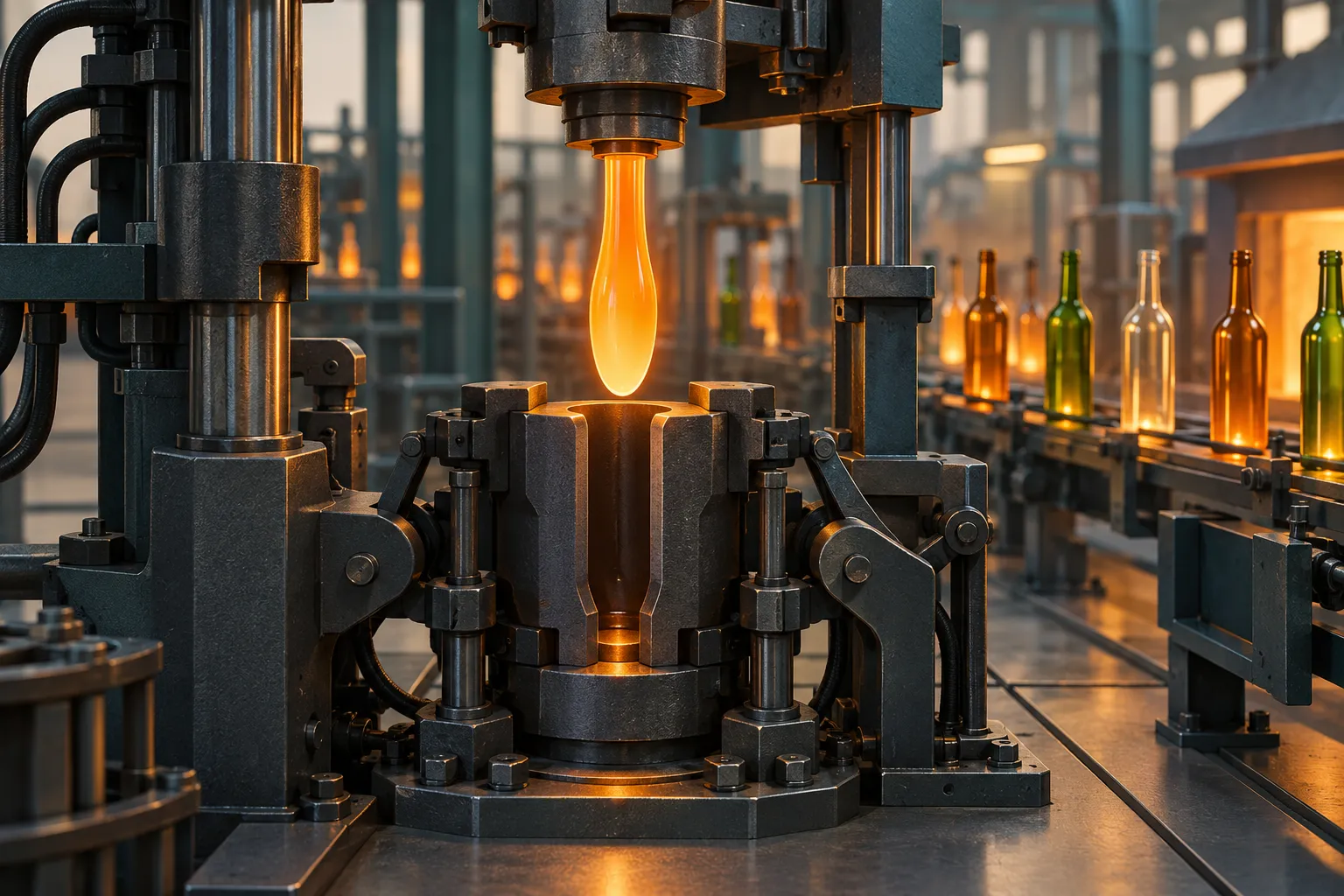
How Glass Bottles Are Made: From Batch Materials to Inspection
A plain-language walk through glass bottle manufacturing: batch, furnace, forehearth, gob feeding, IS machine forming, coatings, annealing and inspection.
Read the guide
Wine Bottling Equipment: Building a Supplier Brief
How a winery can turn wine style, oxygen targets, bottle, closure, capsule and label choices into a brief that equipment suppliers or mobile bottlers can quote.
Read the guide
Recycled Glass Content: How to Read Supplier Claims
How to read a recycled glass content claim: cullet types, plant averages vs product figures, reporting period, colour limits and verification to request.
Read the guide