
How Glass Bottles Are Made: From Batch Materials to Inspection
A plain-language walk through glass bottle manufacturing: batch, furnace, forehearth, gob feeding, IS machine forming, coatings, annealing and inspection.
Glass bottles are made in a fixed sequence: batch materials are melted in a furnace, the molten glass is conditioned and cut into gobs, an individual section (IS) machine forms each gob into a bottle in two stages, the bottles are coated and slowly cooled in a lehr, and the cold end inspects and packs them. Most terms a buyer meets in a supplier conversation (parison, blank mould, hot-end coating, lehr, cullet) name one step in that chain.
Knowing the chain helps you read specifications and ask better questions about weight, color and defects. This guide is an editorial summary of published explanations from glassmakers and industry bodies. It does not describe any specific plant, and details vary by factory.
The process at a glance
Choosing a glass composition? Jump to the soda-lime and borosilicate reference; the eight manufacturing stages below explain how to check a bottle specification.
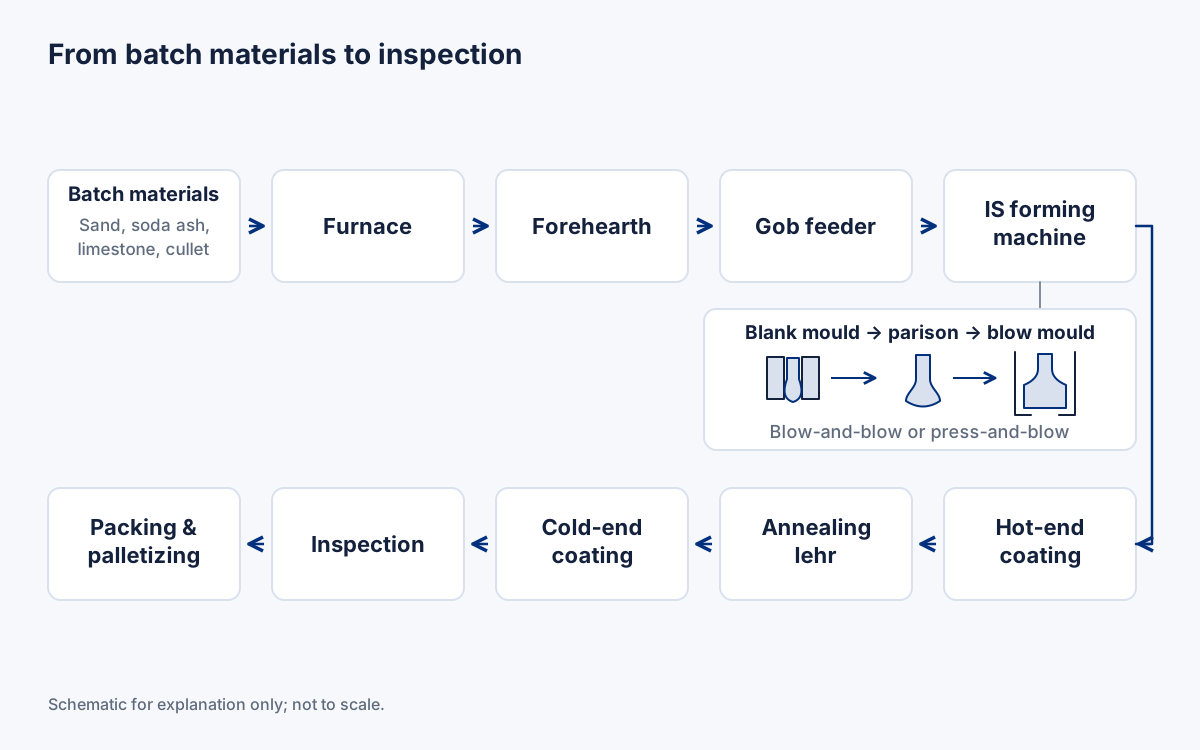
Industry sources divide a plant into three zones: the batch house (raw materials), the hot end (melting, forming, annealing) and the cold end (inspection and packing). The sections below follow the product through them.
1. Batch materials
The Glass Packaging Institute (GPI) states that glass containers are made from soda-lime glass using sand, soda ash, limestone and cullet. Cullet is recycled glass, and GPI says it improves furnace efficiency, including energy use. Minor ingredients such as fining agents, decolorizers and colorizers are added to the typical composition. GPI notes that the proportion of raw materials depends on availability, chemical and physical consistency, sizing, purity and cost.
Two details matter for buyers. First, GPI says the sand used for containers must meet detailed specifications, and beach or riverbed sand is not used in the container industry. Second, GPI describes cullet being color-separated, crushed, screened and checked to remove contaminants such as labels and metal caps before it goes back into a furnace.
The equipment maker Emhart Glass lists the same family of materials (cullet, sand, soda, calcite, dolomite, feldspar) and notes that chemicals such as iron oxide, sulphur and cobalt are added to produce green, amber and blue glass. If a supplier claims a certain recycled content, see recycled glass content: how to read supplier claims for the questions to ask. FEVE, the European container glass federation, states that on average a 10 percent increase of cullet in the furnace decreases energy use by 3 percent; GPI gives a similar range of 2 to 3 percent for the same increase. These are industry-wide averages, not a promise for a particular product.
Takeaway: Check the batch and color specification, including the basis of any recycled-content declaration.
2. Melting
A batch charger feeds the mixture steadily into the furnace. Emhart Glass says the furnace is heated by electric, gas or oil systems to between 1550 and 1600 °C, and that waste gases are used to preheat the combustion air. That figure comes from one equipment maker’s explainer, and furnace practice differs.
Furnace types used for container glass
Container glass is melted in tank furnaces. British Glass, the UK industry association, describes furnace heat recovery and melting technologies in its Glass sector net zero strategy, sections 1.4 and 2.1 (accessed October 8, 2026): regenerators recover exhaust heat to preheat combustion air. The European Commission’s reference document on glass manufacture (the glass BREF), which cites the European glass industry’s standing committee CPIV among its sources, describes a glass furnace as a tank of refractory blocks with a vaulted crown, held in a steel frame. Its designs are distinguished by how they are heated, how combustion air is preheated, and where the burners sit. It names these main types:
- Regenerative furnaces. Heat in the waste gas is stored in two refractory-filled chambers. The furnace fires from one side while the other chamber heats up, then reverses, so the incoming combustion air is always preheated. In a cross-fired furnace the ports run along both sides; in an end-fired furnace both chambers sit at one end and the flame turns in a U shape. The 2012 BREF reports that most conventional container plants use end-fired or cross-fired regenerative furnaces, and that the end-fired type is the most typical in the container sector.
- Recuperative furnaces (unit melters). A continuous metal heat exchanger preheats the air. The BREF describes them as suited to smaller installations and more flexible operation, with a lower melting capacity per square meter than a regenerative furnace.
- Oxy-fuel furnaces. Oxygen replaces combustion air, which greatly reduces the waste gas volume and thermal NOx.
- Electric furnaces. The batch is melted by passing current through the glass. The 2012 BREF describes electric melting particularly for smaller and special-glass furnaces. British Glass’s later strategy also discusses all-electric and hybrid melting as development routes for larger-scale production; the older BREF is not a census of current plants.
- Pot furnaces and day tanks. The BREF describes these as discontinuous melting for small amounts of glass, particularly where the formulation changes regularly, in the domestic and special glass sectors. A “glass melting pot” is this kind of equipment, not the furnace behind mainstream bottle production.
The choice depends on capacity, glass formulation, fuel prices, existing infrastructure and environmental performance. A buyer rarely chooses the furnace, but knowing the type explains part of a plant’s energy and emissions profile, which is worth asking about if you compare suppliers’ sustainability claims.
What happens in the melt
The BREF divides melting into phases. In primary melting, the batch reacts and the gases trapped in the raw materials escape. Fining then removes bubbles: small bubbles are called seeds and larger ones blisters, and for containers all or almost all of them should be removed. In conditioning, the glass cools slowly to working temperature. In a continuous furnace these phases happen at the same time in different zones of the tank and forehearth.
Two points matter for buyers. Bubbles that survive fining become defects in the finished container, so say in the specification how seeds and blisters are graded and accepted. Glass color also depends on melting conditions: the BREF explains that iron in its ferric state gives a yellowish-brown tint and in its ferrous state a bluish-green tint, and that amber needs reducing conditions in the furnace. Color consistency between production runs is therefore a process question as well as a batch question, so ask how the supplier measures and controls it.
Takeaway: Request the supplier’s defect grading and color-control records for the relevant production.
3. Forehearth and gob feeding
Melted glass leaves the furnace and passes along a forehearth, where it is conditioned to an even temperature. At the end of the forehearth, a feeder pushes the glass through a narrow orifice and shears the stream into gobs. A gob is a measured weight of glass, enough for one container. A UK jar maker notes that gob weight can be adjusted by changing plunger position and, in its description, the gob is gravity-fed into the IS machine through troughs and deflectors.
Gob weight is one reason bottle weight is a controlled specification rather than a loose target. It also links to lightweight wine bottles, where weight reduction depends on how glass is distributed in the finished container.
Takeaway: Check the nominal bottle weight, tolerance and production weight records.
4. Forming on the IS machine
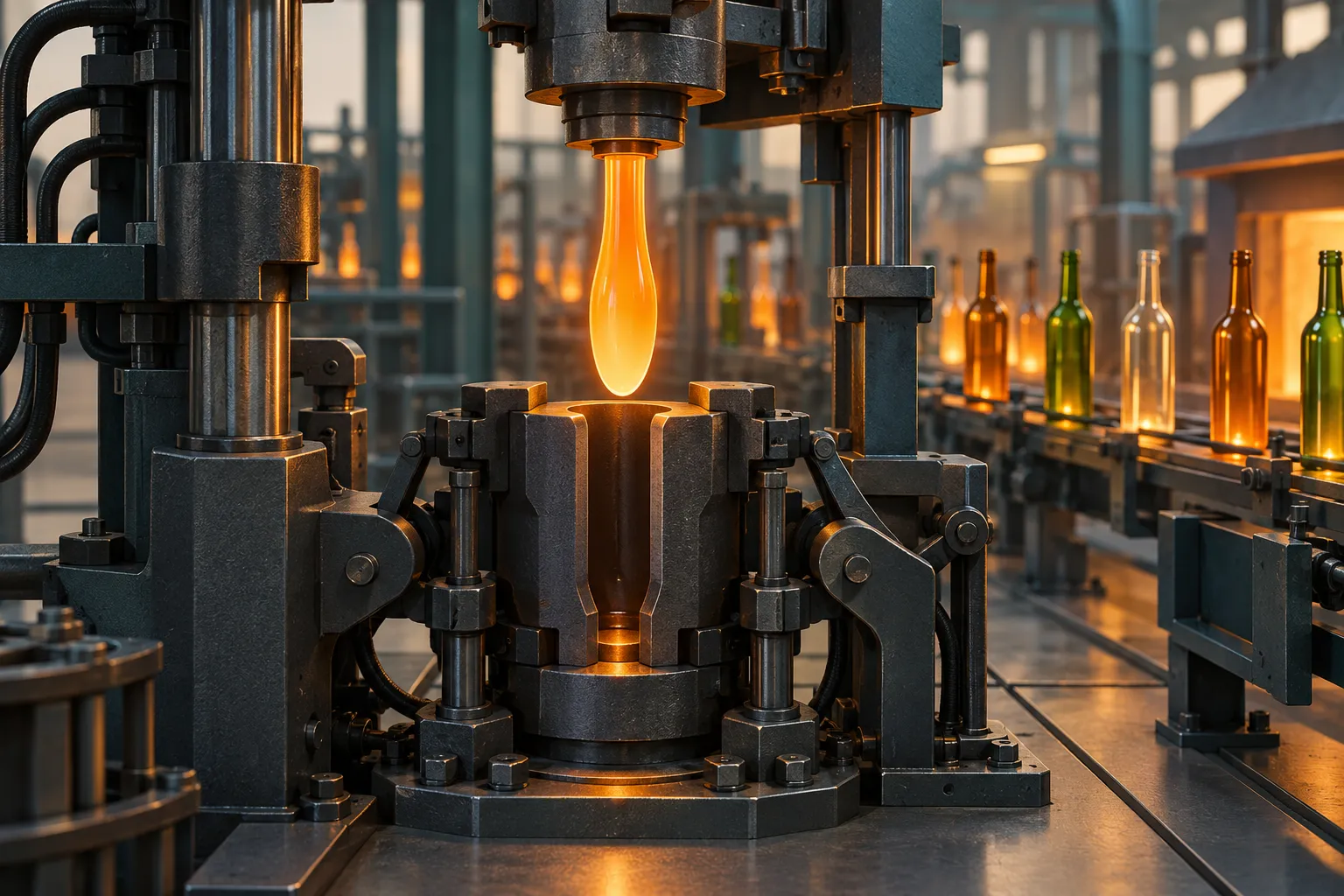
The IS machine is the core of container forming. Emhart explains that it is made of separate sections, each of which can be maintained independently. Each section can make one container at a time (single gob) or two, three or four at once (double, triple and quad gob).
Forming is done in two stages on every section. The blank side shapes the gob into a partially formed container called a parison, using the blank mould and a neck ring that forms the finish. The parison is then inverted and moved to the blow side, where it is blown into the final shape in the blow mould. There are two ways to make the parison.
Swipe or scroll horizontally to see all columns.
| Blow-and-blow | Press-and-blow | |
|---|---|---|
| Parison formed by | A settle blow forms the finish, then a counter blow from below makes the cavity | A metal plunger presses the glass into the blank mould |
| Usually used for | Narrow-neck bottles | Wide-mouth jars |
| Glass distribution | Depends on the blowing steps | A UK jar maker says press-and-blow gives much improved glass distribution |
| Neck limit | Suits narrow necks | A plunger must fit into the finish |
Emhart describes blow-and-blow as primarily for bottles and press-and-blow primarily for jars. Aegg adds that bottles can also be made by press-and-blow, in which case the process is called narrow-neck press-and-blow (NNPB). Which method makes a given bottle is a manufacturing decision, so ask the supplier rather than assume.
After forming, take-out equipment moves the container to the conveyor. Emhart points out that handling hot, fragile containers at high speed is a technical challenge.
Takeaway: Confirm the drawing revision, forming route and finish designation.
5. Hot-end coating
Immediately after forming, the containers pass through a coating hood. GPI and glassmaker pages describe the hot-end coating only briefly, but a supplier of coating chemicals explains the principle. A vaporized tin compound, monobutyltin trichloride (MBTC), is thermally decomposed in the coating hood right after the machine and just before the lehr, leaving a very thin tin oxide layer on the outside of the glass. The supplier states that the layer helps maintain glass strength, improves scratch resistance and provides an anchor for the cold-end coating. This is a coatings supplier’s description, so read it as a statement of purpose, not a measured performance claim for any bottle.
Takeaway: Record the hot-end treatment identified by the glassmaker.
6. Annealing lehr
Glass shrinks as it cools, which can create internal stress. In the lehr the containers are reheated and then cooled under control. Emhart Glass gives a reheating figure of about 580 °C and explains that the process must be managed for finished containers to be as strong as possible. A glass supplier’s technical note adds that controlled annealing is one of the steps manufacturers take to reduce the risk of thermal shock, though even well-made glass has limits that depend on design, weight and geometry.
Takeaway: Ask which residual-stress or thermal-shock evidence covers this bottle.
7. Cold-end coating
After the lehr the containers are cool. A cold-end coating, which the coating supplier says is typically polyethylene wax, adds lubricity so that bottles slide along conveyors instead of scuffing against one another. Discuss the identified treatment with the glass and closure suppliers when planning a conveyor or label change.
Takeaway: Record the surface treatment and trial results using the labeling guide.
8. Inspection and packing
Emhart says inspection was once done by eye or hand tools and is now done by automated devices that check size, shape and thickness, and detect checks (small cracks), bubbles and stones (foreign particles, often broken refractory). Containers that do not make the grade are rejected. FEVE describes the industry as a closed loop in which glass is remelted as cullet, but check with a supplier how rejected ware is handled at a given plant.
Finished containers are packed on pallets or in boxes for transport to the filler, where they will be filled, closed, labeled and distributed. Once empty bottles reach your plant, a second round of inspection is often added; see bottle inspection systems for what each system checks.
If receiving or line inspection finds an anomaly, use the glass bottle defect receiving record to retain the batch, mold marking, feature location and sample evidence for supplier investigation.
Takeaway: Keep the inspection plan and lot acceptance record with the pallet specification.
Short glossary
Swipe or scroll horizontally to see all columns.
| Term | Plain meaning |
|---|---|
| Batch | The mixture of raw materials fed to the furnace |
| Cullet | Crushed recycled glass added to the batch |
| Forehearth | Channel that conditions molten glass before forming |
| Gob | Measured lump of glass sheared off for one container |
| IS machine | Forming machine made of independent sections |
| Blank mould | First mould; shapes the gob into a parison |
| Parison | Partly formed container, inverted before the final blow |
| Blow mould | Second mould; gives the container its final shape |
| Neck ring | Part that forms the finish and grips the container |
| Hot-end coating | Thin metal-oxide layer applied before the lehr |
| Lehr | Annealing oven that relieves stress by controlled cooling |
| Cold-end coating | Lubricating layer applied after the lehr |
| Check | Small crack in the glass |
| Stone | Foreign particle in the glass, often refractory |
Soda-lime or borosilicate: which glass does your container need?
Open the separate glass-composition reference
Almost all bottles and jars are soda-lime glass. GPI says glass containers are made from soda-lime glass, and the BREF describes container glass as a soda-lime or modified soda-lime formulation. Borosilicate glass is a different family with different uses, and it is not the default for food and beverage packaging. Start from soda-lime and move to borosilicate only if your process or product requires something soda-lime containers cannot pass.
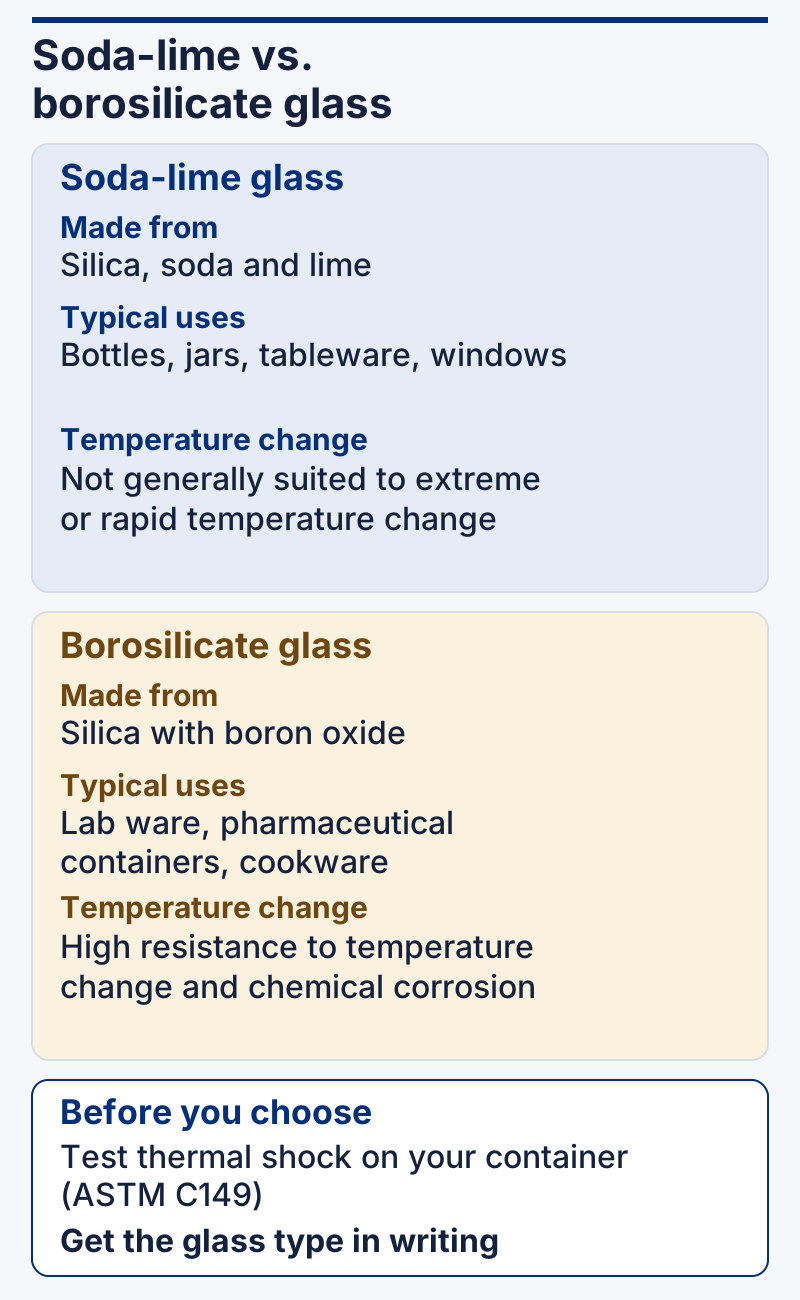
The BREF classifies glass by chemical composition into four main groups: soda-lime glass, lead crystal and crystal glass, borosilicate glass, and special glass. It describes the two that matter here as follows.
Swipe or scroll horizontally to see all columns.
| Soda-lime glass | Borosilicate glass | |
|---|---|---|
| Composition basis | Silica from sand, soda from soda ash and lime from limestone | Silica with boron oxide, plus smaller amounts of alkali and aluminum oxides |
| Typical uses named in the BREF | Bottles, jars, flaconnage, everyday tableware, window glass | Chemical process parts, laboratory equipment, pharmaceutical containers, lighting, cookware |
| Behavior under temperature change | Not generally suited to extreme or rapid changes in temperature; the higher the alkali content, the lower the thermal shock resistance | High resistance to temperature change and chemical corrosion (low thermal expansion) |
| Supply | The basis of container glass production | Many formulations are low-volume technical products counted as special glass |
For laboratory glassware, ASTM E438 sets out glass types: Type I, Class A is a low-expansion borosilicate glass, Type I, Class B is an alumino-borosilicate glass, and Type II is a soda-lime glass. Pharmacopoeia classes for drug containers are a separate system and are not covered here. When a specification has to define glass terms, ASTM C162, the standard terminology of glass and glass products, is the reference to cite.
How to decide
- If your process includes hot fill, pasteurization, washing or a move from hot to cold, test thermal shock on the actual container rather than choosing by material name. ASTM C149 is the test method for the relative thermal shock resistance of commercial bottles and jars that must withstand sudden temperature changes in service. Container design, weight and geometry also affect the result, so ask the glassmaker for results on your bottle.
- If the product is chemically aggressive or is a drug, the container’s chemical durability and its regulatory class decide the glass, and the supplier and regulator must confirm them.
- If you need borosilicate, expect a different supply route from mainstream bottles and jars, because most container plants melt soda-lime glass.
How to use this in a purchase
Weight and glass distribution relate to gob weight and the forming method, color to the batch, finish dimensions to the neck ring and mould, and surface behavior on your line to the coatings. Use the bottle specification checklist to record the resulting fields. Copy this blank evidence record into your project notes; it is an editorial worksheet, not an acceptance standard.
Swipe or scroll horizontally to see all columns.
| Stage / purchase field | Supplier document or result / unresolved item |
|---|---|
| Batch / color and recycled content | ______ |
| Melting / defects and color control | ______ |
| Gob / weight and tolerance | ______ |
| Forming / drawing, finish and glass distribution | ______ |
| Hot-end coating / identified treatment | ______ |
| Annealing / stress or thermal-shock evidence | ______ |
| Cold-end coating / handling and labeling trial | ______ |
| Inspection / lot acceptance and packing | ______ |
Evidence and limitations
This guide summarizes how container glass is made in general. Plants differ in furnace type, feeder design, machine size, coating chemistry, lehr design and inspection equipment, and some product types (very small, very large or specialty containers) follow other routes. Temperatures here appear only where a named source gives them. The furnace and glass-type sections summarize the European glass BREF, which describes EU practice; furnace types and formulations at a given plant elsewhere may differ. Glass-type comparisons are qualitative on purpose, and no thermal expansion values are given. Treat the coating and forming comparisons as published descriptions, not as performance guarantees for a given bottle.
- Best Available Techniques (BAT) Reference Document for the Manufacture of Glass, European Commission Joint Research Centre (2012): glass type classification, the melting process, furnace types and container glass production. Accessed October 8, 2026.
- ASTM E438, Standard Specification for Glasses in Laboratory Apparatus, ASTM International: Type I (borosilicate) and Type II (soda-lime) laboratory glasses. Accessed October 8, 2026.
- ASTM C149, Standard Test Method for Thermal Shock Resistance of Glass Containers, ASTM International: scope of the thermal shock test for bottles and jars. Accessed October 8, 2026.
- ASTM C162, Standard Terminology of Glass and Glass Products, ASTM International: terminology standard for glass. Accessed October 8, 2026.
- Making Glass Containers, Bucher Emhart Glass: stage-by-stage description from batch plant to packing, including IS forming, lehr and inspection. The maker of forming equipment, so this is a manufacturer’s explainer. Accessed October 8, 2026.
- What Is Glass, Glass Packaging Institute: soda-lime composition, raw materials, cullet processing and composition control. Accessed October 8, 2026.
- Industry FAQ, Glass Packaging Institute: cullet and energy relationship. Accessed October 8, 2026.
- The Role of Sand in Glass Container Manufacturing, Glass Packaging Institute: silica sand as a primary raw material and what is not used. Accessed October 8, 2026.
- Why glass always has a happy CO2 ending, FEVE: closed-loop recycling and the energy effect of cullet. Accessed October 8, 2026.
- The Glass Manufacturing Process, Aegg: a UK glass supplier’s description of press-and-blow forming, gobs and lehr. Accessed October 8, 2026.
- What is MBTC? The Key Ingredient for Hot End Glass Coating, Gulbrandsen: coatings supplier’s description of hot-end and cold-end coatings. Accessed October 8, 2026.
- Thermal Shock in Glass Bottles and Jars, Glassworks International: role of annealing and design in thermal shock. Accessed October 8, 2026.
Related guides
Lightweight Wine Bottles: What Buyers Should Verify
Beyond the gram count: glass distribution, strength test evidence, finish fit, line trials and how to read weight and carbon claims on light wine bottles.
Read the guide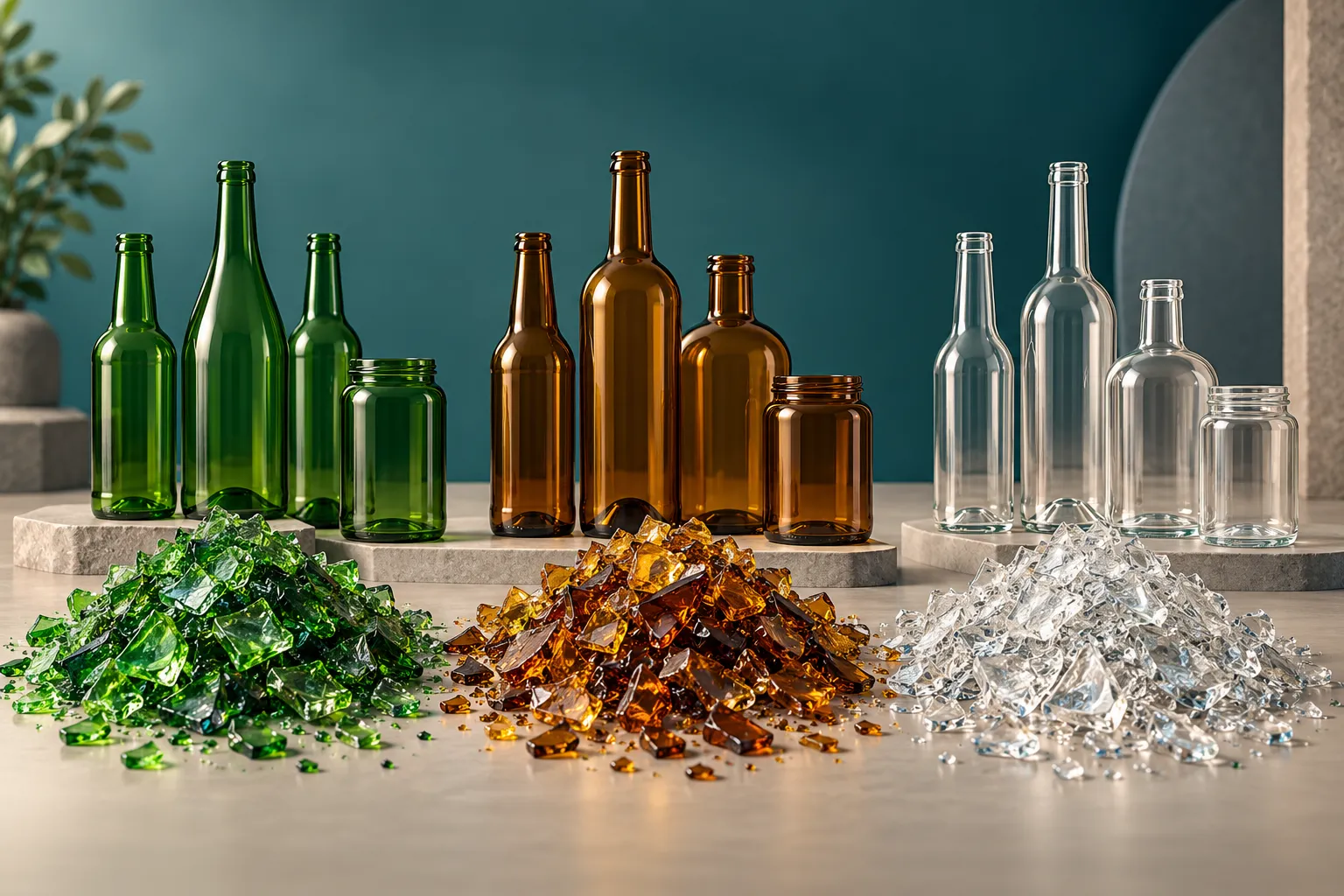
Recycled Glass Content: How to Read Supplier Claims
How to read a recycled glass content claim: cullet types, plant averages vs product figures, reporting period, colour limits and verification to request.
Read the guide
Glass Bottle Types and Sourcing: A Buyer’s Reference
How glass bottle shapes, finishes, colors and capacities are described, how to search for stock and unusual shapes, and what to send suppliers.
Read the guide