
Bottle Labeling Methods: Pressure-Sensitive, Wet-Glue and Sleeve Systems
What pressure-sensitive, wet-glue and sleeve labeling each demand from a glass bottle, and which container and condensation conditions belong in a requirement.
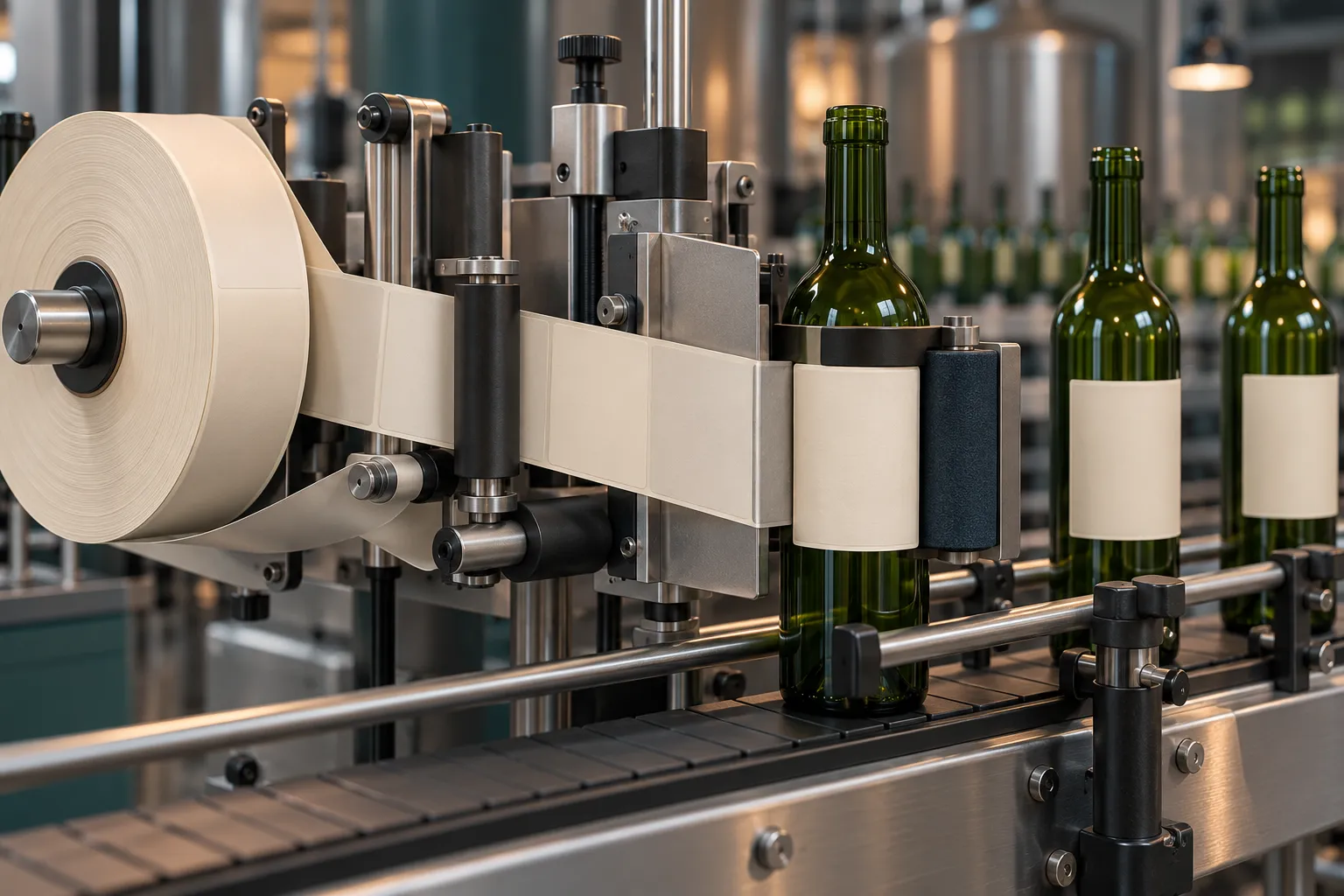
A label system mismatched to the bottle or moisture conditions can leave labels detached or wrinkled. Compare panel geometry, conditions during application and exposure in use as separate requirements, then trial the actual bottle, coating and label.
Swipe or scroll horizontally to see all columns.
| Method | Bottle shape | Condensation at application / immersion in use | Verify |
|---|---|---|---|
| Pressure-sensitive | Defined, reachable panel | Drying and adhesive-specific water limits / stock and adhesive tested in water | Peel, wipe-down and adhesion trial |
| Wet-glue | Panel matching label and glue pattern | Glue process and drying / paper and glue tested in water | Glue type, set time and wet-strength trial |
| Sleeve | Full profile, shoulder and taper | Cold-glass/tunnel conditions / film and seam exposure | Prototype shrink, heat and wrinkle trial |
The detailed container matrix below lists the limits to confirm. Copy the temperature and moisture trial record into your specification.
Three systems, three sets of container demands
Pressure-sensitive labels
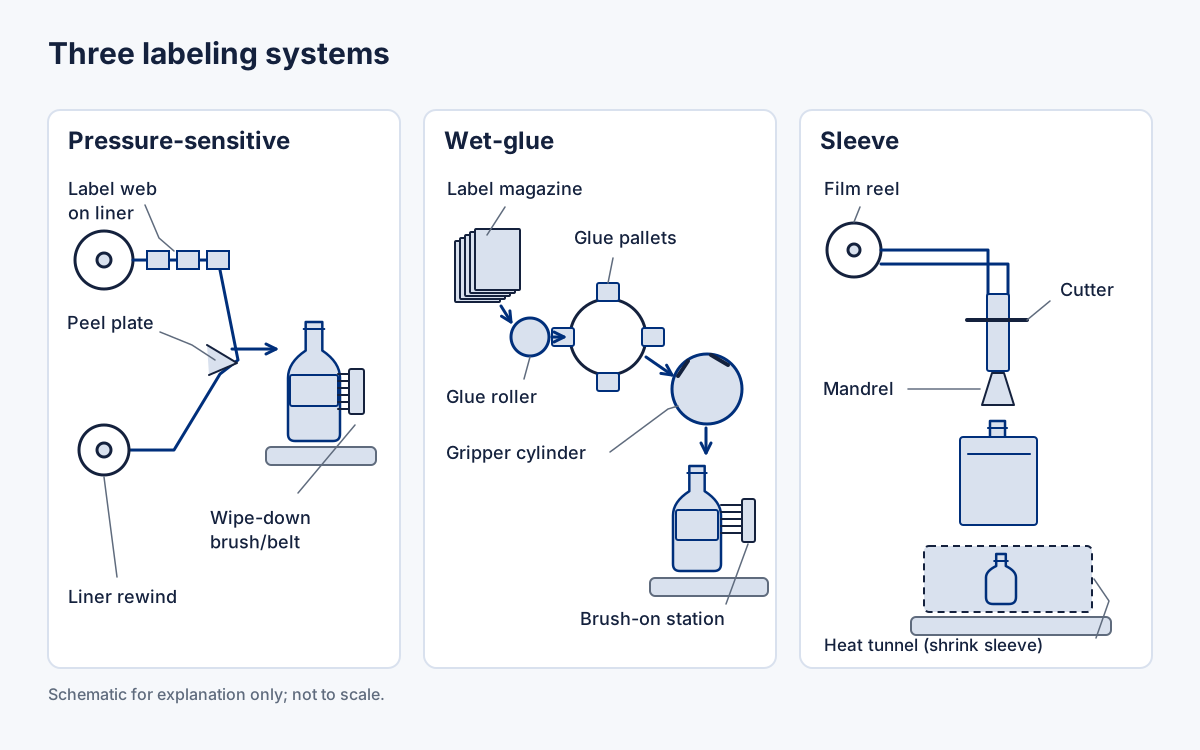
A pressure-sensitive label arrives with its adhesive already on it. Vendor explanations describe the label as a facestock, an adhesive layer and a release liner, and the machine peels each label from the liner and presses it onto the container. In the machine terms used in the diagram, that means a label web, a peel plate and a wipe-down device. A VTOPS buyer’s explanation (a labeler vendor) says a standard round-bottle applicator should not be assumed to handle cones, grooves or compound curves, and that the labeling surface should be defined first as cylindrical, flat, tapered, flexible or recessed.
From the container this means a defined, uninterrupted label panel, a surface free of oil, dust and moisture, and a panel the wipe-down brush or roller can reach. Beontag, a label supplier, adds that pressure-sensitive adhesives may not fully contact irregular surfaces, so a smooth panel matters more than it does for glue.
Wet-glue labels
Wet-glue (cut-and-stack) labels arrive without adhesive. In a rotary cold-glue machine, glue-coated pallets pick up cut labels from a magazine and pass them through a gripper cylinder, and brushes or rollers smooth them onto the bottle. Hot-melt systems heat the adhesive instead, and on roll-fed wraparound machines it is typically applied at the leading and trailing edges. VTOPS notes that these are different processes and should not be treated as one.
Beontag states that liquid glue can fill small gaps and may be more forgiving on irregular surfaces, and that glue-applied labels can hold well in moisture. That is a supplier claim from a company that sells labels, and it should be tested on your glass. The same source and VTOPS both stress that glue condition, application pattern and drying behavior are process variables the buyer has to ask about, not assume.
Sleeve labels
A sleeve is a film tube. In shrink systems the sleeve is opened over a mandrel, dropped onto the bottle and passed through a heat or steam tunnel so it conforms to the container. Taylor, a sleeve converter, says plastic, glass and metal containers can be sleeved, but the container must be rigid enough to withstand the sleeve’s shrink force and tolerate the tunnel heat. Sizing starts from the container’s height, circumference, curves and tapers, and a prototype is run through the tunnel to check fit and wrinkling.
PDC, another sleeve supplier, points out that sleeves can extend up the neck and over the closure for tamper evidence. That is a vendor benefit statement; it also means the finish and closure become part of the labeling interface.
What each method needs from the container
Swipe or scroll horizontally to see all columns.
| Container condition | Pressure-sensitive | Wet-glue | Sleeve |
|---|---|---|---|
| Label panel geometry | Defined flat or cylindrical panel; avoid ribs, seams and embossing under the label | Same, with the panel sized to the label and glue pattern | Full-body profile; shoulder, taper and finish shape the film |
| Surface condition | Clean, dry, free of oil and dust | Adhesive wetting of irregular surfaces is supplier guidance; trial clean production glass | Less adhesive dependence; surface must not interfere with seam or heat transfer |
| Surface coating | Ask the glass supplier what coating is on the panel; adhesive vendors publish coating preferences | Ask the same; glue systems still need adhesion testing on production-coated glass | Coating matters less for adhesion; matters for scuff and handling |
| Condensation and cold | Adhesive loses tack when cold; water on the panel blocks bonding | Glue and paper behavior under moisture must be proven | Cold glass entering a heat tunnel needs checking with the supplier |
| Cold and wet in use | Facestock and adhesive must survive ice water | Paper swelling and glue softening are the risks | Film is generally moisture-resistant; seam and tunnel behavior matter |
| Container strength | Applicator contact and bottle support to verify | Applicator contact and bottle support to verify | Shrink force and heat exposure to verify |
Treat the table as a list of questions, not verdicts; each cell depends on the exact bottle, label and machine.
Condensation, ice buckets and cold product
Two different problems share the word “wet” and need separate lines in the requirement.
The first is the bottle at the labeler. Avery Dennison’s technical bulletin for a cold/wet pressure-sensitive adhesive says cold temperatures make pressure-sensitive adhesives firm and reduce initial tack, and that a pressure-sensitive label will not stick to water. The bulletin, written for one adhesive product, says even a cold/wet adhesive can adhere only to certain levels of surface water, and that an air knife placed close to the peel blade, a complete primary wipe-down and leading-edge application help. It also says a pressure device must push the label into place to squeeze off residual condensation, and it recommends against center-contact application.
The second problem is the label in use, such as chilling or ice-bucket immersion. State that exposure separately from application moisture, and record its test conditions and result below.
A related point for cold-filled or chilled products: bottle temperature at the labeler depends on the filler, any tunnel or cooler, and the time on the conveyor. Record the expected temperature range and whether surface moisture is present, rather than leaving the labeler supplier to guess.
How to waterproof labels on glass bottles?
For ice-bucket use, the cited label printer describes wet-strength face stock, suitable adhesive and a varnish or laminate barrier. Confirm the finished label in an agreed immersion test on the production-coated bottle. A water-resistant label in use does not establish that it will bond to condensation during application.
Label trial record
Copy or print one record per label/bottle revision. Keep application and in-use tests separate.
Swipe or scroll horizontally to see all columns.
| Trial field | Entry |
|---|---|
| Bottle, label, adhesive and coating revisions | ____ |
| Bottle temperature at application; surface water | ____ |
| Drying, peel/wipe-down or glue/tunnel settings | ____ |
| In-use exposure: chilling / immersion / scuff; duration | ____ |
| Agreed criteria; run/sample count and conditions | ____ |
| Adhesion, position, wrinkle and reject results | ____ |
| Owner, open adjustment and retest result | ____ |
What goes into the requirement document
Build the label section from the container specification, not around the machine. The bottle specification checklist already covers drawing data such as height, diameter and finish; add these label-specific items:
- Label panel drawn on the container drawing, with height, wrap length, no-label zones and shoulder, heel and seam locations.
- Panel shape: cylindrical, flat, tapered or interrupted, and whether embossing or ribs sit under the label.
- Surface coating and treatment on the panel, and any washing or drying step before labeling.
- Bottle temperature range and surface moisture at the labeler, for the worst expected condition.
- In-use conditions the label must survive: chilling, ice bucket, condensation, handling or case-pack abrasion.
- Label stock, adhesive type, roll or stack dimensions, and placement and skew tolerances you will accept.
- Number of formats, including future ones, and who supplies the change parts.
- Verification: label presence, position and code checks and where the reject station sits.
- Acceptance method: samples of production-equivalent labels on production-equivalent bottles, run over an agreed duration and counted by good output.
Mojonex, an equipment vendor, makes the last two points in its container, closure and label data sheet: a label trial should use production-equivalent labels and containers, and surface moisture, oil, dust or temperature that may affect adhesion should be noted. VTOPS likewise recommends defining acceptable position, skew and alignment before testing and recording run duration, sample count, rejects and stoppages; a brief peak-speed display is less useful than good-container output over an agreed run.
The line planning guide covers sequencing and buffers, and label presence and position checks cover what inspection can confirm after the labeler. Label stock, change parts and recipes affect every format you plan to add, which the changeover guide treats in detail. Finally, labels must survive packing, so check how case packing and palletizing contacts the labeled surface.
Questions to send suppliers
- Which label panel geometry and surface conditions does the proposed system assume, and where do you need the container drawing to change?
- What bottle temperature and surface moisture range was the system quoted for, and what happens outside it?
- For pressure-sensitive systems: what wipe-down, air-knife and application method is included, and is the adhesive rated for cold or wet application?
- For wet-glue systems: which glue type (cold glue or hot melt), what glue-control and cleaning routine, and what drying or set time is assumed on the line?
- For sleeve systems: what film, tunnel type and shrink profile were assumed for this bottle’s shoulder and finish, and was a prototype run on the real bottle?
- Which tests support the in-use claim (ice bucket, cooler, scuff), on which bottle coating, and can the results be shared?
- How are label presence, position and code verified, and what is rejected and where?
- Which change parts, guides or recipes change per format, and which are included in the quoted price?
- What acceptance run do you propose, with what sample size, run duration and acceptance criteria?
- Which assumptions in your proposal depend on the glass coating or cold-end treatment, and who confirms it with the glass supplier?
Evidence and limitations
This guide stops where configuration decides the answer. Whether a given label system works on a given bottle depends on the glass coating and shape, the label stock and adhesive, the machine configuration and the actual temperature and moisture at the labeler. Sources below include label and equipment vendors with a commercial interest, so their statements are treated as supplier claims or application notes, not independent test results. No speed, accuracy or cost figures are offered here because none are comparable across configurations.
- Z3338 Adhesive Application Recommendations (technical bulletin), Avery Dennison: cold, wet-bottle labeling issues, air knives, wipe-down and application recommendations for one pressure-sensitive adhesive. Accessed October 8, 2026.
- Glue vs Self-Adhesive Labeling: Which Machine Should You Choose?, VTOPS: how cold-glue, hot-melt and sticker labelers work, container-surface definition, and trial-recording advice (vendor source). Accessed October 8, 2026.
- Pressure-Sensitive vs Glue-Applied Labels, Beontag: adhesive differences and surface tolerance (supplier claims). Accessed October 8, 2026.
- Shrink Sleeve Label Packaging Explained, Taylor: shrink sleeve process, container rigidity and heat requirements, sizing and prototype testing. Accessed October 8, 2026.
- Shrink Sleeve Labeling Versus Pressure Sensitive Labels, PDC: sleeve coverage and tamper-evident use (supplier claims). Accessed October 8, 2026.
- Cold-resistant wine labels for ice buckets: The challenge of durability, Grupo Argraf: wet-strength face stock and adhesive recommendations for chilled wine. Accessed October 8, 2026.
- Container, Closure & Label Data for Compact Filling Lines, MUJIU Industry: label-panel and surface data to record before quotation (vendor source). Accessed October 8, 2026.
Related guides
Bottle Inspection Systems: Comparing What Each System Checks
Compare empty bottle, fill level, closure, label and code inspection by scope and limits, and ask for reject verification, test bottles and validation records.
Read the guide
Planning a Glass Bottling Line: From Empty Bottles to Packed Cases
How to divide a glass bottling line into stations, size buffers around the bottleneck machine, and confirm machine interfaces before requesting quotes.
Read the guide
Bottling-Line Changeovers: What to Check Before Adding a New Bottle
Which change parts a new glass bottle touches, which bottle data to check, and how to run and document a trial before the bottle goes into production.
Read the guide