
How Many Pallets of Glass Bottles Fit on a Truck?
A 53 ft van takes 26 floor-loaded 48 x 40 pallets, but glass often reaches the weight limit first. How to work out pallet weight and which limit binds.
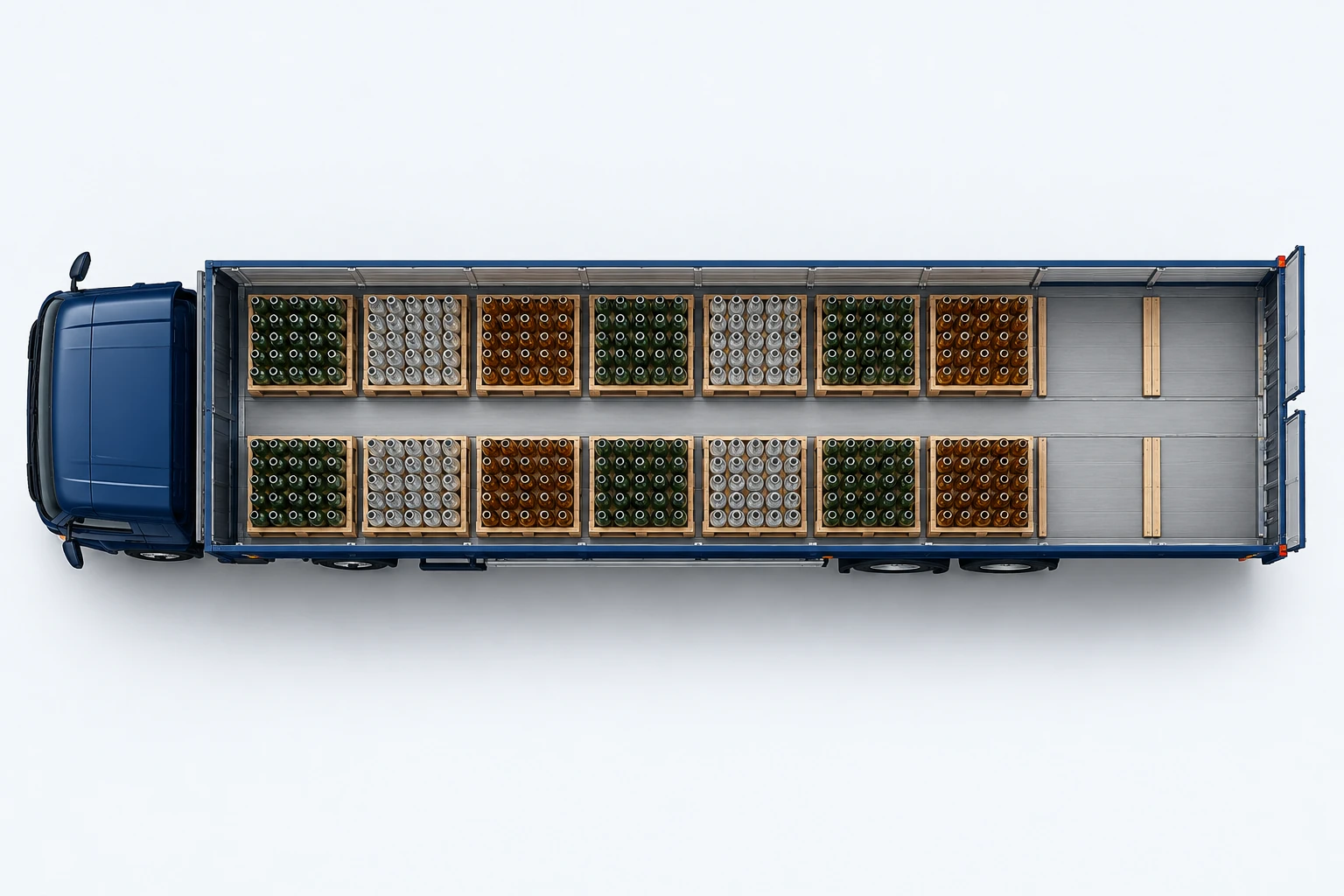
A 53 ft dry van holds 26 standard 48 × 40 in pallets on the floor, or 30 if they are turned. Loaded straight, two across, a 26 ft box truck takes 12 when at least 24 ft (288 in) of its body is usable floor, which Penske’s published inside length of up to 25 ft 11 in allows. If U-Haul’s listed 26 ft 2 in includes the 31 in shelf over the cab, the remaining 283 in of floor gives 10. Confirm the floor length of the truck you get. Those counts assume the truck fills up by space. Glass is heavy, so a load of glass bottles, filled ones in particular, can reach the vehicle’s weight limit while floor positions are still empty.
To find how many pallets of glass bottles fit on a truck, work out two numbers and use the smaller one. The first is floor positions: 26 straight or 30 turned for a 53 ft van with a 52 ft 6 in interior, and, loaded straight two across, 10 or 12 for a 26 ft box truck, depending on how much of the listed length is usable floor. The second is weight: the cargo weight your carrier allows, divided by the gross weight of one pallet and rounded down. On the U.S. Interstate System the whole vehicle is capped at 80,000 lb, or less where the federal bridge formula gives a lower figure (23 CFR 658.17). Treat the result as an estimate and have your carrier check it against the vehicle and the rules for your route.
Key points:
- Floor positions come from the inside length and width of the vehicle you will actually get, not from its nominal length.
- A pallet of glass weighs the bottle (or case) weight times the count per layer times the number of layers, plus the pallet and dunnage. Filled bottles add the weight of the product.
- Divide the cargo allowance by the number of floor positions. If your pallet is heavier than that figure, weight decides the count.
- In the assumed examples below, empty bulk glass fills a 53 ft van by space, while filled glass in cases reaches the weight limit at 17 pallets.
How many 48 × 40 pallets fit on a truck by floor space?
Divide the inside length by the pallet side that runs along the truck, round down, and multiply by the number of pallets that fit across the width. ISO 6780 lists 1 219 × 1 016 mm, which it gives as 48 × 40 in, among its standard pallet sizes. The counts below use that footprint and the inside dimensions the builders and rental fleets publish.
| Vehicle (published spec) | Inside dimensions | 48 in side along the truck | 40 in side along the truck (turned) |
|---|---|---|---|
| 53 ft dry van (Hyundai Translead Composite) | 52 ft 6 in (630 in) long, 101.5 in wide, 110 in high | 13 rows × 2 = 26 | 15 rows × 2 = 30; two 48 in sides need 96 in of width |
| 26 ft box truck (Penske rental) | Up to 25 ft 11 in (311 in) long, 8 ft 1 in (97 in) wide, 8 ft 1 in high | 6 rows × 2 = 12, if at least 288 in of the floor is usable | 7 rows × 2 = 14 on paper, with about 1 in to spare across the width |
| 26 ft box truck (U-Haul rental) | 26 ft 2 in (314 in) long, 8 ft 1 in wide, 8 ft 3 in high; a 2 ft 7 in “Mom’s Attic” over the cab, and U-Haul does not say whether the listed length includes it | 12 if the full listed length is usable floor; 10 if the attic length is part of it | 14 on paper, with the same 1 in margin |
Floor positions = (inside length ÷ pallet length along the truck, rounded down) × pallets across the width.
Inside sizes vary by builder and model. Wabash’s DuraPlate HD sheet gives a 101 in inside width and 110-1/4 to 111-1/4 in inside height but no inside length, so ask the carrier for the dimensions of the trailer it will send. A “26 ft truck” is not one specification either: the two rental fleets above publish different lengths and payloads for trucks of the same name. In the box trucks, we would plan on 12 straight positions for the Penske truck if the truck you get has at least 288 in of usable floor, and 10 for the U-Haul truck until its usable floor length is confirmed, and treat 14 as something to confirm with the truck in front of you, because a 96 in pair of pallets in a 97 in body leaves no room to place them. U-Haul does not say whether its listed length includes the attic over the cab, which is only 3 ft 3 in high; the remaining 283 in would still give 5 rows, or 10 positions, so confirm which applies before you count on 12. For a 22 ft or 24 ft truck, apply the same formula to its published inside length.
How much does a pallet of glass bottles weigh?
Multiply the weight of one bottle, or one case, by the number per layer and the number of layers, then add the pallet and the dunnage. There is no standard weight for a pallet of glass, because bottle weight, layer pattern and layer count all change with the bottle and the supplier.
Pallet gross weight = unit weight × units per layer × layers + pallet + tier sheets, top frame and wrap
Filled bottle weight = empty bottle weight + fill volume × product density + closure and label
Put every input in the same unit before you add: grams to kilograms (÷ 1,000), milliliters to liters (÷ 1,000, so contents in kg = ml ÷ 1,000 × density in kg/L), and convert the final pallet weight to pounds (kg × 2.20462) to compare it with a U.S. vehicle payload.
| Input | Unit | Where to get it |
|---|---|---|
| Empty bottle weight | g or oz | The bottle drawing or specification. Weights differ widely between designs, as the lightweight wine bottles guide shows for 750 ml wine bottles |
| Bottles per layer and layers per pallet (bulk glass) | count | The glass supplier’s pallet card for the article; the bottle specification checklist lists it under packing |
| Fill volume and product density | ml, kg/L | Your product specification |
| Case weight and cases per layer (finished goods) | lb, count | The case supplier and your own pallet pattern |
| Pallet weight | lb or kg | The pallet supplier. CHEP gives an average of 29 kg (about 64 lb) for its 48 × 40 in block pallet |
| Tier sheets, top frame, stretch wrap, corner boards | lb or kg | Weigh them or ask the supplier |
| Loaded height | in | The pallet card or a measurement; you need it for stacking and door checks |
Empty glass and finished product are different loads. Empty bottles may arrive bulk on tier sheets or in cases, as the depalletizers and infeed guide describes. Filled product adds the contents to every bottle. The contents of a 750 ml bottle of a water-like product weigh about 0.75 kg, more than the 500 g empty bottle assumed in the examples below. Check the gross weight against the pallet’s own rating as well. CHEP recommends a maximum of 1,270 kg (about 2,800 lb) uniformly distributed load for the 48 × 40 in block pallet it lists.
Weight or space: which limit does your load reach first?
Divide the cargo weight your carrier allows by the number of floor positions. The result is the heaviest pallet you can put in every position. If your pallet is heavier, the vehicle reaches its weight limit before the floor is full. If it is lighter, space runs out first.
For a tractor and semi-trailer on the Interstate System, federal rules cap gross vehicle weight at 80,000 lb, with a lower figure where the bridge formula requires it. They also limit a single axle to 20,000 lb and a tandem axle to 34,000 lb, including all enforcement tolerances (23 CFR 658.17). The cargo you can load is what remains of the gross limit after the tractor and the trailer:
Cargo allowance = gross weight limit − tractor weight − trailer tare weight
The Hyundai Translead Composite van, for example, lists a tare weight of 13,350 lb. Tractor weight depends on the unit and how much fuel it carries, so ask the carrier for its cargo allowance instead of estimating it. For a straight truck, use the payload published for that vehicle: Penske lists up to 10,000 lb for its 26 ft truck and U-Haul lists 12,859 lb for its own.
| Vehicle and cargo allowance | Floor positions | Heaviest pallet that still fills every position (rounded down) |
|---|---|---|
| 53 ft van, 44,000 lb allowance (assumed), straight | 26 | 1,692 lb |
| 53 ft van, 44,000 lb allowance (assumed), turned | 30 | 1,466 lb |
| 26 ft truck, 10,000 lb (Penske) | 12 (with 288 in of usable floor) | 833 lb |
| 26 ft truck, 12,859 lb (U-Haul) | 12, or 10 if the attic counts in the length | 1,071 lb, or 1,285 lb |
Pallets per truck = the smaller of (floor positions × pallets per position) and (cargo allowance ÷ pallet gross weight, rounded down).
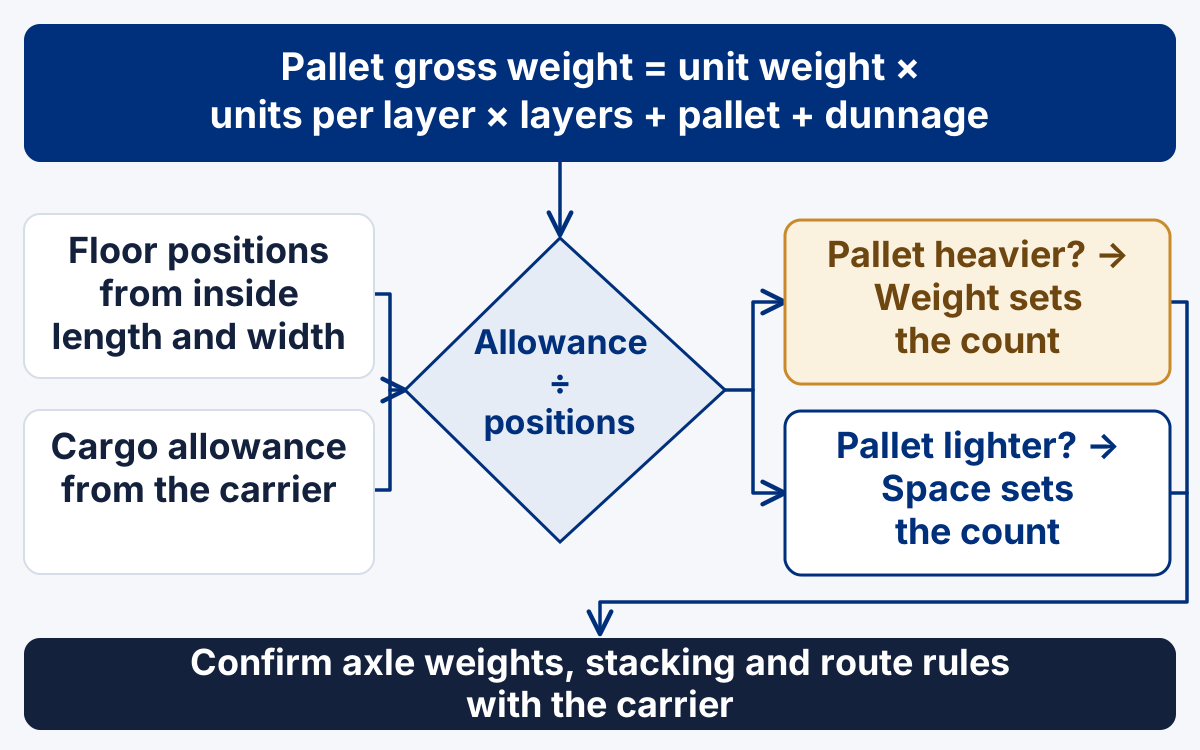
Worked examples (example, assumed inputs)
Under the assumptions below, empty bulk glass fills a 53 ft van by space at 26 pallets, filled glass in cases fills it by weight at 17 pallets, and both loads reach the payload of a 26 ft box truck with floor positions to spare. The inputs are assumptions chosen to show the method, not measurements of any bottle, case or vehicle, so replace every input with your own figures before relying on a result.
| Input | Load A: empty bottles, bulk | Load B: filled bottles in cases |
|---|---|---|
| Empty bottle weight | 500 g (assumed) | 500 g (assumed) |
| Contents | None | 750 ml at 1.0 kg/L = 750 g (assumed) |
| Closure and label | None | 10 g (assumed) |
| Packing unit | Loose bottle | Case of 12; case and partitions 0.6 kg (assumed) |
| Units per layer × layers | 230 × 5 = 1,150 bottles (assumed) | 14 × 5 = 70 cases, 840 bottles (assumed) |
| Pallet | 29 kg (CHEP average) | 29 kg (CHEP average) |
| Tier sheets, top frame, wrap | 16 kg (assumed) | 6 kg (assumed) |
| Loaded height | About 65 in (assumed) | About 66 in (assumed) |
| Pallet gross weight | 620 kg (1,367 lb) | 1,135 kg (2,503 lb) |
Load A: 0.50 kg × 230 × 5 = 575 kg of glass, plus 29 kg and 16 kg, gives 620 kg, or about 1,367 lb.
Load B: each filled bottle weighs 0.50 + 0.75 + 0.01 = 1.26 kg. A case weighs 12 × 1.26 + 0.6 = 15.72 kg. Seventy cases weigh 1,100.4 kg, and the pallet and wrap bring the total to 1,135.4 kg, or about 2,503 lb.
| Vehicle and allowance | Floor positions | Load A | Load B |
|---|---|---|---|
| 53 ft van, 44,000 lb (assumed), straight | 26 | 26 pallets, 35,538 lb: space sets the count | 17 pallets, 42,553 lb: weight sets the count, 9 positions empty |
| 53 ft van, 44,000 lb (assumed), turned | 30 | 30 pallets, 41,006 lb: space | 17 pallets: weight, 13 positions empty |
| 26 ft truck, 10,000 lb (Penske) | 12 (with 288 in of usable floor) | 7 pallets, 9,568 lb: weight | 3 pallets, 7,509 lb: weight; a fourth would bring the load to 10,013 lb |
| 26 ft truck, 12,859 lb (U-Haul) | 10 to 12 | 9 pallets, 12,302 lb: weight | 5 pallets, 12,516 lb: weight |
Under these assumptions, empty bulk glass fills a 53 ft van by space, while filled glass in cases reaches the weight limit with a third of the floor unused. In both 26 ft trucks, both loads reach the payload long before the floor is full, because a box truck’s payload is small relative to its floor area. These counts cover full pallets of equal weight, so the weight result is rounded down: a fourth Load B pallet in the Penske truck would exceed its published capacity by about 13 lb. If the last pallet is a part pallet, work it out from its own gross weight and position and have the carrier confirm it. Totals are converted from kilograms before rounding.
When weight sets the count, recheck bottles per truck, not only pallets per truck. In this example, cutting Load B to four layers (56 cases, about 2,018 lb per pallet, with the same pallet and wrap) raises the count to 21 pallets but carries 14,112 bottles, against 14,280 bottles on 17 five-layer pallets. Lighter glass does change the result: with the bottle assumed at 420 g instead of 500 g, a five-layer Load B pallet weighs about 2,355 lb and the 53 ft van takes 18 pallets instead of 17. Load A is limited by space, so the same change adds nothing there. Whenever you change the pattern or the bottle, recalculate pallet weight, height and total bottles together.
What the pallet count does not tell you
A count that passes the space and weight checks can still fail on a given vehicle or route. These checks belong to the carrier, the glass supplier or the pallet supplier, so ask them before the load is booked.
- Trailer ratings are not your cargo allowance. Utility lists a GVWR of 65,000 lb and a payload capacity of 55,000 lb for its dry vans, and Hyundai Translead lists a GVWR of 68,000 lb for its Composite van. Those figures rate the trailer. On the Interstate System the cargo for the whole tractor and trailer still has to fit inside the 80,000 lb gross limit.
- Axle weights. The federal limits apply to each axle and axle group as well as to the total. Where the heavy pallets sit decides how the weight falls on the tandems, so the carrier sets the loading position and order.
- Double stacking. Answers that put 52 pallets in a 53 ft van assume two pallets per position. In the examples above, two 65 in pallets would need about 130 in of height against a 110 in interior. Stacking also depends on whether the lower load and pallet can carry the one above, so ask the glass supplier before planning on it.
- Pallet rating. Compare each pallet’s gross weight with the rating of the pallet you actually use. CHEP’s figure applies to its own block pallet and to a uniformly distributed load.
- Trailer floor rating. Builders publish a floor rating that is separate from payload: 18,000 lb for the Hyundai Translead Composite and a 20,000 lb dynamic load rating for the Wabash DuraPlate HD. If a forklift drives into the trailer with heavy glass pallets, ask the carrier whether the floor rating suits your forklift and pallet weights.
- Doors and decks on box trucks. U-Haul lists a 6 ft 10 in door opening height, a 35 in deck height and a loading ramp for its 26 ft truck. Check that the loaded pallet clears the door, and that you have a dock or lift that reaches the deck at both ends.
- Route and state rules. Section 658.17 applies to the Interstate System and reasonable access to it. Other roads follow state law, and some states have grandfathered or permitted limits. Ask the carrier which limits apply on your route.
What to send the carrier before you book
Send the carrier the inputs behind your count, not just the count. It can only confirm a load if it knows the footprint, height, weight and stackability of every pallet.
- Pallet footprint and type, for example 48 × 40 in block pallet, and whether pallets may be turned.
- Loaded height per pallet, and whether the pallets may be stacked.
- Gross weight per pallet, and whether it comes from a scale or from the calculation above.
- Number of pallets and the total cargo weight.
- Whether the load is empty glass or filled product, and whether it is cased or bulk on tier sheets. Pallet patterns and protection are covered in case packing and palletizing for glass bottles.
- How the truck will be loaded and unloaded at each end: dock, forklift, liftgate or ramp.
Ask the carrier in return for the cargo allowance and inside dimensions of the vehicle it will send, and for confirmation that the plan fits the axle and route limits. If the result changes how much glass you order at once, the smallest orderable unit (a layer, a pallet or a truckload) is discussed in stock vs. custom glass bottles. The buying resources section collects the other checklists that feed a glass or equipment purchase.
Questions buyers ask about pallets per truck
Most pallet-count questions come down to three things: the vehicle’s real inside length and width, which pallet side runs along it, and whether pallets may be stacked. The answers below apply the same method.
How many pallets fit in a 22 ft truck?
Use the same formula with that truck’s published inside length and width. With the 48 in side along the truck and two 40 in sides across (80 in), every full 48 in of inside length adds two positions. Then divide the truck’s published payload by your pallet weight; in the 26 ft examples above, payload set the count before the floor did.
How many 40 × 48 pallets fit on a truck?
The same number as 48 × 40 pallets: both name one footprint, the 1 219 × 1 016 mm size in ISO 6780. What changes the count is which side runs along the vehicle. In the 53 ft van above, the 48 in side along the trailer gives 26 positions and the 40 in side gives 30. Tell the carrier which way the pallets will be loaded.
Why do some answers say 52 pallets for a 53 ft trailer?
That figure assumes two pallets stacked in each of the 26 floor positions. It depends on pallet height and on the strength of the lower load, and the weight still has to fit: 52 pallets within an assumed 44,000 lb allowance means about 846 lb per pallet, far below both example loads. Check with the glass supplier and the carrier before counting on stacked positions.
Method, limitations and sources
This guide is a calculation method compiled from public sources: a pallet standard, vehicle specifications published by trailer builders and rental fleets, and the federal weight rule. It is not a load plan and reports no measurements. Every bottle, case, dunnage, height and cargo-allowance figure in the examples is an assumption chosen to show the method. Vehicle figures are the builders’ and fleets’ published specifications, which they describe as approximate or subject to change, and the vehicle you receive may differ. Weight rules are summarized from the federal text for the Interstate System only. State rules, permits and carrier policies are outside this guide, so confirm any count with your carrier and the rules that apply to your route. The guide does not cover refrigerated trailers, ocean containers, rules outside the United States, less-than-truckload or parcel shipments, or how to protect glass in transit.
Sources, accessed October 7, 2026:
- ISO 6780:2003, Flat pallets for intercontinental materials handling: principal dimensions and tolerances (preview of the corrected version of 2004-04-15), International Organization for Standardization, via iTeh Standards: Table 1 plan dimensions, including 1 219 × 1 016 mm (48 × 40 in).
- 23 CFR 658.17, Weight, eCFR: gross, single-axle and tandem-axle limits on the Interstate System.
- Composite dry van, Hyundai Translead: inside dimensions, GVWR, floor rating and tare weight.
- Dry Vans with DuraPlate HD Technology (VT-02-5.25), Wabash: inside width and height, GVWR and floor rating.
- Dry van specifications, Utility Trailer: GVWR and payload capacity ratings.
- US Wooden Pallet (48 x 40 inches), CHEP: dimensions, average weight and recommended load rating.
- Pooled Wood Block Pallet, CHEP USA: 2,800 lb uniformly distributed load rating.
- 26 ft moving truck, Penske Truck Rental: inside dimensions and load capacity.
- 26 ft moving truck, U-Haul: inside dimensions, door opening, deck height and maximum load.
Related guides
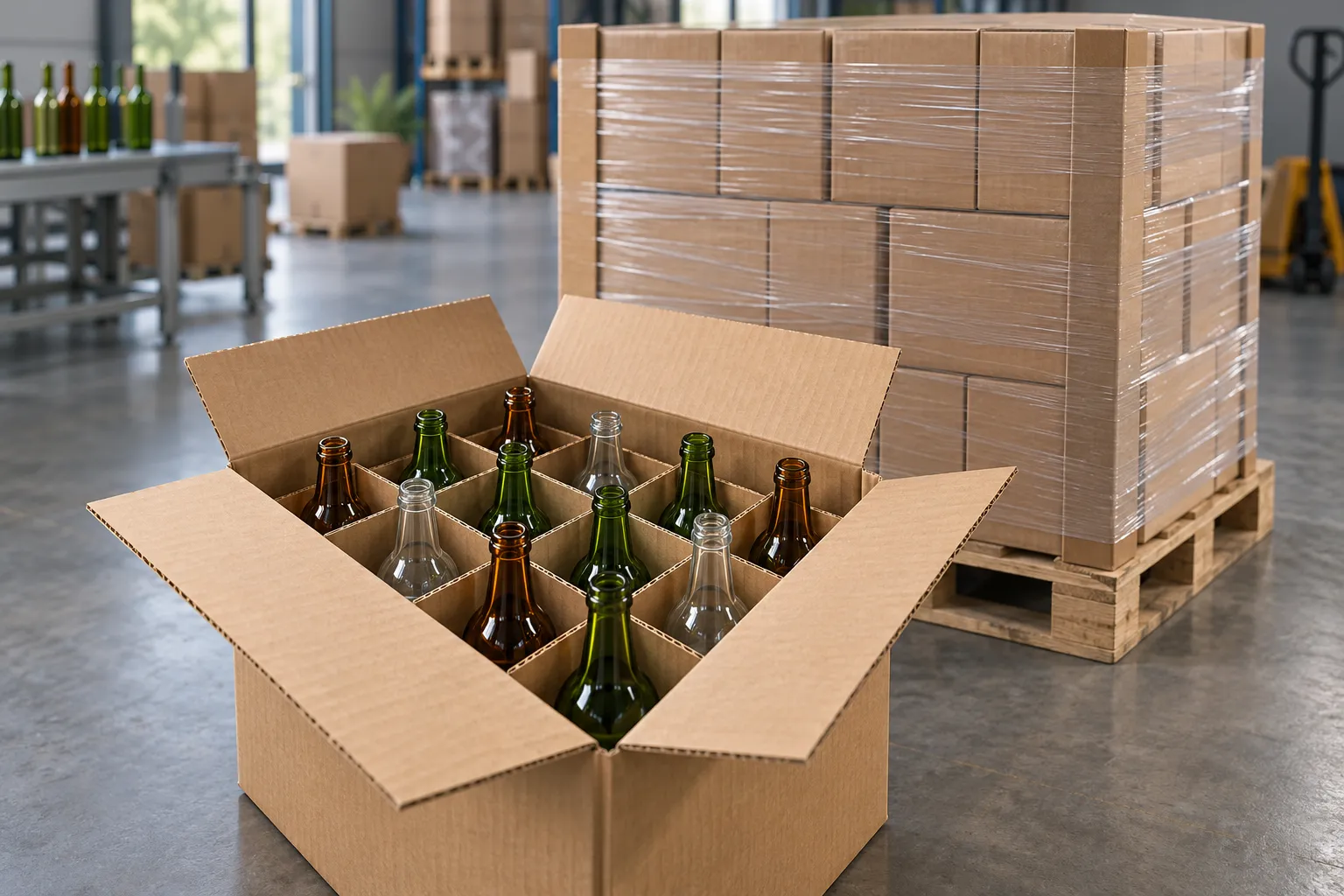
Case Packing and Palletizing for Glass Bottles: Layout and Protection
How to compare case styles, drop and pick-and-place packers, partitions, tier sheets and pallet containment for glass, and which logistics rules to confirm.
Read the guide
Glass Bottle Specifications: A Checklist for Supplier Enquiries
A checklist of what to state in a glass bottle enquiry: drawing dimensions, capacity and fill point, finish, color, strength, decoration, quality and packing.
Read the guide
Stock vs. Custom Glass Bottles: What to Compare Before Ordering
Compare stock and custom glass bottles on tooling ownership, minimum quantities, sampling, documentation, line trials and supply continuity before you order.
Read the guide