
Glass vs. Plastic Bottles: Comparing Product and Line Fit
Compare glass and plastic bottles for a commercial product: package and closure evidence, line trials, quote inputs and the limits of environmental claims.
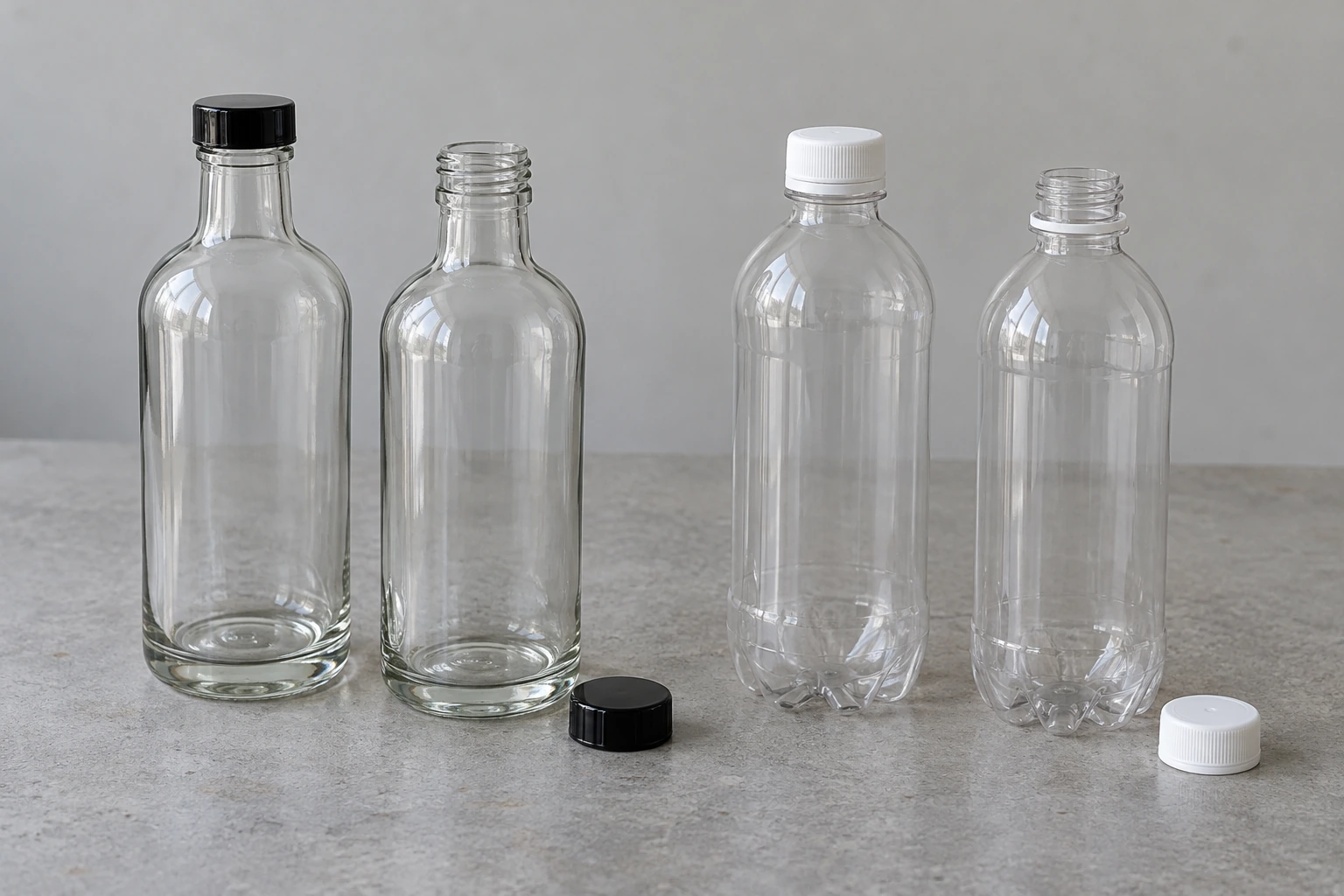
Glass or plastic: what to compare first
Glass and plastic bottles are not two grades of the same thing, so a general verdict on which is better does not help a packaging decision. What helps is comparing two specified packages for the same product: a named glass bottle with its closure, against a named plastic bottle with its closure, each checked for product protection, fit on your filling line, logistics, quoted scope and end-of-life route. This guide sets out those checks for brand owners, buyers and plant teams packing a commercial product. It does not review baby bottles or personal drinking bottles.
Short answer: choose the material only after both candidate packages pass the same tests. Fix the product, delivered volume, process and end-of-life route first; obtain package-specific evidence for each bottle and closure; run both samples through your actual line against written criteria; then compare quotes on identical scope. Published life cycle studies can inform an environmental claim, but their results depend on the system they modelled.
Swipe or scroll horizontally to see all columns.
| Decision area | What to establish for the glass option | What to establish for the plastic option | Evidence to hold |
|---|---|---|---|
| Container specification | Drawing, glass color, finish and capacity | Drawing, named resin and grade, any layers or coatings, finish and capacity | Drawing revision for each |
| Closure | Closure and liner made for this finish | Closure and liner made for this finish | Closure drawing and fit data |
| Product protection | Package-specific data for your product | Package-specific data for your product | Supplier data or your own study |
| Process temperature | Fill, heating and cooling steps the bottle is designed for | Fill, heating and cooling steps the bottle is designed for | Supplier’s written conditions |
| Line fit | Behavior at every station | Behavior at every station | Trial record against criteria |
| Logistics and quotes | Pack pattern, load, freight and change parts | Pack pattern, load, freight and change parts | Same-scope written quotes |
| Environmental claim | Study system, region and end-of-life route | Study system, region and end-of-life route | Study reference and scope |
Takeaway: The right-hand column is the work; no row is decided by the material name alone.
Are glass bottles better than plastic for your product?
Neither is better in general; one specified package can be better for your product, line and market than another. Settle the basis of comparison before collecting evidence, or the two options will be judged on different terms.
The 2020 UNEP review of life cycle assessments makes the same point about environmental results. It reviewed earlier studies of beverage containers and notes that one of them, a UK study of carbonated soft-drink packaging, compared bottles of different capacities on the basis of one litre of packaged drink. The review adds that bottles of different capacities “cannot be always compared directly since they deliver different functionalities”, because a small bottle can be a single take-away serving and a large one cannot. The same reasoning applies to a commercial packaging choice.
Write down five things before asking any supplier for a sample:
- Product. Formula or product family, and anything that affects packaging: carbonation, acidity, oils, light sensitivity, particulates.
- Delivered volume and use. The fill quantity, and how the customer opens, pours, reseals and stores the pack.
- Process sequence. Fill temperature and every later heating, holding, cooling or washing step.
- Market and route. Where the product is filled, shipped and sold, and how it is cased and palletized.
- End-of-life route. Whether the pack goes into a local collection or recycling program, or into a return-and-wash system you operate or join.
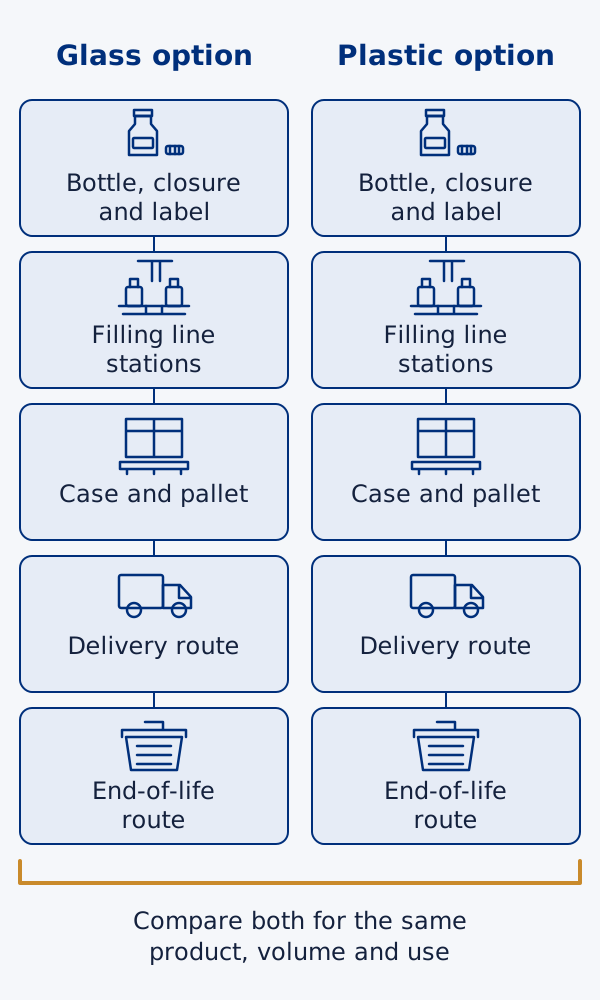
These five lines become the header of the worksheet later in this guide. They also show why a single comparison found online may not apply to you: change the product, volume or end-of-life route and the comparison changes. The glass containers overview puts the same decisions in order for glass packs: product and process first, then closure and finish, then shape.
Takeaway: Write the five-line comparison basis and send the same version to every supplier before any sample is made.
What product and closure evidence decides the shortlist?
The shortlist depends on evidence for the exact package, not on material properties in the abstract. Identify each candidate precisely, then ask its suppliers for data that covers your product and your process.
Identify the package. For the glass option, that means a drawing with the finish designation, capacity, color and weight. For the plastic option, it means a drawing plus the named resin and grade and any layers, coatings or additives the supplier declares. “Plastic” is not a specification: the bottle’s material and construction decide its behavior, and they differ between products that look alike. The bottle specification checklist lists the drawing fields to request; ask the plastic bottle supplier for the equivalent fields.
Treat the closure as part of the package. A bottle body never reaches the customer on its own. In the UK study reviewed by UNEP, each container’s materials were listed as body, top and label. The two candidates may have different finishes and use different closures, so check each bottle against its own finish and closure drawings rather than assuming one cap or liner suits both, and approve each bottle and closure as a pair. Neck finishes and closure compatibility explains why a matching diameter does not make a closure fit.
Ask for product protection data, not a material ranking. Whether a package holds your product’s quality over its intended life is a package-specific question. Request the supplier’s data for the named bottle and closure with a comparable product, or plan your own study. Where nothing exists, record the field as pending; do not fill it with a general statement about glass or plastic.
Check the thermal process with the glass supplier. If the product is hot-filled, heat-treated, washed or cooled quickly, temperature changes become a selection question. Glassworks International, a UK glass packaging supplier, explains that thermal shock occurs when the inside and outside surfaces of a glass container are at significantly different temperatures, for example when cold glass is filled with hot product or hot containers meet cold wash water. It states that “thermal shock resistance will vary depending on container design, weight, and geometry”, and that glass supplier and filler need to communicate so containers are matched to the application. Ask for the proposed bottle’s design conditions in writing; do not assume a catalog glass bottle suits your process. Ask the plastic bottle supplier the same question about fill temperature and later heating or cooling. The guide to glass jars for food covers hot-fill questions for jars and their closures.
Keep food-contact review separate. In the US, FDA explains that the regulatory status of a food contact material depends on the status of each substance in the article, and that a buyer may ask the manufacturer for a letter of guaranty that a product is acceptable for the intended food-contact use. This guide does not assess food-contact compliance for any material. Request the documentation for the specific bottle, closure and liner from their suppliers and have it reviewed for your product and market.
Takeaway: Shortlist a package only when its drawing, closure pair, protection data and process conditions are on file; a gap in any of them is a pending item, not a pass.
How do you test both bottles on the same line?
Run both samples through the line that will fill them, station by station, against criteria written before the trial. A bottle that meets its drawing can still behave differently from your current format on conveyors, under the fill nozzles or in the capper.
E-PAK Machinery, a filling-equipment maker, describes what each station needs from the containers it receives. Its filler list says containers must be clean and free of debris, positioned correctly under each nozzle, arriving at a consistent interval and “uniform in size and shape, within the tolerances the machine was configured for”. It says cappers need upright, centered containers with no product residue on the sealing surface and a correctly fed and seated cap; conveyors need container dimensions to set guide rails, transfer plates and accumulation tables, plus consistent weight and shape; and labelers need upright, centered, clean and dry containers in the right orientation. That is the manufacturer’s general explanation of line integration, not evidence that any particular bottle will run on any particular machine.
Glass and plastic bottles of the same volume can differ in height, diameter, shoulder, base, weight and finish, so treat a material change as a format change. Use the station list to write the trial record:
Swipe or scroll horizontally to see all columns.
| Station | What the container must do | Record for the glass sample | Record for the plastic sample |
|---|---|---|---|
| Depalletizing and infeed | Arrive upright and spaced as the line expects | ||
| Conveyors and transfers | Pass guide rails, transfers and accumulation without tipping or jamming | ||
| Filler | Sit correctly under each nozzle; reach the target fill point | ||
| Capper | Arrive upright and centered with a clean sealing surface; receive a correctly seated cap | ||
| Labeler | Arrive clean, dry and correctly oriented; hold the label on its panel | ||
| Case packing | Fit the case, partitions and pallet pattern | ||
| Change parts and settings | Parts and settings each format needs |
Agree the acceptance criteria, sample quantity and who signs the record with the bottle, closure and equipment suppliers before the trial. This guide does not set release limits. Bottling-line changeovers lists the change parts and checks to cover when adding a format; depalletizers and infeed systems, glass bottle filling machines and capping equipment cover each station for glass lines. For the plastic option, ask the equipment supplier which parts and settings change for that bottle.
Common mistake: Approving a bottle from its drawing or an empty-bottle run alone. The capper needs a correctly fed and seated cap on a clean sealing surface, so run each bottle with its intended closure and label through every station.
Takeaway: Book the trial only after the criteria, sample quantity and sign-off are agreed in writing, and run both samples on the same line under the same record.
What does a glass vs. plastic bottle cost comparison need?
A cost comparison needs written quotes on identical scope for both complete packages; a unit price per bottle is only one line. This guide gives no prices or cost ratios, because they depend on the bottle, closure, quantity, plant, route and date.
Ask every supplier to price, or mark as excluded, each line below for the same product, delivered volume, annual and per-order quantity and delivery point:
- Bottle: unit price and quantity basis, tooling or development charges, samples.
- Closure and liner: unit price, and any change of closure supplier the material switch causes.
- Line: change parts, set-up, trial time and any equipment changes, from the equipment supplier.
- Inbound packaging: pallets, tier sheets or cases for empty bottles, and whether the format suits your infeed.
- Outbound packaging: case, partitions, pallet pattern and load per pallet for the filled product.
- Freight: empty bottles in and filled product out, priced by the carrier for your route, with the load that fits a pallet and a truck.
- Losses: a loss allowance only from your trial records or the supplier’s written terms, not assumed from the material.
- Return system, where used: collection, transport, washing, inspection and replacement of bottles that leave the loop.
Bottle weight alone does not price a load. A truck is limited by its floor positions or by the weight the carrier allows, whichever is reached first, and the product, case and pallet all add to the weight of a filled load. Glass bottle pallets per truck shows how to work through those limits for glass, and case packing and palletizing covers the pack pattern questions. The quote record in stock vs. custom glass bottles and the bottling equipment RFQ checklist use the same method: one scope, every line priced or excluded.
Common mistake: Comparing the bottle unit price per piece and stopping there. Closures, change parts, packaging, freight and losses can move the total in either direction, and none of them follows from the material name.
Takeaway: Send one written scope to every supplier and compare totals only when each line is priced or marked excluded.
Which environmental claims hold up?
An environmental claim holds up only for the system the study modelled: the containers, region, end-of-life practice and impact categories it covered. A claim that glass or plastic is greener in general does not.
UNEP’s 2020 report reviewed earlier life cycle assessments of single-use plastic bottles and their alternatives. It is a review of studies of beverage containers published before 2020, so read it as background on what drives results rather than as current data for your market. Its summary points that matter for a packaging buyer:
- Single-use glass performed poorly in the reviewed studies. UNEP reports that single-use glass bottles were found to have worse environmental performance than their alternatives for almost all impact categories, while noting frequent trade-offs between categories.
- End-of-life practice changes the result. Collection, recycling and reuse rates, and how much material is landfilled or incinerated, significantly influence the impact of beverage containers.
- Region and container volume matter. Recycling rates and other parameters depend on geography, and results for small and large containers differ.
- Production routes differ within a material. The report says differences within one container material are sometimes larger than differences between materials; for PET, using fossil, recycled or bio-based feedstock makes a considerable difference.
- LCA does not cover everything. Impacts from littering and the toxic effects of microplastics released to the marine environment are seldom included in LCAs of plastic bottles and their alternatives, so UNEP recommends using additional sources of information.
The UK carbonated-drinks study UNEP reviewed shows how much sits behind a headline. Its base case used single-use glass; reuse was modelled only in a sensitivity analysis, which counted transport, de-palletizing, de-crating, de-capping, washing and inspection in every reuse cycle, and the study did not discuss the region’s average reuse rate. It also found that transport contributed a small share of the impacts in its scenario, with little difference between bottle types. Both findings belong to that study’s scope: they do not establish a reuse threshold, or the role of transport, for your route.
Before using or accepting a claim, ask:
- Which study, published when, and covering which region?
- What functional unit: how much product, delivered how?
- Which containers, including closures, labels and secondary packaging?
- Which end-of-life assumption, and does it match your market’s actual collection, recycling or return system?
- Which impact categories, and which were left out?
- If reuse is claimed, how many uses are actually achieved, and what return, wash and inspection steps does the system run?
For glass-specific claims, recycled glass content and lightweight wine bottles list the evidence to request before accepting a recycled-content or weight claim.
Common mistake: Quoting a headline from a historical study, such as single-use glass performing worse in the reviewed studies, as if it described your product and market. The UNEP review itself shows that end-of-life practice, region, volume and production route can change the result.
Takeaway: Accept or make an environmental claim only after the six questions above have written answers that match your product, route and end-of-life market.
A side-by-side worksheet for two samples
Copy this record and fill it with documents from suppliers and your own trial. Enter a document reference beside each answer; a blank stays pending. The worksheet is an editorial record format, not an industry standard, and it has no winner column on purpose.
Swipe or scroll horizontally to see all columns.
| Field | Glass sample (reference) | Plastic sample (reference) | Evidence / status |
|---|---|---|---|
| Product and delivered volume | |||
| Bottle drawing and revision | |||
| Glass color / named resin and grade, layers or coatings | |||
| Nominal and brimful capacity; fill point | |||
| Closure and liner drawing | |||
| Product protection data for this package | |||
| Fill temperature and later heating, cooling or washing steps the bottle is designed for | |||
| Food-contact documentation for bottle, closure and liner | |||
| Infeed and conveyor trial result | |||
| Filler trial result | |||
| Capper trial result and acceptance criteria | |||
| Labeler trial result | |||
| Case, partitions and pallet pattern | |||
| Load per pallet and per truck, empty and filled | |||
| Quote scope: bottle, closure, change parts, packaging, freight | |||
| Return, wash and inspection route, if used | |||
| Local collection or recycling route | |||
| Environmental study: functional unit, region, year, stages, categories | |||
| Open questions, owner and next test |
When both columns are complete, the choice is usually visible from the record itself. If one column is still mostly blank, the comparison is not ready.
Questions to send bottle, closure and equipment suppliers
SG Containers Review is an editorial publication; it does not sell bottles or equipment and does not take quotation requests. Send these questions to the suppliers of each candidate package:
- Which drawing revision, glass color or named resin and grade, and any layers or coatings, apply to the sample you are sending?
- Which closure and liner are made for this finish, and what fit or seal data exists for the pair?
- What package-specific data do you hold for a product like ours, and under what storage conditions?
- What fill temperature and later heating, cooling or washing steps is this bottle designed for, in writing?
- What food-contact documentation can you supply for the bottle, closure and liner for our market?
- Which change parts and settings does our line need for this bottle, and what should the trial cover?
- What acceptance criteria and sample quantity do you propose for the trial, and who signs it off?
- How are empty bottles packed for delivery, and how many fit on a pallet and in a truck?
- Which quote lines are included, which are excluded, and how long does the quote hold?
- If you make an environmental claim, which study supports it, and does its system match our product, route and end-of-life market?
When this comparison does not apply
The method above compares two specified commercial packages for one product. It does not cover the following:
- Baby bottles and personal drinking bottles. These are a different buying task with their own product rules.
- Food-contact compliance. Status depends on each substance in the bottle, closure and liner; have the suppliers’ documentation reviewed for your product and market.
- Release limits and trial criteria. Set these with your bottle, closure and equipment suppliers; this guide gives a record format only.
- Prices, cost ratios and freight rates. These depend on the package, quantity, plant, route and date; obtain written quotes.
- A current environmental verdict for your market. The UNEP review covers earlier studies of beverage containers; a claim for your pack needs a study whose system matches your product, route and end-of-life market.
Evidence and limitations
This guide compiles a review of published life cycle studies, one glass supplier’s explanation of thermal shock, one equipment maker’s explanation of line integration and an FDA page into a comparison method. The worksheet, station table and quote list are editorial recommendations. No bottle, closure, product or filling line was tested for this article, and no prices, quotes or trial results are reported.
The UNEP report is a 2020 review of earlier studies of beverage containers, and its findings apply to the systems those studies modelled. It is not a current US comparison. The Glassworks International and E-PAK Machinery pages describe their authors’ general guidance; neither gives limits or performance figures for a specific bottle. The FDA reference is cited only to show that food-contact status is a separate review. Package-specific protection data, process limits, trial results, quotes, freight and local end-of-life data must come from your suppliers, carriers and own records.
- Single-use plastic bottles and their alternatives – Recommendations from Life Cycle Assessments, United Nations Environment Programme, 2020: critical parameters and policy recommendations (executive summary, pp. 6–7); UK carbonated-drinks study by Amienyo et al. (section 2.2.2 and Table 7, pp. 24–25). Accessed October 11, 2026.
- Thermal Shock in Glass Bottles and Jars, Glassworks International: causes of thermal shock and the role of glass supplier and filler. Accessed October 11, 2026.
- Filling Line Integration: How Fillers, Cappers, Conveyors, & Labelers Work Together, E-PAK Machinery, posted July 23, 2026: what each station needs from incoming containers. Accessed October 11, 2026.
- Determining the Regulatory Status of Components of a Food Contact Material, U.S. Food and Drug Administration: status depends on each substance; letters of guaranty. Accessed October 11, 2026.
The images in this guide are created editorial visuals of unbranded bottles and a schematic. They identify the objects being compared and show no test, measurement or supplier result.
Related guides
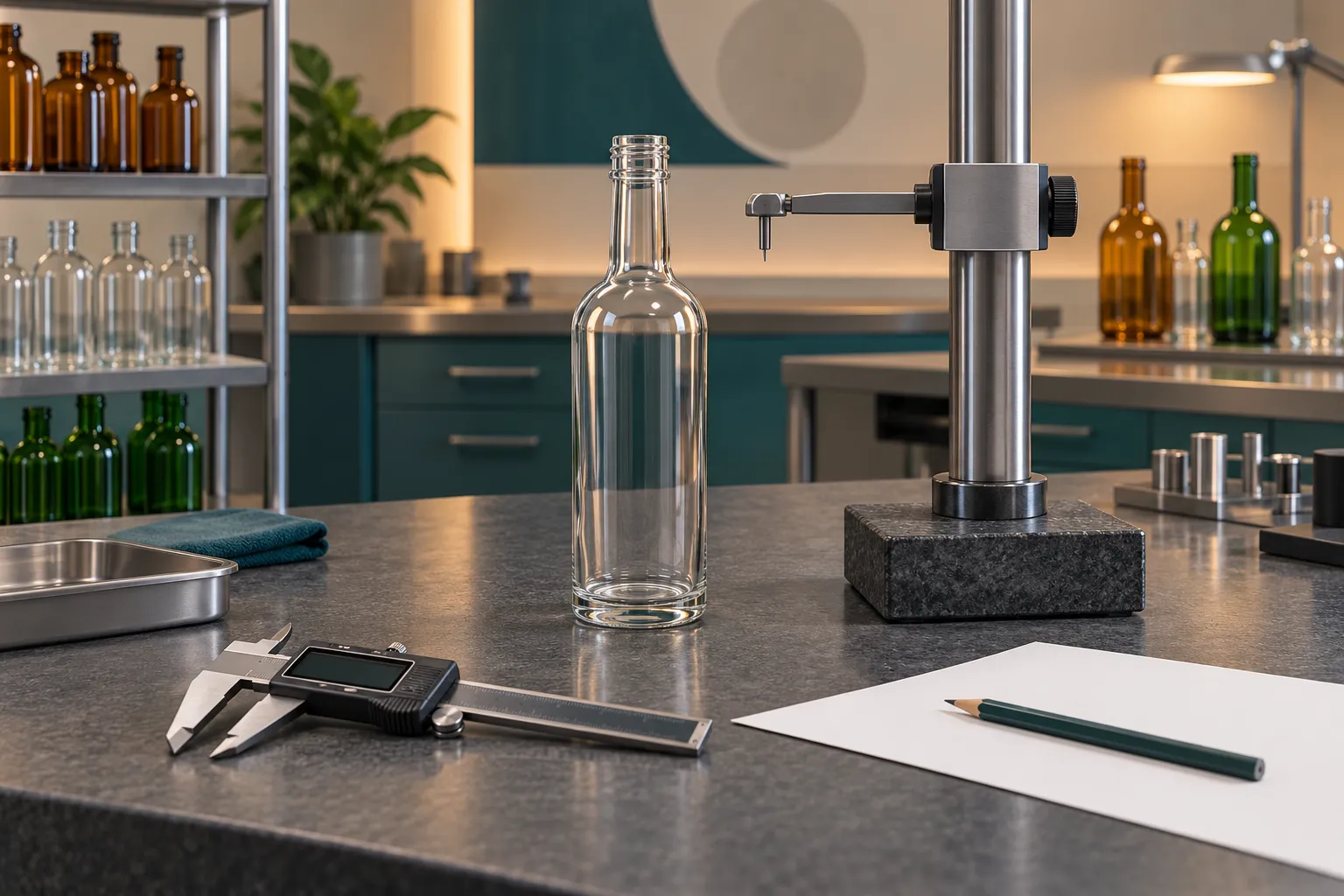
Glass Bottle Specifications: A Checklist for Supplier Enquiries
A checklist of what to state in a glass bottle enquiry: drawing dimensions, capacity and fill point, finish, color, strength, decoration, quality and packing.
Read the guide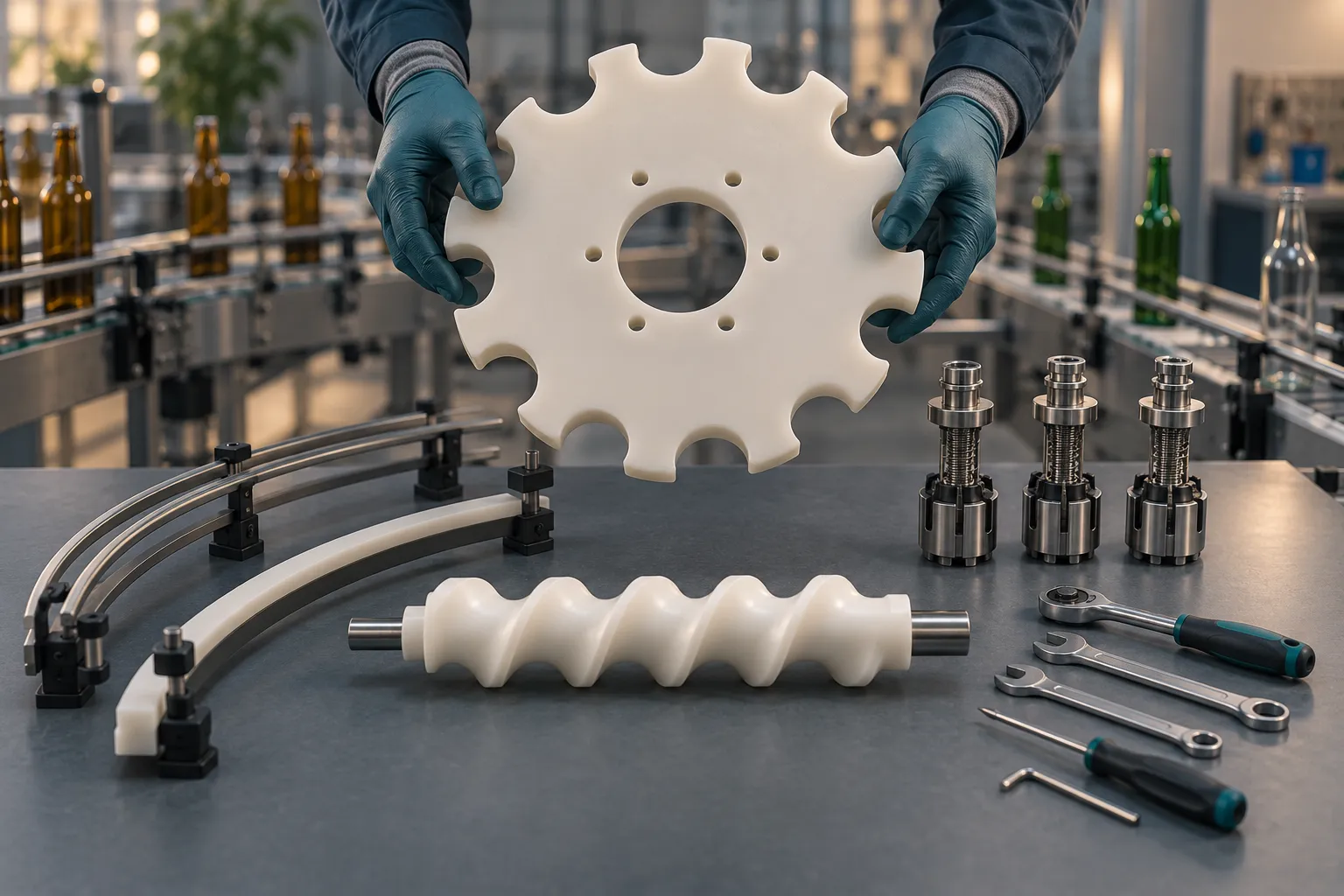
Bottling-Line Changeovers: What to Check Before Adding a New Bottle
Which change parts a new glass bottle touches, which bottle data to check, and how to run and document a trial before the bottle goes into production.
Read the guide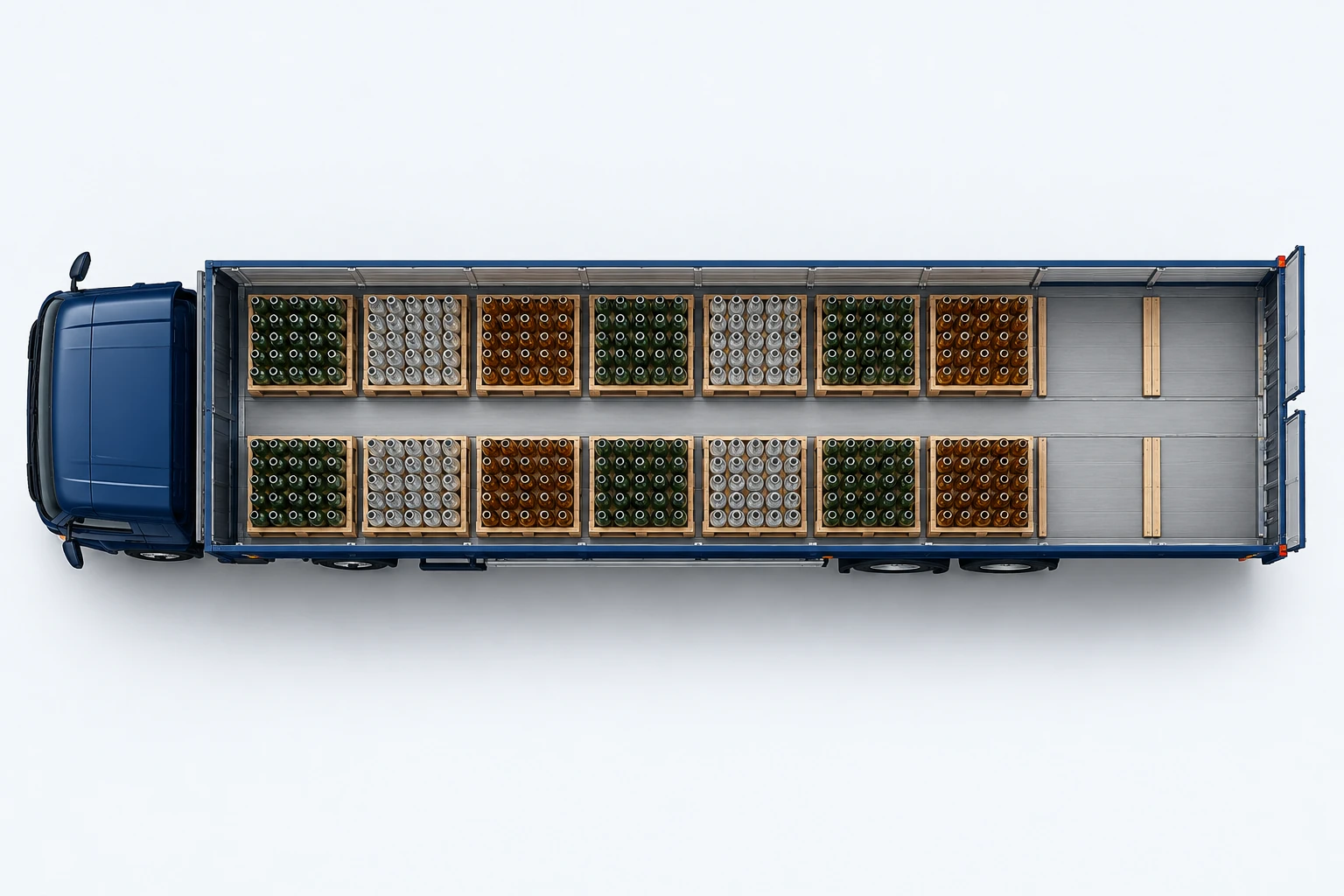
How Many Pallets of Glass Bottles Fit on a Truck?
A 53 ft van takes 26 floor-loaded 48 x 40 pallets, but glass often reaches the weight limit first. How to work out pallet weight and which limit binds.
Read the guide