
Empty Glass Pump Bottles: Neck and Dip Tube
Specify empty glass pump bottles by matching 24/410, 28/410, or 28/400 screw-on pump dispenser collars to glass neck T, E, I, H, and S dimensions and FBOG dip tube lengths.
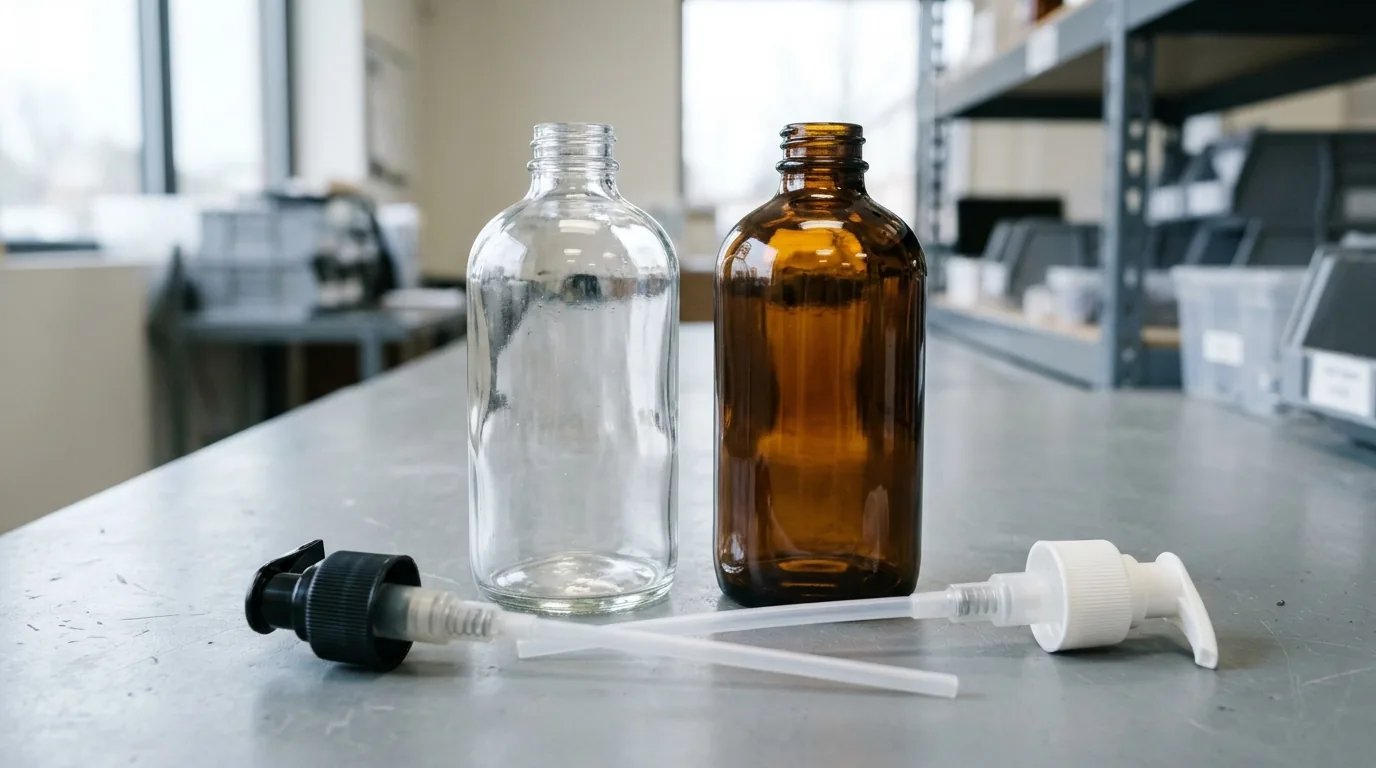
Pairing empty glass pump bottles with a screw on pump dispenser requires matching two coupled mechanical interfaces before releasing tooling or purchase orders: the external thread finish and bore where the pump collar seats (T, E, I, H, and S), and the internal cavity depth where the dip tube draws product (FBOG / S2T relative to the glass floor and base push-up). Ordering by nominal bottle capacity or neck diameter alone leaves packages vulnerable to collar thread run-out, gasket leaks, suction lock against the glass bottom, or axial pump-engine damage on the capping line.
Start by reconciling the split between stock glass bottle catalogs and commercial pump platforms. In North America, stock glass Boston round containers documented in the DWK Life Sciences (WHEATON) Container Guide are blow-molded with 1-turn -400 finishes (20-400, 22-400, 24-400, 28-400, 33-400), whereas personal-care lotion and soap pumps from manufacturers such as Aptar Beauty predominantly target taller 1.5-turn 24/410 and 28/410 finishes. Once the neck finish series and collar skirt geometry match, specify the dip tube cut length from the underside of the gasket (FBOG or S2T) against the glassmaker’s internal base section drawing, and control application torque within glass closure limits (15–21 in-lbs for 20–28 mm polypropylene/polyethylene collars on glass per DWK WHEATON).
Quick specs: what to verify before pairing a glass bottle and pump
Compare the bottle drawing and the complete pump assembly drawing side by side before approving samples. Every dimension must reference an explicit datum on the glass finish or pump gasket.
Swipe or scroll horizontally to see all columns.
| Verification item | Parameters to record | Primary reference or standard | Operational failure prevented |
|---|---|---|---|
| Glass article & glass type | Mold article, nominal capacity (oz / mL), USP <660> Type I borosilicate or Type III soda-lime glass |
DWK Life Sciences (WHEATON) Container Guide | Substituting bottles whose wall thickness alters internal cavity depth |
Neck finish (T, E, H, S) |
Thread OD (T), root OD (E), finish height (H), thread start (S), turns (400 = 1, 410 = 1.5, 415 = 2) |
Drug Plastics & Glass Co. Selected S.P.I. Neck Finish Specifications; Richmond Containers Understand Neck and Closure Dimensions; SGS Bottle 24-410 data; Cetie GME40.07 |
Threading a 24/410 pump onto a 24-400 glass neck where the collar runs out of thread before sealing |
Minimum neck bore (I min) |
Minimum bore (0.404 in on 20 mm, 0.516 in / 13.11 mm on 24 mm, 0.614 in on 28 mm) vs housing and filling tube OD |
Drug Plastics & Glass Co. SPI table; SGS Bottle 24-410 data; Richmond Containers Understand Neck and Closure Dimensions; Cetie GME30.15 (BVP/BVS bore) |
Pump housing binding inside the neck bore or fouling filling nozzles |
| Sealing zone & collar profile | Top-lip, bore, or mixed seal zone; collar compatibility (1N, 2N, 3N, N-Shelled (1+2), N-Screw) |
Cetie Closures and Finishes; Aptar Beauty GS and GSA Collar Options matrices |
Ordering a metal-shelled collar (N-Shelled or N-Screw) on an unsupported 28/400 neck |
Dip tube datum (FBOG / S2T) |
Gasket-to-tip length (FBOG / S2T) vs internal depth, base push-up (punt), and angled tip cut |
Richmond Containers Diptube Terminology; The Cary Company; Berlin Packaging Measuring & Cutting Your Dip Tube | Orifice sealing flat against the glass floor, stranded product, or capping force stressing the pump engine |
| Torque & vertical load | Glass application/removal torque (in-lbs at 5 minutes and 24 hours), planarity, vertical load, anti-unscrewing |
DWK Life Sciences (WHEATON) Torque Table; Cetie DT15.05, DT15.54, DT29.00, DT35.01, GME40.20 (SNI 15); ASTM D2063/D2063M, ASTM D3474, ASTM D7860 |
Breaking the glass container from over-tightening or collar back-off when content lubricates the neck |
For broader container decisions, start with the glass container overview. This guide covers mechanical pump dispensers with dip tubes; bulb-and-pipette serum droppers are covered in the glass dropper bottle guide.
Takeaway: Lock the bottle finish drawing, internal base profile, and complete pump assembly drawing together before evaluating physical samples.
Why do stock glass bottles and 24/410 pumps clash?
The most frequent sourcing error with glass pump bottles comes from assuming that a 24 mm or 28 mm cosmetic lotion pump will seal on a stock 24 mm or 28 mm glass Boston round bottle. As Richmond Containers explains in Understand Neck and Closure Dimensions, Glass Packaging Institute (GPI) and Society of the Plastics Industry (SPI) two-part codes pair the nominal outer diameter in millimeters with a three-digit thread and height series:
400series (1complete thread turn, equivalent to EuropeanR3): Shallow neck height (H) standard on North American stock glass Boston rounds, laboratory bottles, and jars.410series (1.5thread turns): Medium-tall neck height designed for deeper cosmetic pump skirts while providing an extra half-turn of thread engagement.415series (2complete thread turns): Tall neck profile used for deep-skirt closures and European refillable flaconnage screw necks such as CetieGME40.20/GME40.25(SNI 15, based on theGPI 415thread).
In the DWK Life Sciences (WHEATON) Container Guide, most glass containers are manufactured from USP <660> Type I borosilicate or Type III soda-lime glass, and every stock glass Boston round from 1 oz (30 mL) through 32 oz (1000 mL) carries a -400 neck finish:
Swipe or scroll horizontally to see all columns.
| DWK WHEATON article (Clear / Amber) | Nominal capacity | DWK exterior OD × height (mm) |
DWK native glass finish | Specialty Bottle Clear Boston Round pump kit (1–16 oz) |
|---|---|---|---|---|
W216830 / W216865 |
1 oz (30 mL) |
31 × 79 mm |
20-400 |
Treatment pump with transparent cover (BRF1TB / BRF1TW) |
W216831 / W216866 |
2 oz (60 mL) |
39 × 94 mm |
20-400 |
Treatment pump with transparent cover (BRF2TB / BRF2TW) |
W216832 / W216867 |
4 oz (125 mL) |
48 × 112 mm |
22-400 |
Locking lotion style pump (BRF4P / BRF4PW) |
W216833 / W216868 |
8 oz (250 mL) |
60 × 136 mm |
24-400 |
Black or white lotion pump (BRF8P / BRF8PW) |
W216834 / W216869 |
16 oz (500 mL) |
75 × 168 mm |
28-400 |
Black or white lotion pump (BRF16P / BRF16PW) |
W216835 / W216870 |
32 oz (1000 mL) |
94 × 206 mm |
33-400 |
Not in Specialty Bottle pump kit series (33-400 cap in DWK) |
Compare those stock -400 glass finishes against Drug Plastics & Glass Co.’s Selected S.P.I. Neck Finish Specifications for Standard Closures. Within any nominal diameter (18 mm through 33 mm), the 400, 410, and 415 series share identical thread crest diameter (T), thread root diameter (E), start-of-thread distance (S), minimum internal bore (I min), and thread pitch (THDS./IN.), changing only the finish height (H):
Swipe or scroll horizontally to see all columns.
Finish size (mm) |
Thread OD T (in, Max–Min) |
Root OD E (in, Max–Min) |
400H height (in, 1 turn) |
410H height (in, 1.5 turns) |
415H height (in, 2 turns) |
Start S (in, Max–Min) |
Min bore I (in) |
Threads per inch (TPI) |
|---|---|---|---|---|---|---|---|---|
18 mm |
0.704–0.688 |
0.62–0.604 |
0.386–0.356 |
0.538–0.508 (13.28 mm nom.) |
0.632–0.602 |
0.052–0.022 |
0.325 |
8 |
20 mm |
0.783–0.767 |
0.699–0.683 |
0.386–0.356 |
0.569–0.539 (14.07 mm nom.) |
0.757–0.727 |
0.052–0.022 |
0.404 |
8 |
22 mm |
0.862–0.846 |
0.778–0.762 |
0.386–0.356 |
0.6–0.57 |
0.852–0.822 |
0.052–0.022 |
0.483 |
8 |
24 mm |
0.94–0.924 (23.67 ± 0.20 mm) |
0.856–0.84 (21.54 ± 0.20 mm) |
0.415–0.385 |
0.661–0.631 (16.41 mm nom.) |
0.972–0.942 |
0.061–0.031 (1.17 mm nom.) |
0.516 (13.11 mm) |
8 |
28 mm |
1.088–1.068 |
0.994–0.974 |
0.415–0.385 |
0.723–0.693 (17.73 mm glass dwg) |
1.097–1.067 |
0.061–0.031 |
0.614 |
6 |
33 mm |
1.265–1.241 |
1.171–1.147 |
0.418–0.388 |
Not listed in SPI table | 1.289–1.259 |
0.061–0.031 |
0.791 |
6 |
Source note: Inch Max–Min ranges and TPI are from Drug Plastics & Glass Co.; metric values in parentheses for 24-410 (T = 23.67 ± 0.20 mm, E = 21.54 ± 0.20 mm, I min = 13.11 mm, H = 16.41 mm, S = 1.17 mm, giving a single-side thread depth (T − E) / 2 = 1.065 mm across 1.5 turns) and the 410-series nominal heights (13.28 mm at 18 mm, 14.07 mm at 20 mm, 16.41 mm at 24 mm, and 17.73 mm on the glass 28-410 drawing) are from SGS Bottle.
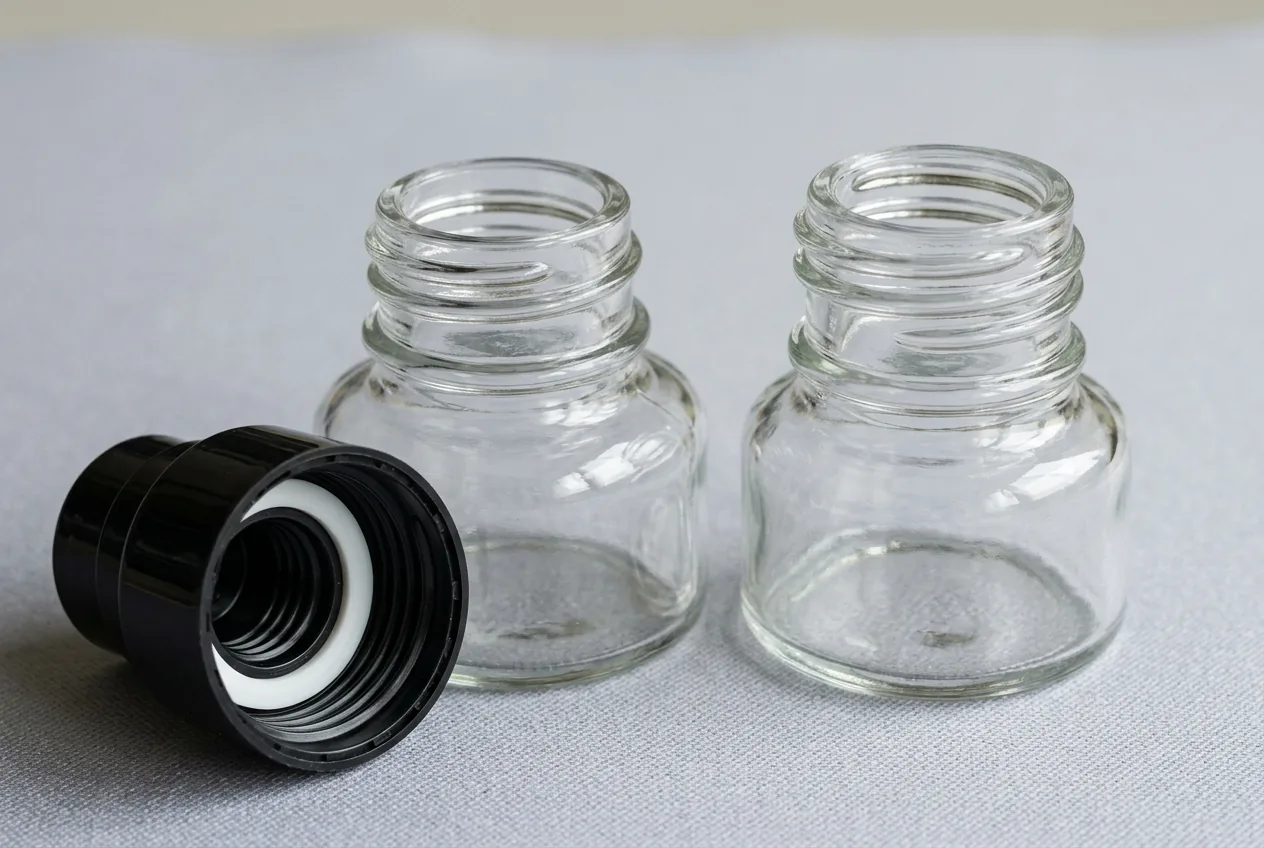
Why a pump 24/410 fails on a 24-400 glass bottle: Because 24-400 and 24/410 share the same T (0.94–0.924 in), E (0.856–0.84 in), and 8 TPI pitch, a 24/410 collar begins threading onto a 24-400 glass neck. However, 24/410 (H = 0.661–0.631 in) is 0.246 in (6.25 mm) taller than 24-400 (H = 0.415–0.385 in). If bottle finish height H < 0.631 in on a 24 mm glass neck → choose a 24-400 closure/pump rather than a 24/410 deep-skirt pump. As ProPacks (Closure Torque Guide) and SGS Bottle document, a 24/410 pump on a 24-400 bottle runs out of thread before the gasket seats against the top sealing surface. Review our neck finish and closure compatibility guide and Boston round glass bottle neck finish guide when checking stock -400 bottles.
Takeaway: Never pair a 24/410 or 28/410 pump with a -400 glass bottle; match both the diameter and the three-digit finish height code (-400 vs -410).
How do OEM screw-on pump platforms and collars map to glass necks?
When specifying a commercial screw on pump dispenser for a glass container, either select a pump platform offered in a -400 finish (such as 28/400 on Aptar Future, GS, or GSA, or a -400-compatible treatment or lotion pump) or source a cosmetic glass bottle mold blown to a 24/410 or 28/410 finish drawing.
Published specifications from Aptar Beauty show how neck finish availability, dosage, fluid pathway, and collar options vary across specific pump models:
Swipe or scroll horizontally to see all columns.
| Pump platform (Aptar Beauty) | Published doses | Supported neck finishes | Pathway & collar architecture | Glass bottle engineering notes |
|---|---|---|---|---|
| Aptar Future | 1.4 cc, 2 cc |
24/410, 28/400, 28/410 |
Mono-material polyethylene (PE); locking ring + 360° free-spinning actuator (Amazon ISTA-6 Overbox compliant) |
Fits 28/400 glass; Cyclos-HTP / APR recyclability applies only on PE or PET bottles—unscrew PE pump before glass recycling |
| Aptar GS | 1.2 cc, 2 cc |
28/400, 24/410, 27 mm Snap On, 24/410 Rachet, 24/415, 28/410, 28/415 |
Screw or snap collars across 1N, 2N, 3N, N-Shelled (1+2), and N-Screw |
Covers 28/400, 24/410, and 28/410 screw finishes, plus 24/410 Rachet |
| Aptar GSA | 1.2 cc, 2 cc |
24/410, 24/410T, 24/415, 27/30 Snap On, 28/400, 28/410, 28/410T, 28/415 |
Metal-free pathway (spring outside dosage chamber so formula avoids metal contact) | Used on Guerlain’s L’Art & La Matière refillable bottles with a screw-on twist-to-lock anodized collar |
| Aptar GSA Luxe | 1.2 cc, 2 cc |
28/410 only (EMEA) |
Metal-free pathway with 65g Zamac-finished actuator and collar (gold, light gold, silver, black) |
Designed for refillable glass, aluminum, or ceramic/porcelain bottles on 28/410 only |
| Aptar Satine (L’Occitane custom) | 500 μl (0.5 ml) |
24/410 screw-on |
Custom oversized glossy black collar on Satine platform with technical orientation system |
Built for L’Occitane-En-Provence’s 350 ml and 500 ml refillable glass and plastic bottles; aligns unlocked actuator with bottle front |
Within Aptar Beauty’s GS and GSA families, collar geometry restricts compatible neck finishes:
1N(Cylindrical Smooth):28/410,28/415,27/230(not offered in24/410or28/400).2N(Stepped Smooth):24/410,24/415,28/400,28/410.3N(Stepped Ribbed):24/410,24/415,28/400,28/410,28/415.N-Shelled (1+2)(Metal Shell — Smooth or Stepped):24/410and28/410only.N-Screw(Metal Shell Available):24/410only.
For European perfumery and cosmetic glass flaconnage, Cetie specifies GME40.07 (CV 13, CV 15, CV 17, CV 18, and CV 20 screw pump finishes) alongside GME40.20 (without bead) and GME40.25 (with bead) for sustainable 13, 15, and 17 mm refillable screw necks (such as SNI 15) based on the GPI 415 thread. See our analysis of the Aptar 24/410 refillable glass pump notes for refill qualification checks.
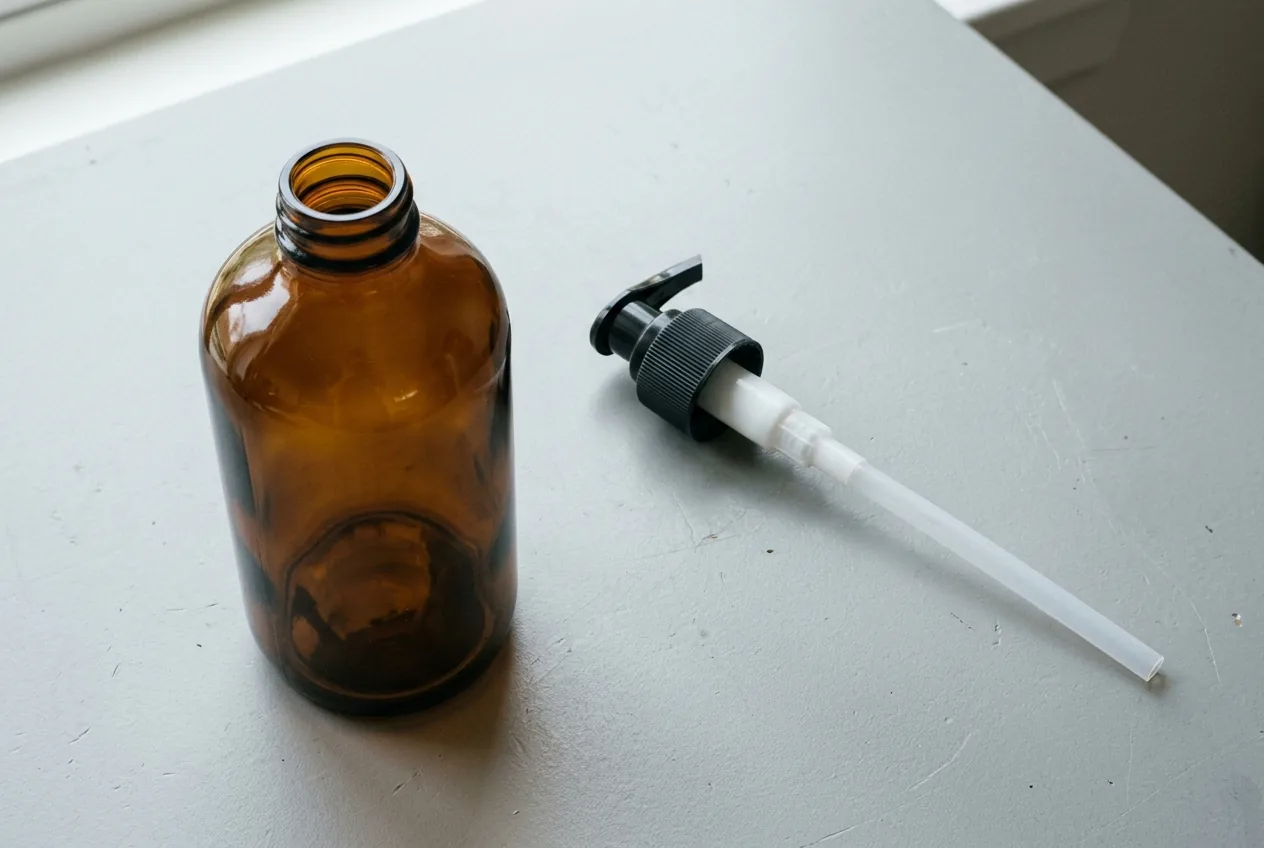
Takeaway: Verify that the chosen collar profile (1N, 2N, 3N, or metal-shelled) is actually tooled for your bottle’s exact finish code before locking aesthetic specifications.
How do you specify dip tube length (FBOG / S2T) and tip cut for glass bottles?
A pump dispenser’s dip tube length cannot be specified by quoting exterior bottle height or measuring only the tubing visible below the cap. In Diptube Terminology, Richmond Containers defines the four measurement conventions used across pump drawings:
Swipe or scroll horizontally to see all columns.
| Dip tube datum | Full name | Measurement endpoints | Relevance to glass pump bottles |
|---|---|---|---|
FBOG |
From Base Of Gasket | Underside of gasket to distal tip of dip tube | Primary standard; gasket seats on top glass sealing land, mapping directly to internal depth |
S2T |
Seal To Tip | Underside of seal to tip of dip tube (same as FBOG) |
Used interchangeably with FBOG on pump drawings |
LB |
Length Below | Measured from the tip of the dip tube to the underside of the collar | Uses the underside of the collar rather than the underside of the seal (FBOG / S2T) |
Exposed |
Exposed length | Visible portion of dip tube below pump housing | Ignores tube hidden inside housing/collar; Berlin Packaging warns to measure the entire length starting at the gasket rather than just the tube itself |
As Richmond Containers notes, while S2T (FBOG) tracks bottle height, five factors require length adjustment:
- Very thick or inflexible dip tubes;
- Bottles with a large push-up (
punt) on the base; - Thick, viscous products requiring an unrestricted orifice;
- Straight versus bent dip tube profile choice;
- Filling-line automation requirements.
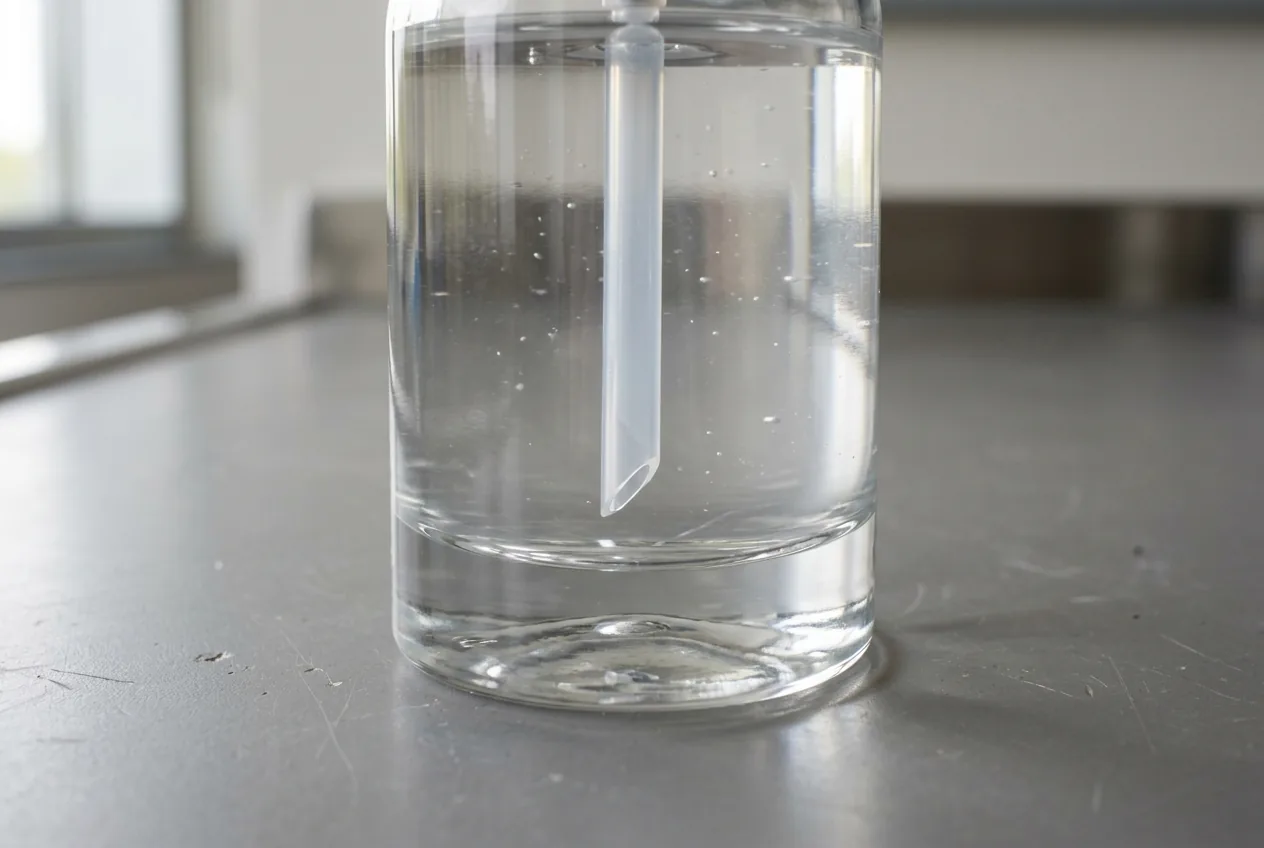
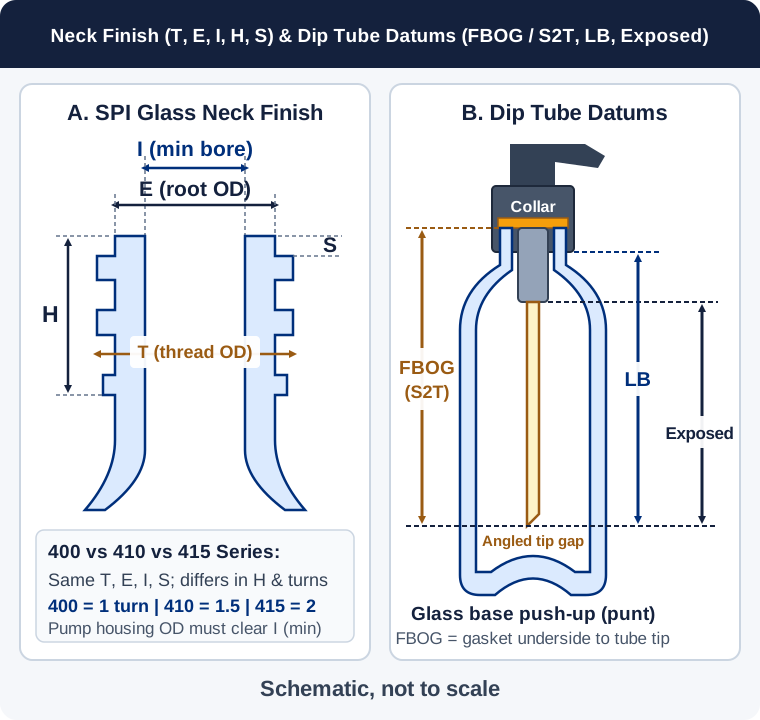
Choosing between straight-hang clearance and curved corner reach
The Cary Company (How to Measure a Dip Tube for the Right Length) and Berlin Packaging (Measuring & Cutting Your Dip Tube for Optimal Dispensing) separate dip tube geometry into two functional profiles:
- Profile 1 — Straight hang with angled cut (
Berlin Packaging Option 1; rigid high-viscosity pumps inThe Cary Company): Berlin Packaging’sOption 1cuts the dip tube at an angle with a slight gap between the tube and the bottle base, and warns never to cut the tube flush with the base. As The Cary Company documents, rigid dip tubes on pumps for thicker or high-viscosity products (such as lotion or condiments) must sit straight in the product with a small space above the container bottom and never touch or sit flush on the base. - Profile 2 — Curved corner reach with angled cut (
Berlin Packaging Option 2; flexible sprayer tubes inThe Cary Company): Berlin Packaging’sOption 2cuts the tube at an angle long enough to bend toward the bottle sidewall. As The Cary Company specifies, thinner dip tubes on sprayers bend slightly toward the container wall by adding about1 inchto the bottle height.
Three mechanical failure modes of mis-specified dip tubes
When stock distributor pumps—shipped with uncut dip tubes sized for the tallest bottles that must be trimmed for shorter bottles, as noted in Specialty Bottle’s Clear Boston Round catalog—or FBOG drawings are mis-specified, three failures occur (Richmond Containers; The Cary Company; Berlin Packaging):
- Orifice starvation (
FBOGtoo long or flat cut): The tip presses against the glass floor orpuntdome, sealing the orifice so viscous product cannot enter. - Excessive capping force and pump engine failure (
FBOGtoo long on automated lines): An overly long rigid tube hits the glass floor before threads engage, requiring excessive downward push force to seat the pump and stressing the pump engine to failure (Richmond Containers). - High stranded residual (
FBOGtoo short): SpecifyingFBOGfromExposedtube length leaves product stranded below the intake tip.
Takeaway: Specify dip tube length using FBOG (S2T) with an angled tip cut, and verify internal clearance above the glass base punt on the bottle section drawing.
What torque and bore clearances protect glass necks on the filling line?
In the DWK Life Sciences (WHEATON) Container Guide, glass containers have higher recommended application and minimum removal torques than plastic containers of the same diameter, and DWK WHEATON warns that if a screw closure is applied too tightly, it may be too difficult to remove, or the glass container could break during application.
DWK WHEATON specifies recommended application and minimum removal torques (in in-lbs, checked about 5 minutes after application and maintained after 24 hours) across 15 mm to 33 mm finishes:
Swipe or scroll horizontally to see all columns.
Closure diameter (mm) |
Phenolic / Urea on Glass (App / Min Rem in-lbs) |
Phenolic / Urea on Plastic (App / Min Rem in-lbs) |
Polypropylene / Polyethylene (PP/PE) on Glass (App / Min Rem in-lbs) |
Polypropylene / Polyethylene (PP/PE) on Plastic (App / Min Rem in-lbs) |
|---|---|---|---|---|
15 mm |
8 / 4 |
6 / 3 |
12 / 7 |
8 / 4 |
20 mm |
10 / 5 |
8 / 4 |
15 / 9 |
10 / 5 |
24 mm |
12 / 6 |
10 / 5 |
18 / 11 |
12 / 6 |
28 mm |
14 / 7 |
12 / 6 |
21 / 12 |
14 / 7 |
33 mm |
18 / 9 |
15 / 7 |
24 / 14 |
17 / 8 |
For polypropylene (PP) and polyethylene (PE) pump collars on glass, the PP/PE on Glass column (15 / 9 in-lbs at 20 mm, 18 / 11 in-lbs at 24 mm, 21 / 12 in-lbs at 28 mm) sets the reference baseline, while Cetie DT29.00 notes that exact production torques must be confirmed with closure and liner manufacturers. Pair these torque limits with four filling-line controls:
- Torque retention and meter calibration (
ASTM D2063/D2063M,ASTM D3474, &ASTM D7860): Use torque meters calibrated underASTM D3474and verify torque retention over time underASTM D2063/D2063M(withASTM D7860covering automated torque testing for continuous-thread packages, per ProPacks). - Self-unscrewing from neck lubrication (
Cetie GME40.20/GME40.25): CetieGME40.20andGME40.25(SNI 15) add molded glassrice grainson the neck to limit the risk of self-unscrewing from neck lubrication by the content (beadlessGME40.20is not compatible with heavy bottles without glassmaker validation). - Finish planarity and vertical capping load (
Cetie DT15.05,DT15.06,DT15.54,DT35.01): Verify tolerances under CetieDT02.00andDT15.00–DT15.06(ISO 12818) for capacity, height, finish planarity (DT15.05/DT15.51), mouth-base parallelism (DT15.06/DT15.52), and vertical capping load resistance (DT15.54,DT35.01). - Through-bore clearance (
I min) (Cetie GME30.15): Minimum neck bore (I min = 0.404 inon20 mm,0.516 in/13.11 mmon24 mm,0.614 inon28 mmper Drug Plastics & Glass Co. and SGS Bottle) limits submerged pump housing OD and filling nozzle tube OD (Richmond Containers; CetieGME30.15forBVPandBVSminimum through-bore harmonization). See our glass bottle filling machines guide and capping equipment guide.
Takeaway: Set capper clutches to the glass-specific PP/PE torque window (15–21 in-lbs across 20–28 mm) and verify I min bore clearance before ordering line tooling.
Pre-order specification checklist for glass bottle and pump suppliers
Send the same drawing package to the glass supplier, pump manufacturer, and contract packager so all three parties sign off on identical datums. Use our bottle specification checklist and stock vs. custom glass bottles guide to structure the commercial inquiry.
Swipe or scroll horizontally to see all columns.
| Specification record | Exact fields to lock before ordering | Responsible party |
|---|---|---|
| 1. Glass finish drawing | Full SPI/GPI or Cetie code (20-400, 24-400, 24/410, 28-400, 28/410, or GME40.07 / GME40.20), T, E, I min, H, S tolerances, top sealing land (Cetie DT15.05), and glass type (USP <660> Type I or Type III) |
Glass container supplier |
| 2. Internal cavity & punt drawing | Sealing-land-to-inside-base depth at center axis (punt crest) and outer heel, plus bottom thickness and height tolerance (Cetie DT02.00 / DT15.02) |
Glass container supplier |
| 3. Pump & collar drawing | Pump model, dose (0.5 ml, 1.2 cc, 1.4 cc, 2 cc), pathway type (standard vs metal-free), collar code (1N, 2N, 3N, N-Shelled, N-Screw), gasket material, and housing OD vs I min |
Pump dispenser supplier |
| 4. Dip tube specification | FBOG (S2T) length with tolerance, tube stiffness, hang profile (straight hang vs curved corner reach), and angled bevel tip cut |
Pump supplier & brand engineer |
| 5. Line qualification | Filling nozzle OD vs I min (Richmond Containers; Cetie GME30.15 for BVP/BVS), dip tube insertion force check, application torque (15–21 in-lbs for 20–28 mm PP/PE on glass per DWK WHEATON), and 5-minute / 24-hour removal torque check (ASTM D2063/D2063M, ASTM D3474, ASTM D7860) |
Contract packager / bottling line engineer |
Takeaway: Require written sign-off on the paired bottle finish drawing, internal punt section, and FBOG dip tube specification before releasing production orders.
Frequently asked questions
Will a 24/410 pump fit a 24-400 glass Boston round bottle?
No. Although 24-400 and 24/410 share the same thread crest (T = 0.94–0.924 in / 23.67 ± 0.20 mm), thread root (E = 0.856–0.84 in / 21.54 ± 0.20 mm), and 8 TPI pitch in Drug Plastics & Glass Co. and SGS Bottle data, 24/410 uses 1.5 turns (H = 0.661–0.631 in / 16.41 mm nominal) while 24-400 uses 1 turn (H = 0.415–0.385 in). As SGS Bottle and ProPacks document, a 24/410 pump on a 24-400 bottle runs out of thread before the gasket compresses against the top sealing surface.
How do FBOG, S2T, LB, and Exposed dip tube measurements differ?
Per Richmond Containers (Diptube Terminology), FBOG (From Base Of Gasket) and S2T (Seal To Tip) both measure from the underside of the gasket to the tip of the dip tube. LB (Length Below) measures from the underside of the collar skirt to the tip, while Exposed measures only the visible tube below the housing. Specify FBOG (S2T) because the gasket seats directly on the glass sealing land.
Should a glass pump bottle dip tube hang straight or curve into the bottom corner?
As The Cary Company and Berlin Packaging explain, rigid dip tubes on pumps for thicker or high-viscosity products such as lotion or condiments must hang straight with a small clearance gap above the glass bottom and an angled tip cut so the tube never sits flush against the base. Thin, flexible dip tubes on mist sprayers are cut slightly longer than bottle height (about 1 inch on tall bottles per The Cary Company) with an angled tip to curve into the lower corner.
Does a mono-material PE pump make a glass pump bottle fully recyclable?
No. Aptar Beauty’s Future mono-material polyethylene (PE) pump is certified by Cyclos-HTP and meets APR Preferred Guidance for full recyclability only when paired with a PE or PET bottle.
Related guides

Bottle Neck Finishes and Closure Compatibility
How to read finish designations such as 28-400 and the T, E, I, H and S dimensions, and why a matching nominal diameter does not prove a closure fits.
Read the guide
Boston Round Glass Bottles: Neck Finishes and Stem Selection
Specify Boston round glass bottles using catalog finish designations, bottle and assembly drawings, and documented dropper or pump stem geometry.
Read the guide
Glass Bottle Filling Machines: How to Compare Filling Principles
Compare gravity, vacuum, counter-pressure, piston and flowmeter filling for glass bottles by product, container and line fit, and learn what to ask suppliers.
Read the guide