
Boston Round Glass Bottles: Neck Finishes and Stem Selection
Specify Boston round glass bottles using catalog finish designations, bottle and assembly drawings, and documented dropper or pump stem geometry.
Choosing Boston round glass bottles by neck finish alone can leave a filled pack leaking or unable to dispense. Specify the bottle article, complete neck finish and installed dispensing assembly together, using retrieved catalogs to identify candidates and drawings to establish fit.
Boston round glass bottles describe a shape family, not a universal neck finish or dispensing package. Begin with the selected bottle’s catalog reference, capacity, material and full finish designation. Then obtain the bottle section and the complete dropper or pump drawing, including the stem’s installed projection from the seated closure. A matching finish identifies an interface to investigate; it cannot establish internal depth, stem clearance or product pickup. Approve the assembled pack with its intended liquid and process before treating a component substitution as routine.
Quick specs: what defines the Boston round you need?
Specify each component explicitly. The rounded shoulders and circular body help identify the family, while the actual dimensions and finish belong to the chosen article.
Swipe or scroll horizontally to see all columns.
| Input or item | Value or source to record | Why it matters |
|---|---|---|
| Bottle identity | Manufacturer article and drawing revision | Makes the specification reproducible |
| Capacity and fill point | Catalog capacity plus product fill requirement | Capacity does not establish stem reach |
| Full finish | Bottle and closure catalog/drawing references | Prevents matching by nominal diameter alone |
| Internal geometry | Usable depth and minimum passage on the bottle section | Locates the stem and its insertion envelope |
| Dispensing assembly | Closure, seal, bulb or pump, and stem references | Identifies the whole installed package |
| Stem datum | Drawing definition of loose length and installed projection | Prevents comparing unlike measurements |
| Product and process | Compatibility, filling, closing and use conditions | Connects drawing approval with actual operation |
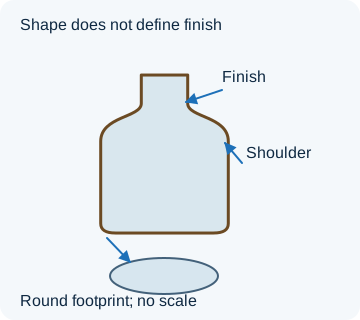
Use the glass container overview to settle the broader container decisions. The neck finish and closure guide explains finish terminology and drawing dimensions; retain that explanation as the reference rather than substituting a shape-specific shortcut.
Which neck finishes do retrieved catalog rows support?
Only the finish printed for the selected article is a supported starting point. A useful example comes from the DWK WHEATON Container Guide, printed page 3, PDF page 6, retrieved October 19, 2026. Its Boston Round Bottle table lists these clear, uncapped bottles; the catalog marks the capacities as approximate.
Swipe or scroll horizontally to see all columns.
| Catalog article | Approximate capacity | Listed cap-size designation |
|---|---|---|
| W216830 | 30 mL | 20-400 |
| W216831 | 60 mL | 20-400 |
| W216832 | 125 mL | 22-400 |
These are examples from a particular catalog, not a universal capacity-to-finish chart. The finish codes are designations, not measurements of usable bore. The table does not identify a compatible pump or supply installed pipette dimensions.
Formula: R = capacity_B / capacity_A.
Worked example: comparing catalog rows W216831 and W216830, R = 60 mL / 30 mL = 2, a dimensionless editorial calculation from the approximate capacities on the cited page, retrieved October 19, 2026. The quotient is not printed in the catalog. It shows that capacity can double while the listed finish remains the same; it establishes no stem-length ratio.
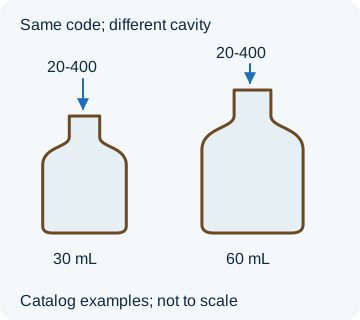
That is the practical reason to keep finish fit and stem reach as separate checks. Reusing a closure family after changing bottle capacity may be a reasonable candidate decision, but the bottle section and installed assembly still need review.
What changes between a screw cap, dropper and pump?
Each closure adds a different functional requirement below or at the neck. Compare those requirements before accepting a catalog match.
Swipe or scroll horizontally to see all columns.
| Assembly | Evidence needed beyond bottle shape | Dominant Failure Mode & Prevention |
|---|---|---|
| Plain screw cap | Full finish, sealing design and liner compatibility | Cap turns but seal is unsuitable; review bottle and closure drawings together |
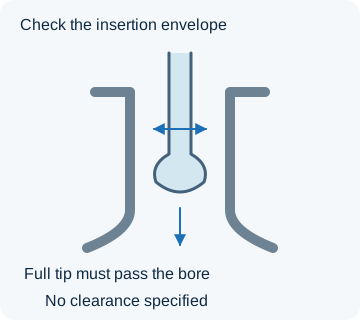
| Bulb-and-pipette dropper | Collar/seal fit, pipette passage and installed projection | Stem interferes with neck or base; check the full tip envelope and seated assembly |
| Pump with dip tube | Finish, sealing arrangement, tube datum and product compatibility | Wrong installed reach or restricted inlet; validate the documented assembly in filled samples |
| Replacement dispenser | Traceable reference to the approved component combination | Similar appearance hides changed geometry; reopen affected drawing and sample checks |
The glass dropper bottle guide develops the bulb, pipette and liquid checks. A pump needs its own supplier documents; a dropper catalog does not establish pump tube dimensions or dosing performance.
How do you set the installed stem boundary?
Compare the usable bottle depth with the stem projection from the same seated-closure datum. External bottle height and loose stem length use different reference points and should not be subtracted as though they describe the same space.
Let A be usable internal depth in millimeters and X be installed stem projection in millimeters, both taken from compatible drawings at the closure seat. Threshold rule: If A < X under the fully seated assembly condition → choose a shorter supplier-approved stem or a revised assembly because the nominal tip projects beyond the usable cavity. This is a geometric interference screen. The required positive clearance and worst-case tolerances remain assembly-specific and must come from the suppliers.
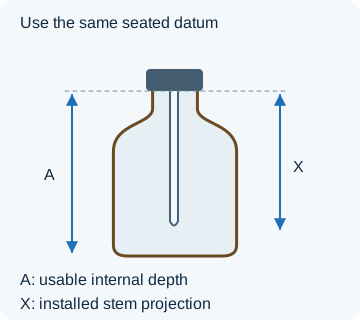
After checking the nominal geometry, review its extremes. The relevant question is whether the bottle, closure seating and stem variations can combine to consume the approved clearance. Ask the suppliers to identify the limiting combination and the acceptance record; do not invent a general allowance. For a flexible dip tube, also obtain the intended end cut and installed path rather than applying a rigid-pipette model to it.
What does a published stem-length range tell you?
A range identifies catalog capability, not an approved stem for your bottle. Glass Dynamics’ Glass Pipettes catalog, retrieved October 19, 2026, lists 34–160 mm in the Length row of its 5 mm borosilicate, straight-tip category. The category name does not establish a measured bottle opening or a finished assembly clearance.
If the required loose stem length is below 34 mm for that specific straight-tip category → choose a separately documented component option because the retrieved range does not cover the requirement. This catalog boundary does not select a length inside the range. The supplier must still identify the actual part, its dimensional definition and its installed position.
An unscaled product photograph cannot resolve these questions. Neither can a bottle-volume label. Keep pump stem length unspecified until the relevant pump drawing or catalog has actually supplied it.
When does a substitution require rework?
Reopen the affected approval whenever the bottle article, closure seating, stem, seal or product changes. The rework boundary is the documented assembly, not the name “Boston round.”
Return to the bottle specification checklist when a proposed replacement lacks a matching drawing reference. If the format changes on the line, use bottle changeovers to review handling and setup alongside the package checks. A component that works in a hand-closed sample still needs evaluation under the intended filling and closing conditions.
Include the hidden work in the comparison: sorting mixed component references, holding incoming stock, rebuilding samples, repeating leak or dispensing evaluations, and resetting insertion or closing equipment. Record actual labor, rejected components and production interruption before assigning a cost. A low component price does not reveal whether the combination will require those activities.
Method and sources
The DWK catalog supplies the article-specific capacity and finish examples. Glass Dynamics supplies the stated loose-pipette range. Both were retrieved October 19, 2026; neither document establishes compatibility between those bottles and those pipettes. The capacity quotient and installed-geometry screening rule are editorial reasoning, with no invented internal dimensions, tube tolerances or package test results.
Related guides

Bottle Neck Finishes and Closure Compatibility
How to read finish designations such as 28-400 and the T, E, I, H and S dimensions, and why a matching nominal diameter does not prove a closure fits.
Read the guide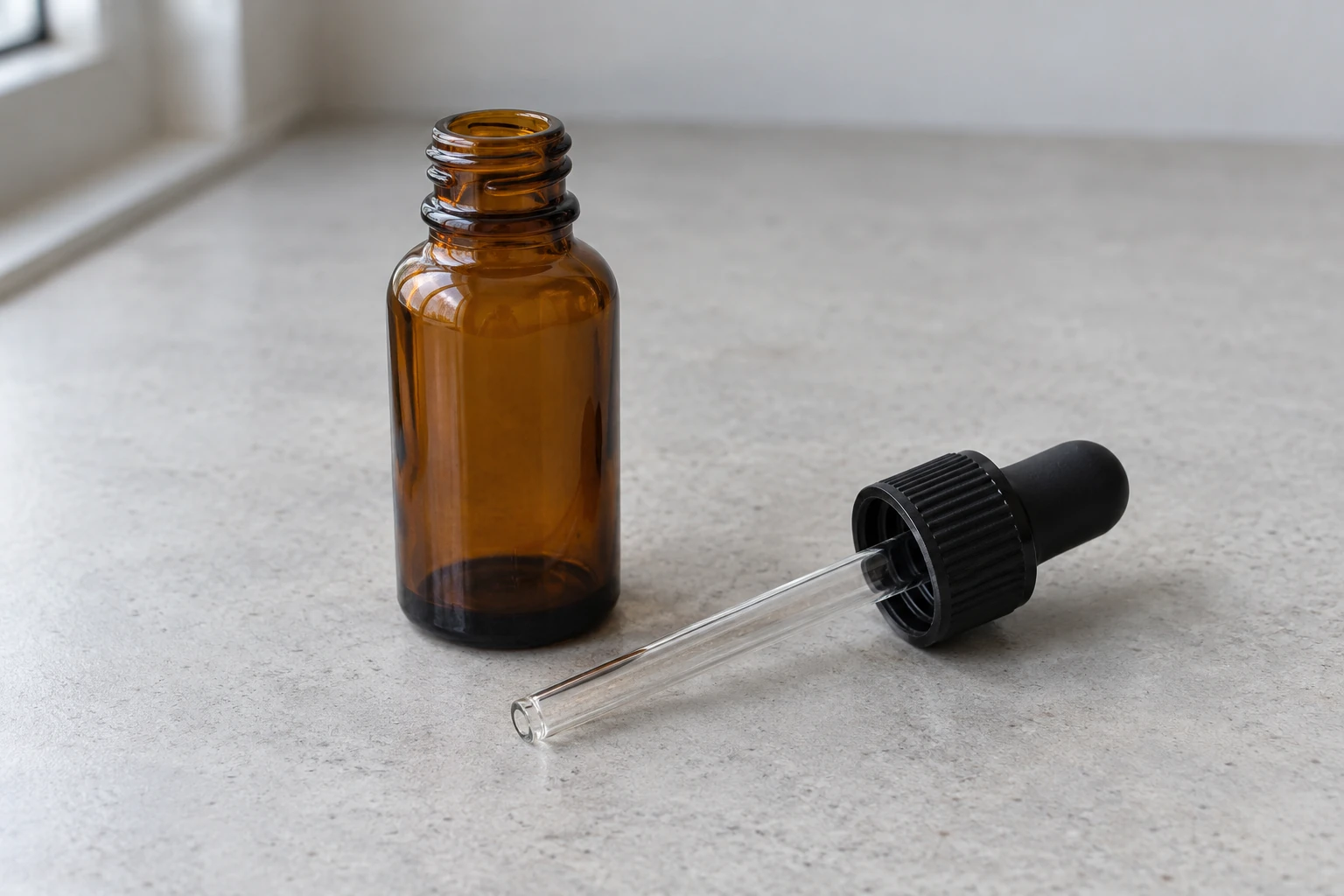
Glass Dropper Bottles: Matching Bottle, Pipette and Product
Choose glass dropper bottles by checking the finish, pipette length and diameter, bulb material, fill level and sample results before a bottling-line trial.
Read the guide
Glass Bottle Specifications: A Checklist for Supplier Enquiries
A checklist of what to state in a glass bottle enquiry: drawing dimensions, capacity and fill point, finish, color, strength, decoration, quality and packing.
Read the guide