
Counter Pressure Bottle Filler: CO2 Cycle
A counter pressure bottle filler uses CO2 purge, equalized backpressure, and slow snift to keep carbonation in glass bottles and minimize oxygen pickup.
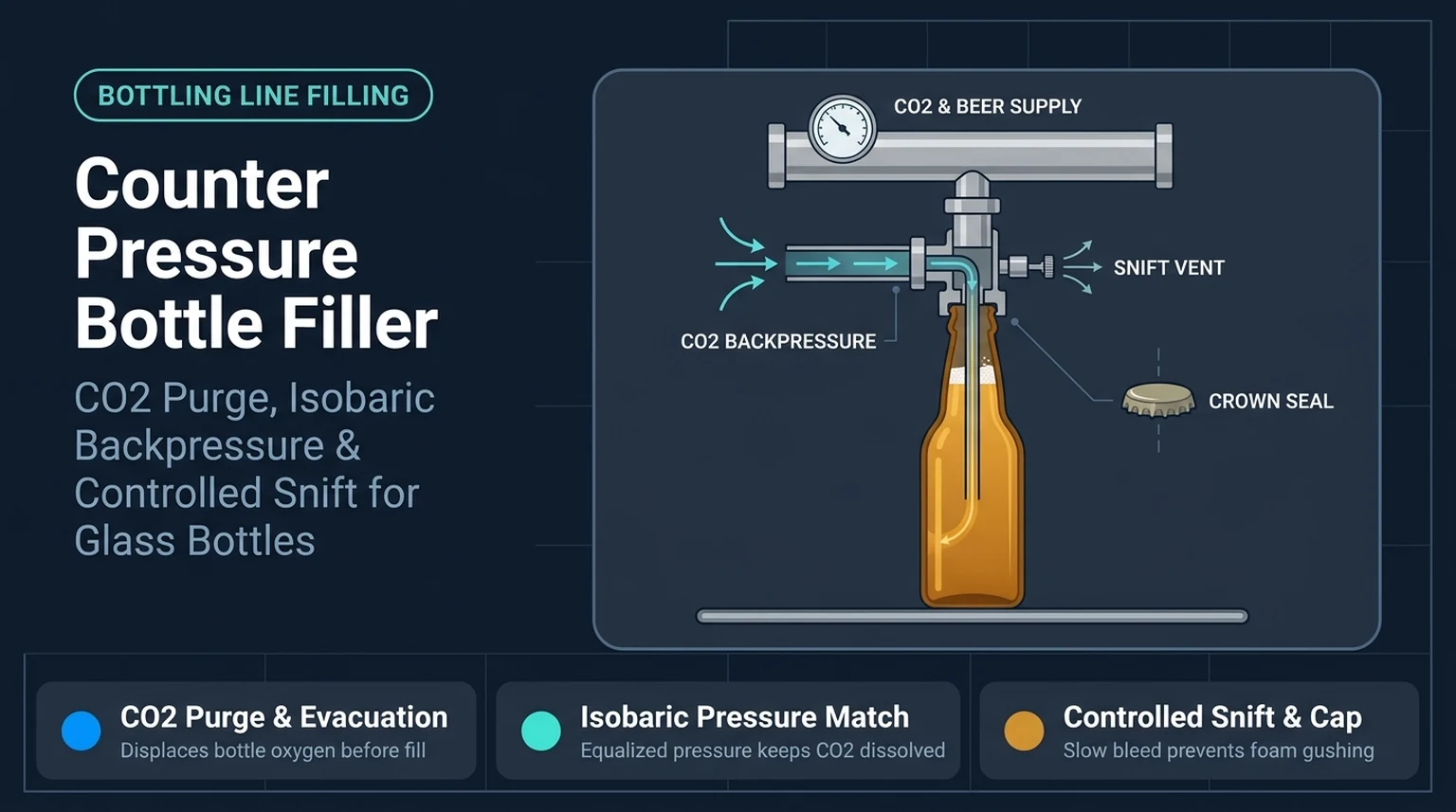
A counter pressure bottle filler seals a glass bottle, flushes air out with heavier carbon dioxide, equalizes bottle pressure to match supply conditioning pressure (commonly 8 to 12 psi for beer), transfers chilled liquid from the bottom under gentle differential pressure, and vents slowly before crowning to retain carbonation and minimize oxygen exposure.
This guide covers the pressure mechanics, foaming failure modes, container strength ratings, and oxygen controls specific to counter-pressure filling on glass bottling lines. For non-carbonated gravity, vacuum, piston, and flowmeter principles, compare glass bottle filling machines. For downstream stabilization, crowns, and inspection across an entire beer bottling line, review the dedicated brewery line guide.
How does a counter pressure bottle filler operate without foaming over?
Preventing foam-over on a counter pressure bottle filler starts with keeping beer cold around 32 °F and equalizing bottle gas pressure with the supply tank before liquid enters. Cracking the bleeder valve slowly holds roughly a 3 psi pressure difference for a calm fill, followed by closing every valve before detaching the head.
Unlike bottle conditioning—which adds priming sugar and leaves yeast sediment inside the finished bottle—a counter-pressure setup transfers already conditioned, carbonated beer or sparkling cider straight from a pressurized vessel into clear, sediment-free bottles. Commercial tank-to-bottle workflows commonly pair a pressurized stainless-steel carbonating tank with a sterile filter upstream of the counter-pressure filler, as outlined in the University of Vermont Extension commercial cider production guide.
Step-by-step valve sequence and pressure balance
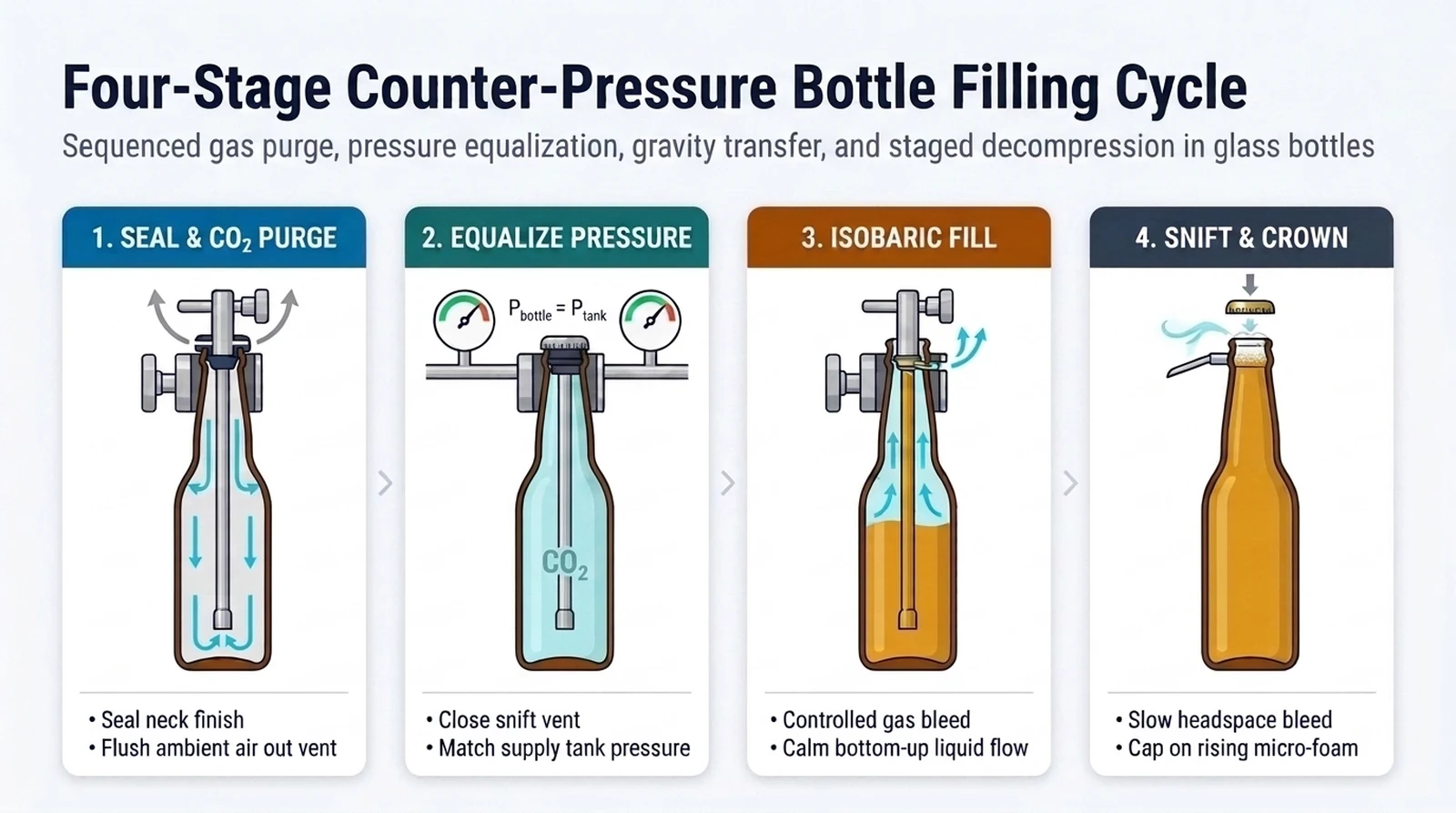
Across manual counter-pressure wands, semi-automatic multi-head frames, and automated rotary valves, the physics of each filling cycle follows four strict phases:
Swipe or scroll horizontally to see all columns.
| Cycle stage | Valve and seal action | Process goal | Foam or oxygen failure if rushed |
|---|---|---|---|
| 1. Seal and CO2 purge | Clamp the bottle finish tightly against the gasket, open gas-in, and crack the bleeder vent for 10 to 12 seconds | Fill from the bottom with denser CO2 to push ambient air out the top vent | Incomplete air displacement leaves oxygen trapped in the bottle and speeds staling |
| 2. Equalize backpressure | Close the bleeder valve first, then let internal bottle pressure match the supply vessel (commonly 8 to 12 psi for beer) | Eliminate any pressure drop when the product valve opens | Under-pressurized bottles trigger immediate CO2 breakout on liquid entry |
| 3. Isobaric bottom-up fill | Open the product valve (no flow occurs at equal pressure), then crack the bleeder to hold roughly a 3 psi differential for a 5 to 10 second fill | Deliver chilled liquid smoothly from the bottom tube under a CO2 blanket | Opening the bleeder too wide accelerates velocity, turbulence, and runaway foam |
| 4. Controlled snift and crown | Close the bleeder first, close the product valve second, confirm all valves shut, detach head smoothly, and crown over rising micro-foam | Return headspace gently to atmospheric pressure without gushing | Detaching under excessive backpressure pops the seal and causes explosive foaming |
Operating pressure recommendations across small-scale brewing guides span 3 to 15 psi, with most brewers holding conditioning pressure around 8 to 12 psi depending on beer style. Running well below conditioning pressure invites CO2 breakout the moment beer enters the bottle, whereas running too high forces the stopper or gasket to pop loose mid-fill and triggers violent foaming when the head lifts off.
Physical and surface triggers that cause runaway gushing
Even with careful valve timing, three physical faults turn an isobaric fill into a foam fountain:
- Warm product or warm glass: Carbon dioxide dissolves more readily in cold beer around 32 °F than in warm liquid, so chilled product produces far fewer foaming problems from CO2 breakout.
- Interior surface nucleation sites: Research on carbonation stability at Oregon State University notes that discharge nuclei, excess dissolved air, unnecessary agitation, rough irregular particles, heavy metals, scratches on interior bottle walls, oil droplets, and microorganisms all accelerate rapid carbonation loss.
- Turbulent vertical drop: Peer-reviewed research in ACS Omega on CO2 bubble dynamics in bottled beer demonstrates that guiding liquid gently down the inner glass wall preserves dissolved CO2 far better than turbulent vertical center-pouring. Bottom-reaching fill tubes and wall-deflector tips apply this principle directly inside the bottle.
Counter pressure bottle filler vs beer gun: why does equalized pressure retain carbonation?
A counter pressure bottle filler retains carbonation because Henry’s law ties dissolved CO2 concentration directly to headspace CO2 partial pressure; matching bottle pressure to the tank keeps dissolved gas stable, whereas an open atmospheric beer gun drops the beer to roughly 0.4 mbar of ambient CO2 partial pressure and forces dissolved gas out of solution.
Henry’s law, cold solubility, and nucleation thresholds
In a hermetically sealed crown-capped beer bottle, several bar of gas-phase CO2 pressure in the headspace hold dissolved carbonation steady. As quantified in Liger-Belair and Cilindre’s ACS Omega study, a standard 5% ABV commercial lager holds close to 5.5 g/L of dissolved CO2, while standard 12.5% ABV Champagne holds roughly 11 g/L—about twice as much gas and correspondingly higher internal pressure.
Temperature amplifies that pressure balance dramatically. In the same 5% ABV lager without residual sugar, the Henry’s law solubility constant climbs from approximately 1.6 g/L per bar at 20 °C (just below pure water at 1.7 g/L per bar) up to roughly 2.4 g/L per bar when cooled to 6 °C. Beverage composition shifts solubility too: the Oregon State University carbonation analysis notes that dissolved solutes such as citric acid, glycerol, and sucrose reduce CO2 solubility, with a 12% sucrose solution lowering CO2 solubility by 10%.
Once chilled beer leaves a pressurized keg into an unpressurized open bottle, the headspace CO2 partial pressure plunges to ambient air levels near 0.4 mbar. Under Henry’s law at 6 °C, the new equilibrium concentration drops to roughly 1 mg/L—meaning nearly all dissolved CO2 becomes supersaturated and tries to escape. Nucleation happens wherever microscopic gas pockets trapped in glass-wall microcrevices or tiny hollow cellulose fibers exceed the critical radius of curvature: about 0.7 µm in lager beer at 6 °C and 5.2 g/L CO2, shrinking to just 0.3 µm in Champagne at 10 °C and 8 g/L CO2.
Counter-pressure filler vs open atmospheric beer gun comparison
Swipe or scroll horizontally to see all columns.
| Transfer variable | Counter pressure bottle filler | Open atmospheric beer gun | Impact on glass bottle fill |
|---|---|---|---|
| Bottle headspace pressure during fill | Equalized to supply vessel (commonly 8 to 12 psi) via sealed neck gasket | Atmospheric pressure with ambient CO2 partial pressure near 0.4 mbar | Equalized head pressure blocks abrupt CO2 supersaturation and breakout |
| Driving force for liquid flow | Controlled pressure differential (roughly 3 psi) or gravity head while venting back-gas | Full tank pressure pushing liquid into an open vessel | Gentle differential flow minimizes shear and foam-inducing turbulence |
| Sensitivity to glass microcrevices | Lower during transfer because internal pressure stays near equilibrium | High; cavities wider than 0.7 µm in beer trigger rapid heterogeneous bubbling | Open filling loses more carbonation on scratched, dusty, or lightly warmed glass |
| Oxygen exposure during transfer | Sealed CO2 purge followed by bottom-up fill under a pressurized CO2 blanket | Brief unsealed CO2 flush that mixes easily with room air around the open neck | Sealed counter-pressure transfer gives repeatable air displacement before crowning |
In commercial quality control, carbonation is commonly reported in beverage “volumes”—defined as the milliliters of CO2 absorbed per unit volume of water at 760 mm Hg and 15.6 °C—so plants pair temperature charts with regulated backpressure to hold target carbonation consistently across every bottle.
When should a small brewery step up to a multi-head counter pressure bottle filler?
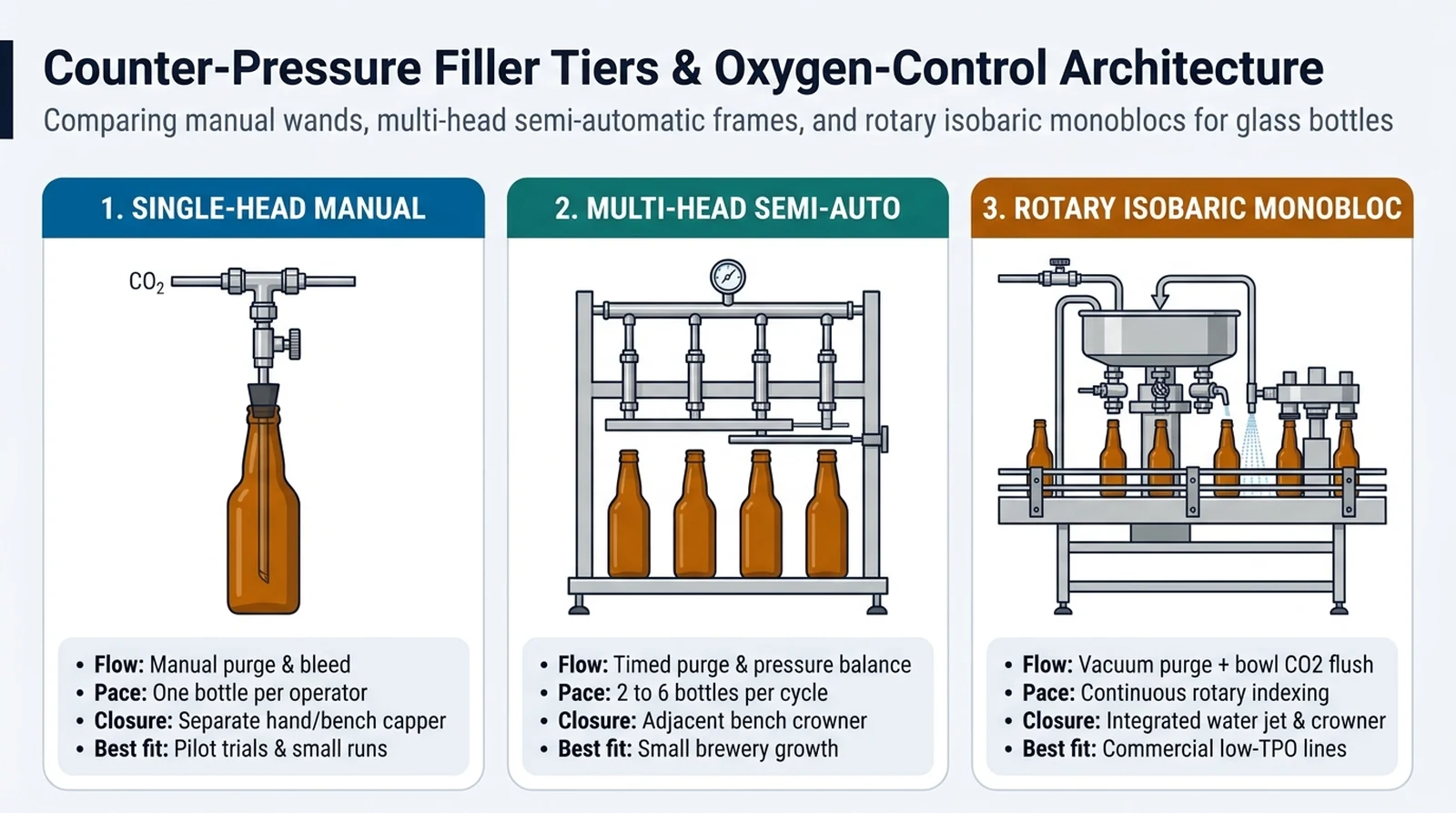
Step up from a single-head manual counter pressure bottle filler to a multi-head semi-automatic frame or rotary monobloc once bottling-day labor, operator fatigue, or hygiene consistency outgrows sequential hand-valving—because a single wand spending 10 to 12 seconds purging and 5 to 10 seconds filling per bottle quickly stalls full-batch packaging.
Architecture, filling endpoint, and sanitation scale-up
A manual single-head counter-pressure wand requires the operator to seat the rubber stopper, sequence four valves (including the cylinder supply), monitor fill speed by eye, close every valve before removal, and immediately crown each individual bottle before starting the next. Even for pilot batches, Brew Your Own’s bottling techniques guidance notes that packaging an entire keg on a single manual wand is so time-consuming that most operators fill only a small run of bottles rather than a full batch.
Stepping up to a multi-head semi-automatic manifold (commonly built in two-head, four-head, or six-head frames) lets one operator purge, equalize, and fill several glass bottles in parallel while mechanical clamping removes hand-fatigue leaks at the neck seal. At higher commercial throughput, the bottling line engineering overview contrasts two structural choices buyers must separate cleanly:
- Inline versus rotary architecture: Inline multi-head fillers are the most widespread layout for general packaging budgets, whereas rotary machines run much faster at a significantly higher capital and maintenance commitment.
- Liquid-level versus volumetric endpoint: Liquid-level fillers bring every bottle to a matching visual neck line despite slight glass capacity variation, whereas volumetric fillers dispense an identical liquid volume regardless of minor height shifts.
Hygiene scaling matters just as much as speed. A peer-reviewed review in Foods on craft and large-scale beer safety emphasizes that maintaining exacting sanitation is harder at smaller production scales and that secondary microbial contaminants introduced during bottling, canning, or kegging represent roughly 50% of documented beer microbiological contaminations. Automated commercial lines cut manual handling and open-air dwell time, though the University of Vermont Extension cider guide cautions that full lines demand substantial routine maintenance.
Matching filler tier to bottling-day volume
Swipe or scroll horizontally to see all columns.
| Filler tier | Operator role per cycle | Purge, fill, and closing workflow | Best-fit bottling operation |
|---|---|---|---|
| Single-head manual wand | Seats stopper, cycles CO2/beer/bleeder valves, removes wand, and caps each bottle individually | Manual 10 to 12 second purge and 5 to 10 second differential fill; separate hand or bench capper | Competition entries, recipe trials, and short taproom runs |
| Multi-head semi-automatic frame | Loads and unloads parallel bottles and initiates timed purge/fill cycles | Shared CO2 rail and mechanical/pneumatic neck clamping; adjacent bench crowner | Small breweries and cideries packaging regular batch runs without full conveyor automation |
| Rotary isobaric filler-crowner monobloc | Supervises PLC parameters, feeds bottles/crowns, and audits inline QC | Integrated rinsing, inert-gas flushing, continuous rotary filling, and synchronized immediate crowning | Commercial distribution lines requiring high speed and strict oxygen and microbial control |
Before committing capital to an upgrade, map total bottling-day hours—including rinsing, crowning, labeling, and clean-in-place turnaround—using our small-scale bottling equipment guide and the filling-line output and OEE worksheet.
What glass bottle pressure specs and filler hardware requirements matter for carbonated beverages?
Any glass bottle entering a counter pressure bottle filler must carry documented internal pressure strength matched to the beverage’s carbonation and storage temperature—verified under ASTM C147-86(2020) for containers holding sustained pressures of 138 kPa (20 psi) or greater—paired with matched pressure closures and worker shard protection.
Under ASTM C147-86(2020) Standard Test Methods for Internal Pressure Strength of Glass Containers, glass manufacturers qualify pressure-service bottles expected to sustain at least 138 kPa (20 psi) after processing using two distinct protocols: Test Method A applies uniform internal pressure for a predetermined hold period, while Test Method B increases internal pressure at a predetermined constant rate until fracture. Confirm both the container drawing and the applicable pressure test report before running a new glass mold—see the glass bottle specification checklist for drawing fields to lock down.
Mismatching glass class to internal gas pressure creates an acute physical safety hazard. Sealed carbonated beverages such as fermented cider or sparkling beer can build internal pressures up to 4 atmospheres, and exploding bottles have injured packaging staff—requiring strong pressure-rated glass, compatible closures, and written sanitation and safety operating procedures (SSOPs) to shield operators from flying shards. Match container classes strictly by carbonation level:
- Still beverages: Standard 750 mL wine bottles are intended strictly for uncarbonated products. Under federal alcohol regulation Section 24.245, still wine and still hard cider may contain no more than 0.392 gram of carbon dioxide per 100 milliliters at removal, with a narrow mechanical variation tolerance of no more than 0.009 gram per 100 milliliters under good commercial practice.
- Lightly to moderately carbonated beverages: Crown-capped or flip-top pressure-rated beer bottles suit typical beer and lightly sparkling ciders (such as lager holding roughly 5.5 g/L dissolved CO2).
- Highly carbonated styles: Champagne-style products holding around 11 g/L dissolved CO2 require sturdy, new Champagne bottles fitted with dedicated stoppers and wire hoods.
Workplace carbon dioxide and compressed gas safety rules
Running pressurized CO2 headers, purge vents, and snift valves introduces an invisible asphyxiation hazard inside enclosed bottling rooms. According to the OSHA Occupational Chemical Database entry for Carbon Dioxide, carbon dioxide (CAS 124-38-9, molecular weight 44.0) is a colorless, odorless gas with a vapor pressure of 56.5 atm and a vapor density of 1.53—meaning vented purge gas is heavier than air and pools along floors, pits, and unventilated corners without smell warning.
U.S. facilities operating pressurized carbon dioxide fillers manage workplace air quality and cylinder hardware under two federal benchmarks:
- Airborne exposure ceilings: Both the OSHA 8-hour PEL-TWA (29 CFR 1910.1000 Table Z-1) and NIOSH REL-TWA cap carbon dioxide at 5,000 ppm (9,000 mg/m³); the NIOSH short-term exposure limit (REL-STEL) is 30,000 ppm (54,000 mg/m³), and the Immediately Dangerous to Life or Health (IDLH) threshold is 40,000 ppm.
- Compressed gas cylinders and relief valves: OSHA Standard 1910.101 mandates visual cylinder inspections under DOT 49 CFR parts 171-179 (or CGA Pamphlets C-6-1968 and C-8-1962), in-plant handling and storage per CGA Pamphlet P-1-1965, and pressure relief devices installed and maintained per CGA Pamphlets S-1.1-1963 (1965 addenda) and S-1.2-1963.
Carbonated glass bottle and filler specification checklist
Swipe or scroll horizontally to see all columns.
| Specification area | Engineering parameter to define | Regulatory or standard basis | Supplier or plant check |
|---|---|---|---|
| Glass container pressure rating | Sustained internal pressure capacity (>= 138 kPa / 20 psi up to 4 atmospheres for sparkling classes) | ASTM C147-86(2020) Test Method A (uniform hold) and Test Method B (constant ramp) | Attach lot pressure test report to the approved bottle drawing |
| Container and closure class | Crown or flip-top beer glass vs sturdy new Champagne bottle with wire hood; exclude standard 750 mL still wine glass | Carbonation level (e.g., ~5.5 g/L lager vs ~11 g/L Champagne) and Section 24.245 (0.392 g/100 mL still cap) | Verify finish geometry against capping equipment tooling |
| Filler product-contact hygiene | Drainable stainless steel passages, inspectable elastomer seals, and hot-water / chemical cleanability | Secondary bottling contamination drives ~50% of beer microbial spoilage | Confirm full disassembly or clean-in-place coverage of blind gas and vent tubes |
| CO2 ventilation and gas monitoring | Low-level exhaust and continuous NDIR CO2 alarm setpoints | OSHA PEL-TWA 5,000 ppm (9,000 mg/m³), NIOSH REL-STEL 30,000 ppm (54,000 mg/m³), IDLH 40,000 ppm | Mount sensors near floor level where 1.53 vapor-density CO2 accumulates |
| Cylinder and pressure-relief hardware | Restrained cylinders, rated regulators, and maintained safety relief valves | OSHA Standard 1910.101 (CGA P-1-1965 handling; CGA S-1.1-1963 and S-1.2-1963 relief devices) | Log periodic visual inspections and pressure-relief maintenance intervals |
| Post-fill inspection and burst guarding | Operator shard SSOPs, protective guarding, and foam-tolerant fill-height sensing | Pressure-burst shard hazard on carbonated lines | Pair filler burst signals with fill level inspection |
Combine these container and safety gates with our bottling equipment RFQ checklist before comparing competing filler proposals.
What counter-pressure bottling techniques minimize oxygen pickup before crowning?
Minimizing oxygen pickup on a counter pressure bottle filler begins with rinsed glass and beer held at or below 0 °C while avoiding oxygen contact. Bottom-up carbon dioxide purging, laminar bottom filling under a pressurized CO2 blanket, minimal neck headspace, and immediate crowning over rising foam work together to protect freshness.
Six floor controls from bottle rinse to headspace verification
Oxygen accelerates staling reactions in beer and degrades fresh aroma and shelf stability in sparkling cider and wine. Because every unsealed second between snift decompression and closure crimping allows ambient air to diffuse into the bottle neck, high-performing packaging operations lock down six consecutive controls:
- Rinse out glass dust before purging: Commercial beer lines rinse empty glass bottles with filtered water or air prior to CO2 injection so particulate debris does not remain inside to trigger wild foaming and air entrainment.
- Hold liquid temperature at or below 0 °C: Commercial maturation, filtration, and packaging hold beer at or below 0 °C while avoiding oxygen contact. Cold liquid keeps Henry’s solubility high, lowers foaming turbulence during filling, and preserves intrinsic antimicrobial stability alongside beer’s 0.5 to 10% w/w ethanol, 17 to 55 ppm iso-alpha-acids, pH 3.8 to 4.7, and roughly 0.5% w/v CO2 matrix.
- Purge from the bottom up with denser CO2: With a vapor density of 1.53 relative to air, carbon dioxide introduced through a bottom-reaching fill tube forms a rising blanket that pushes lighter ambient air cleanly out of the open vent rather than mixing turbulently at the neck.
- Crown every bottle immediately over rising micro-foam: Never queue a row of open filled bottles before capping. On commercial lines, fillers may also inject a final pulse of inert gas (carbon dioxide or nitrogen) across the headspace just ahead of the crowner, while capping over gentle rising foam sweeps remaining oxygen out of the neck right as the crown crimps shut.
- Keep headspace tight and store bottles cool: At the instant of capping, headspace sits at atmospheric pressure, and dissolved CO2 subsequently diffuses out of the beer to re-pressurize that headspace. Smaller headspace sacrifices less dissolved carbonation, and storing finished bottles cool without major temperature swings protects both seal pressure and flavor stability.
- Sanitize hidden filler passages and audit headspace air: Internal valve bores, return tubes, and snift passages cannot be inspected visually during a run; immediate post-run chemical soaking and thorough hot-water rinsing prevent biofilm and deposit buildup. When checking finished bottles with a Zahm piercing device, remember that trapped headspace air inflates total gauge pressure and biases calculated CO2 readings—use headspace “sniffing” or sodium hydroxide CO2 absorption as documented in the Oregon State University carbonation methodology to isolate true gas purity.
Frequently asked questions
What pressure should a counter pressure bottle filler run at for beer?
Counter-pressure bottling pressure recommendations span 3 to 15 psi, commonly held at keg conditioning pressure around 8 to 12 psi depending on beer style, with roughly a 3 psi pressure difference across the bleeder valve during filling. Setting pressure too low causes CO2 breakout inside the bottle, while excessive pressure risks unseating the neck seal and triggering sudden foaming when the valve detaches.
Why must beer stay cold during counter-pressure bottle filling?
Henry’s law governs CO2 solubility, and carbon dioxide responds more strongly to temperature shifts than most other gases. In a 5% ABV lager, cooling from 20 °C down to 6 °C increases Henry’s constant from roughly 1.6 g/L per bar to 2.4 g/L per bar, and commercial packaging holds beer at or below 0 °C (around 32 °F) so gas stays dissolved calmly without excessive foaming.
Can standard still wine glass bottles be filled on a counter pressure bottle filler?
No. Standard 750 mL wine bottles are built for uncarbonated still products (capped at 0.392 g CO2 per 100 mL under federal Section 24.245, with a 0.009 g/100 mL mechanical tolerance) and lack the pressure margin needed for carbonated drinks. Specify pressure-rated glass tested under ASTM C147-86(2020) (sustained pressures of 138 kPa / 20 psi or greater)—using crown or flip-top beer bottles for moderate carbonation and sturdy new Champagne bottles with wire hoods for highly carbonated styles up to 4 atmospheres.
How does capping on foam reduce oxygen in a filled glass bottle?
Right after snift decompression and head removal, ambient air can enter the open neck above the liquid meniscus. Allowing a gentle column of micro-foam to rise to the lip just as the crown cap seats physically sweeps residual headspace gas out of the bottle before crimping, minimizing oxidation and staling during storage.
Why do bottling rooms using CO2 purging need gas monitoring and low-level ventilation?
Carbon dioxide (CAS 124-38-9) is colorless, odorless, and has a vapor density of 1.53, causing vented purge and snift gas to settle silently near floor level and displace breathable oxygen. OSHA and NIOSH set workplace carbon dioxide benchmarks at 5,000 ppm (9,000 mg/m³) PEL-TWA and REL-TWA, 30,000 ppm (54,000 mg/m³) REL-STEL, and 40,000 ppm IDLH, while OSHA Standard 1910.101 governs compressed gas cylinder inspections, handling, and pressure relief devices.
Sources
- ASTM C147-86(2020): Standard Test Methods for Internal Pressure Strength of Glass Containers, ASTM International: breaking-strength qualification for glass containers holding sustained internal pressures of 138 kPa (20 psi) or greater via Test Method A (uniform pressure hold) and Test Method B (constant-rate pressure increase).
- How Many CO2 Bubbles in a Glass of Beer?, Liger-Belair & Cilindre, ACS Omega (2021): Henry’s law CO2 solubility in 5% ABV lager (5.5 g/L) vs 12.5% ABV Champagne (11 g/L), temperature-dependent Henry’s constants (1.6 vs 2.4 g/L per bar), 0.4 mbar ambient CO2 partial pressure drop, heterogeneous nucleation critical radii (0.7 µm vs 0.3 µm), and gentle wall-guided pouring.
- Beer Safety: New Challenges and Future Trends within Craft and Large-Scale Production, Ciont et al., Foods (2022): intrinsic beer chemistry (0.5–10% w/w ethanol, 17–55 ppm iso-alpha-acids, pH 3.8–4.7, ~0.5% w/v CO2), packaging at or below 0 °C without oxygen contact, and secondary bottling contamination (~50% of documented microbial contaminations).
- Carbonation, CO2 Solubility, and Equilibrium Analysis, Oregon State University ScholarsArchive: Henry’s law temperature sensitivity, beverage CO2 volume definition (760 mm Hg and 15.6 °C), solute solubility penalty (12% sucrose reducing CO2 solubility by 10%), foaming nucleation triggers, and Zahm piercing-gauge headspace air bias correction.
- Commercial Production of Unpasteurized and Fermented Ciders in Vermont, T. Bradshaw, University of Vermont Extension: stainless-steel carbonating tank plus sterile filter and counter-pressure bottle filler workflow, internal bottle pressures up to 4 atmospheres, shard SSOPs, and glass bottle class selection by carbonation level.
- OSHA Occupational Chemical Database: Carbon Dioxide (CAS 124-38-9), U.S. Occupational Safety and Health Administration: vapor density (1.53), vapor pressure (56.5 atm), molecular weight (44.0), OSHA PEL-TWA and NIOSH REL-TWA (5,000 ppm / 9,000 mg/m³ under 29 CFR 1910.1000 Table Z-1), NIOSH REL-STEL (30,000 ppm / 54,000 mg/m³), and IDLH (40,000 ppm).
- OSHA Standard 1910.101: Compressed Gases (General Requirements), U.S. Occupational Safety and Health Administration: DOT 49 CFR 171-179 / CGA C-6 and C-8 cylinder inspections, CGA P-1-1965 in-plant compressed gas handling, and CGA S-1.1 and S-1.2 safety relief device maintenance.
- Use of Carbon Dioxide in Still Wine and Still Hard Cider (Section 24.245), Electronic Code of Federal Regulations (eCFR): 0.392 g per 100 mL maximum CO2 threshold for still wine and still hard cider and 0.009 g per 100 mL mechanical variation tolerance.
- Bottling Line Overview, Wikipedia: filtered water/air rinsing, CO2 oxygen displacement, inert-gas headspace flushing against oxidation, liquid-level vs volumetric filling endpoints, and inline vs rotary filler architecture tradeoffs.
Related guides
Glass Bottle Filling Machines: How to Compare Filling Principles
Compare gravity, vacuum, counter-pressure, piston and flowmeter filling for glass bottles by product, container and line fit, and learn what to ask suppliers.
Read the guide
Beer Bottling Equipment: Questions for Line Suppliers
Questions for bottling-line suppliers on oxygen pickup, counter-pressure filling, foaming, crowning, pasteurization, and fill-level and crown inspection.
Read the guide
Small-Scale Bottling Equipment: Manual, Semi-Automatic or a Compact Line?
How small glass-bottle producers can choose between manual fillers, semi-automatic machines and compact lines, using published rates and bottle-fit limits.
Read the guide