
Fill Level Inspection: Optical, X-Ray & HF
Compare optical, Vision AI, HF, microwave, and X-ray fill level inspection for glass bottles, line placement, and burst-bottle neighbor rejection.
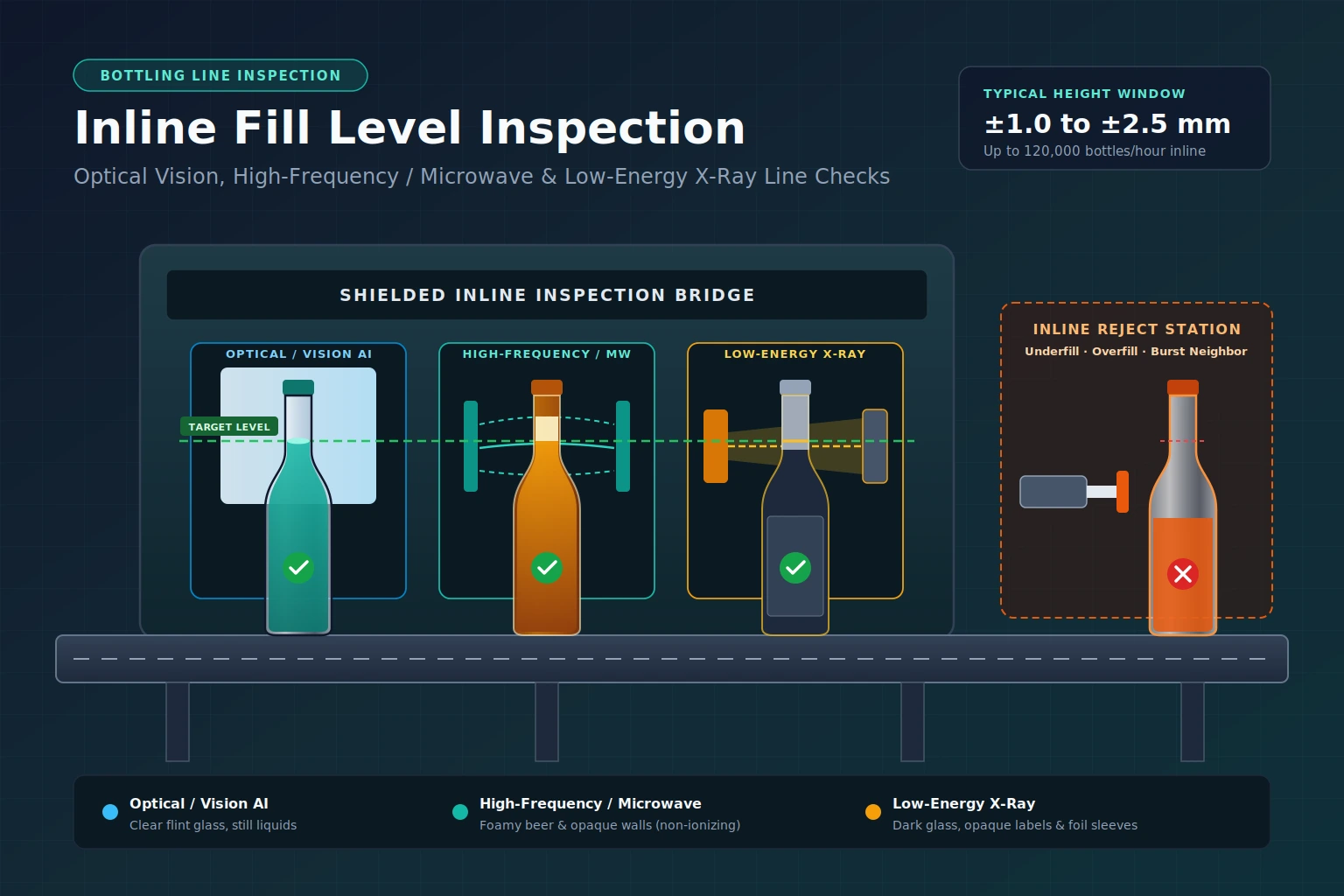
Inline fill level inspection verifies glass bottles against a target liquid height—on the order of ±1.0 to ±2.5 mm—at speeds up to 120k/h, rejecting underfills, overfills, and burst-bottle neighbors before packing. Match backlit optical cameras to clear still glass, high-frequency or microwave sensors to foamy carbonated drinks, and low-energy X-ray to dark or foil-necked bottles.
This guide focuses strictly on post-fill height sensing, line placement, and rejection logic within glass bottling lines. For empty-bottle crack, finish, and foreign-object checks before filling, see bottle inspection systems. For filler dosing principles and level-versus-volume control, see glass bottle filling machines.
How does an automated fill level inspection system verify container net contents at line speed?
Automated fill level inspection replaces slow mechanical weighing with non-contact sensors that measure each bottle’s liquid surface against a calibrated pass window—commonly ±1.0 to ±2.5 mm—at production speeds reaching 120k/h. Measuring fill height directly on the conveyor prevents legal underfill shortages and expensive overfill product giveaway without load-cell bottlenecks.
Checkweighers struggle on high-speed glass lines because of their physical bulk, limited throughput, frequent routine servicing to hold calibration, and load-cell sensitivity to plant humidity and temperature shifts. Non-contact inline level inspectors—spanning optical cameras, infrared (IR) beams, high-frequency (HF) capacitive bridges, microwave antennas, and low-energy X-ray gauges—inspect moving bottles continuously without touching the container or slowing the line.
Underfilled bottles expose bottlers to customer complaints and regulatory enforcement, whereas overfilled containers cause steady financial loss through product giveaway. In the United States, FDA Section 101.7 governs net quantity of contents declarations: fluid volume must be expressed at 40 °F (4 °C) for refrigerated foods sold refrigerated and at 68 °F (20 °C) for ambient foods. While federal rules recognize unavoidable deviations in good manufacturing practice, variations from stated quantity cannot be unreasonably large, and inspectors audit packaged net volume under NIST Handbook 133 Chapter 3 volume test procedures.
Because inline sensors measure height rather than net mass directly, verify that bottle mold capacity tolerances and filling temperature match the declared reference temperature before locking inspection thresholds. Coordinate fill-height limits with your glass bottle filling machines so thermal expansion or internal bottle-volume spread does not mask real quantity errors.
When is X-ray fill level inspection required over optical cameras for dark glass or foamy beer?
Specify low-energy X-ray fill level inspection whenever dark amber or opaque glass, full-neck opaque labels, metallic caps, or foil neck sleeves block light and disrupt capacitive fields, or when one line runs water, oil, and high-alcohol liquids interchangeably. Optical cameras fail once glass opacity, foam, or neck foil hides the liquid meniscus.
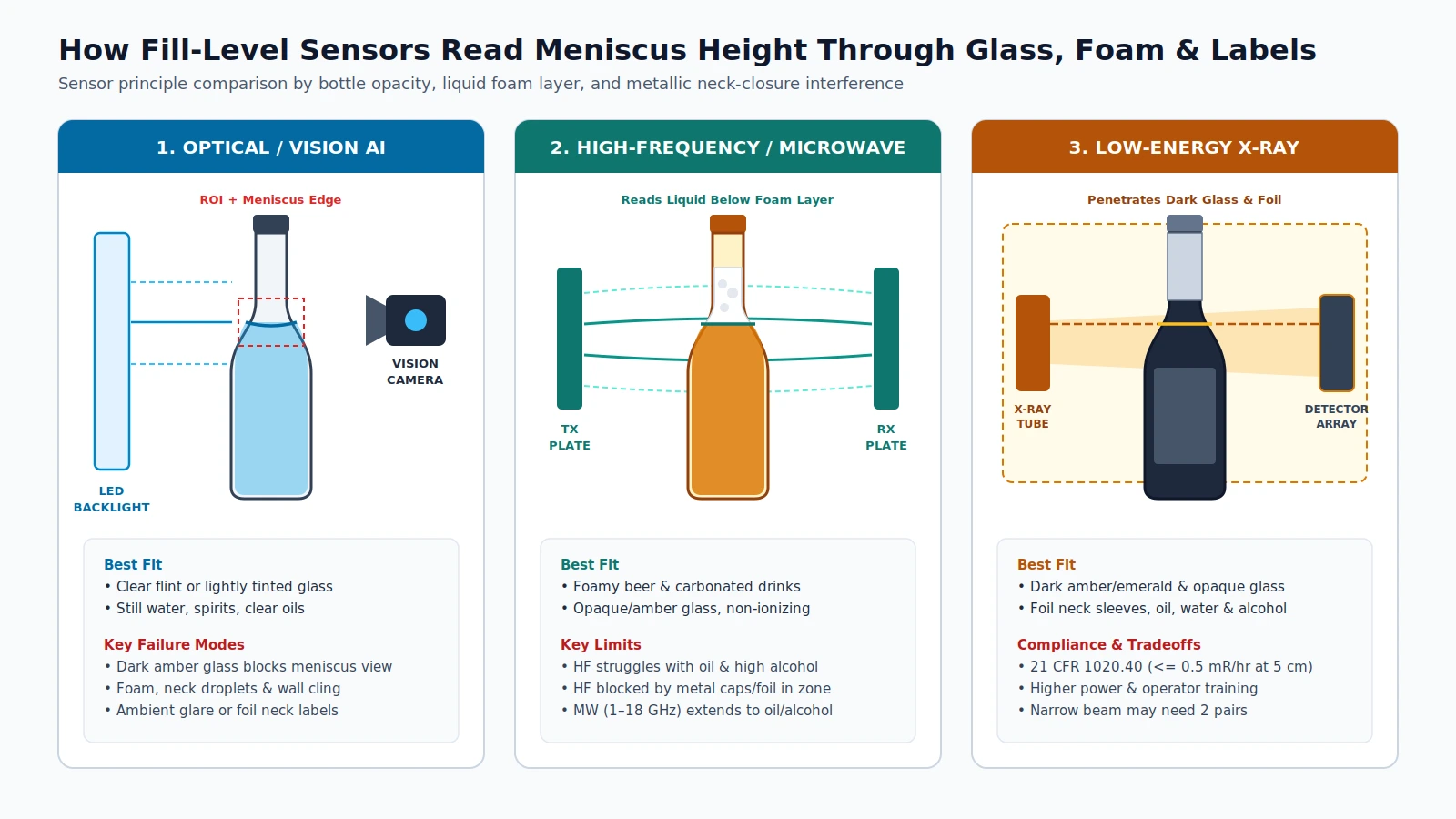
A peer-reviewed Sensors study on inline fill-level inspection technologies compares five deployed industrial methods alongside multi-frequency microwave sensing across opacity, labeling, metal closures, liquid chemistry, and power draw.
Swipe or scroll horizontally to see all columns.
| Inspection technology | Radiation type | Dark or opaque glass | Labeled or foil neck | Metallic cap in zone | Liquid compatibility | Primary engineering tradeoff |
|---|---|---|---|---|---|---|
| Optical camera / Vision AI | Non-ionizing visible light | Fails on opaque or heavy amber glass | Blocked by opaque labels or foil | Tolerated above neck ROI | Water, oil, and alcohol when clear | Sensitive to foam, neck droplets, wall cling, and lighting shifts |
| Infrared (IR) beam | Non-ionizing infrared | Limited to IR-transparent glass | Fails behind foil or labels | Blocked in beam path | Water, oil, and alcohol | Cannot inspect foiled or labeled neck zones |
| High-frequency (HF) capacitive | Non-ionizing RF electric field | Penetrates opaque glass walls | Blocked by foil or metal labels | Fails if metal enters sensing zone | Best on aqueous and foamy beer | Struggles with viscous, non-aqueous oils and high-alcohol spirits |
| Multi-frequency microwave (MW) | Non-ionizing 1 to 18 GHz EM | Penetrates opaque glass walls | Inspects labeled glass bottles | Compatible with metallic caps | Water, oil, and alcohol validated | Requires controlled bottle spacing and mechanical centering guides |
| Low-energy X-ray | Ionizing X-radiation | Penetrates dark and opaque glass | Penetrates labels and neck foil | Compatible with metallic caps | Water, oil, and alcohol | Higher energy use, licensing, safety interlocks, narrow vertical window |
X-ray remains the broadest workhorse for dark beer, wine with foil capsules, and mixed-product bottling lines because radiation absorption requires minimal routine mechanical maintenance. However, X-ray units draw higher electrical energy, demand trained personnel and radiation protection compliance, and inspect a relatively narrow vertical beam zone—meaning lines requiring simultaneous underfill and overfill verification sometimes need multiple emitter-detector pairs. Legacy gamma-ray isotope fill gauges are effectively being phased out as radiation safety rules tighten.
Federal safety rules for inline X-ray fill-level inspectors
Installing an X-ray fill inspector on a food or beverage line triggers specific federal hardware and operational obligations in the United States:
- Tube energy and food dose limits: Under FDA Section 179.21, X-ray tubes inspecting packaged food may operate at 500 kilovolt peak or lower, and accompanying labeling states that no exposed food shall receive an absorbed dose in excess of 10 grays.
- Cabinet leakage and guarding: Under FDA Section 1020.40, cabinet X-ray emission cannot exceed 0.5 milliroentgen in one hour at any point five centimeters outside the external surface. Conveyor ports must prevent insertion of any part of the human body into the primary beam.
- Interlocks and operator controls: Cabinet X-ray systems require at least two safety interlocks on each door, at least one interlock on each access panel, a key-actuated switch preventing generation with the key removed, and two independent indicators legibly labeled X-RAY ON (with one permitted to be a milliammeter).
How does high-frequency or microwave fill level inspection read meniscus height through foam?
High-frequency (HF) capacitive and microwave (MW) fill-level sensors pass each glass bottle neck through a non-ionizing electromagnetic field that responds to the higher dielectric mass of dense liquid rather than airy foam. This physics lets carbonated beverage lines measure true liquid volume beneath a thick foam head without X-ray licensing.
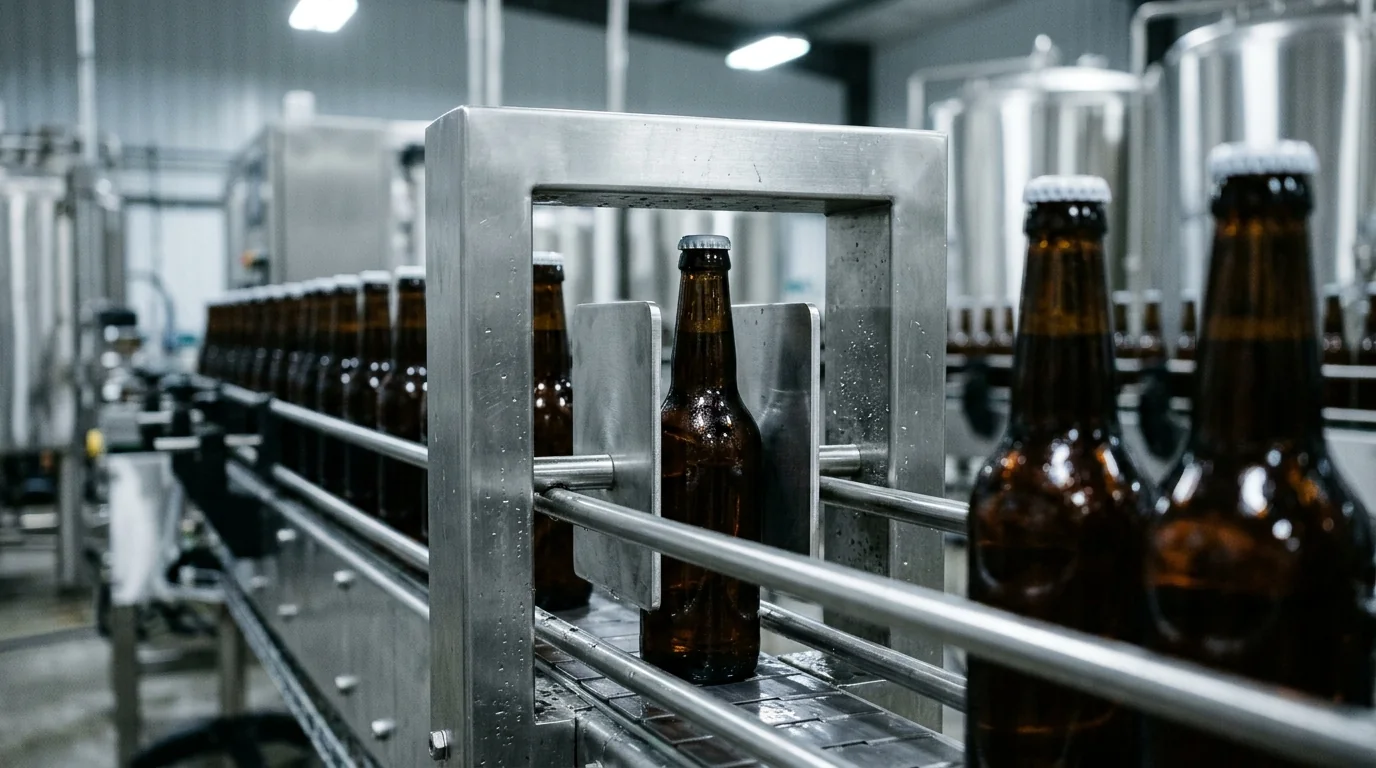
High-frequency capacitive sensing on foamy beverage lines
In an HF-capacitive inspector, the bottle travels through a high-frequency electric field integrated into a resonant circuit. Because dense liquid shifts the electric field far more strongly than headspace air or foam bubbles, changes in liquid height inside the bottle neck alter resonant capacitance predictably. Software compares multiple electrical field parameters against statistically learned reference profiles, making HF sensing a widely adopted non-ionizing choice for foamy beer and carbonated soft drinks in amber glass.
HF-capacitive gauges have two clear physical boundaries. First, they struggle with viscous products, non-aqueous liquids such as cooking oils, and high-alcohol spirits whose dielectric behavior differs sharply from water. Second, they cannot operate when metallic closures, foil neck bands, or metallized labels sit inside the active capacitive sensing region.
Multi-frequency microwave inspection across water, oil, and alcohol
To overcome HF-capacitive fluid limits while avoiding ionizing radiation, researchers at Politecnico di Torino demonstrated an inline multi-frequency microwave fill-level inspection system using two opposing wideband printed Vivaldi antennas. The prototype swept 1 to 18 GHz across 69 frequency points at 0.25 GHz steps, with a 100 kHz intermediate filter frequency and 0 dBm input power, mounted along a 20 m/min conveyor fitted with mechanical centering bars.
Validated on moving 180 ml soda-lime glass bottles (52 mm base diameter and 190 mm height), visual opacity of the glass or liquid did not obstruct measurement. Multi-level classification across water, oil, and alcohol also illustrates how liquid density alters the millimeter height equivalent of a fixed mass error in a tapered bottle neck:
Swipe or scroll horizontally to see all columns.
| Tested liquid | ±0.5 g height band and hit rate | ±1.5 g height band and hit rate | ±2.5 g height band and hit rate |
|---|---|---|---|
| Water | ±0.36 mm (58.28%) | ±1.08 mm (88.60%) | ±1.79 mm (99.36%) |
| Oil | ±0.40 mm (58.07%) | ±1.19 mm (96.12%) | ±1.97 mm (99.36%) |
| Alcohol | ±0.49 mm (43.44%) | ±1.46 mm (85.37%) | ±2.44 mm (95.91%) |
Using optimized spatial-frequency parameter selection, the fault-rejection algorithm achieved a hit rate higher than 90% within ±2.5 g across water, oil, and alcohol, completing per-bottle processing in approximately 0.80 ms after a 1.84 ms trigger sweep (compared with 4.70 ms for full multi-level classification). Mechanical conveyor pitch remains critical: adjacent bottles must stay properly spaced so neighboring containers do not enter the active sensing window.
How does Vision AI fill level inspection handle meniscus glare and colored glass bottles?
Vision AI fill-level systems isolate the liquid boundary on clear or lightly tinted glass by running grayscale conversion, Gaussian blur noise filtering, Canny edge detection, contour mapping, Region of Interest (ROI) masking, and Hough Transform line detection. Even with trained software, heavy amber glass, unstable lighting, foam, and wall-clinging oils still trigger false rejects.
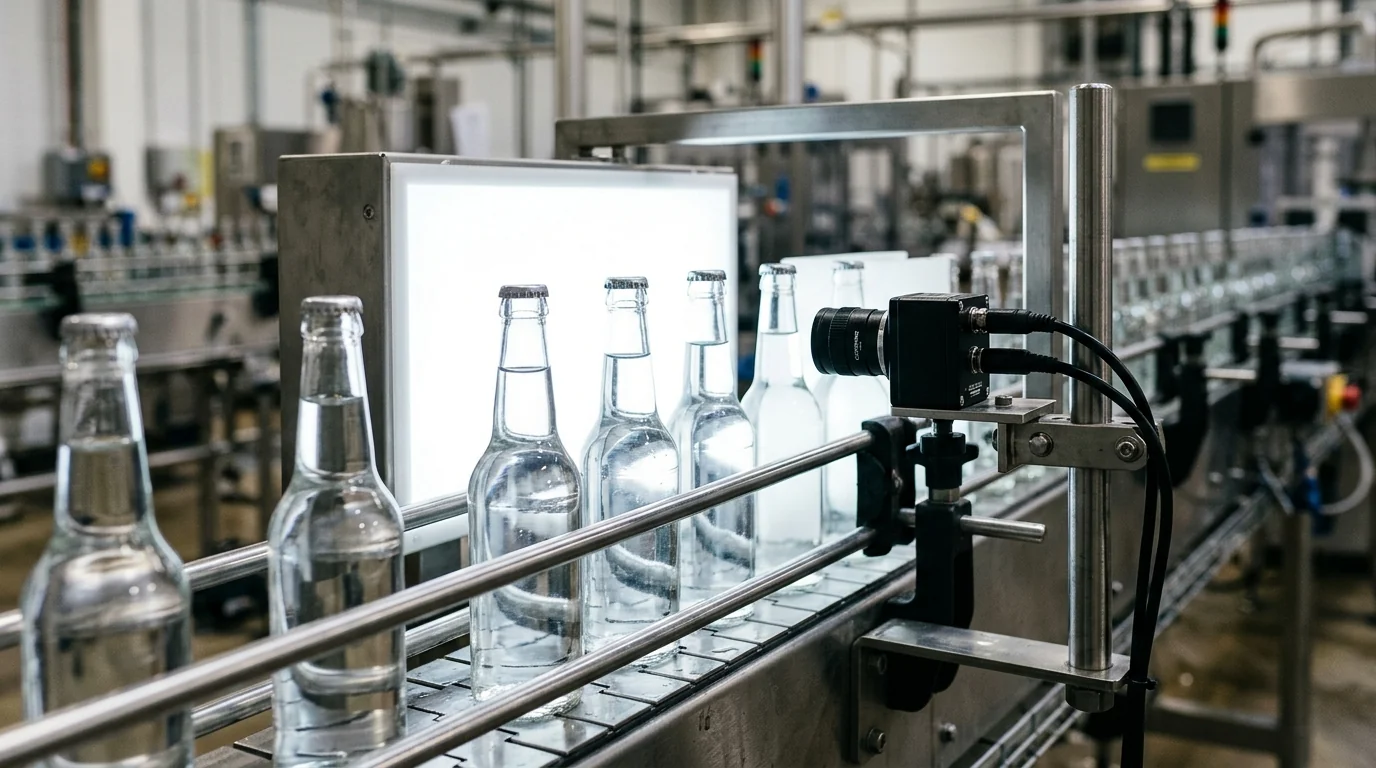
In a standard camera-based inspection bridge, uniform backlighting creates contrast between the empty headspace and the liquid column below. Computer-vision pipelines preprocess each frame into grayscale to cut computational load, apply Gaussian blur to suppress surface noise, and execute the Canny edge algorithm to highlight high-contrast boundaries. Contour mapping and ROI masking restrict analysis strictly to the calibrated neck tolerance band, where a Hough Transform extracts the straight meniscus line and compares it against upper and lower pass/fail thresholds.
Optical and Vision AI stations deliver high speed and non-ionizing simplicity on clear flint bottles filled with still water or clear spirits, yet real bottling floors expose recurring failure modes:
- Dark or tinted glass opacity: Deep amber or opaque bottles block backlight transmission so cameras cannot resolve the internal liquid line reliably.
- Foam and uneven settling: Carbonated products generate neck bubbles that mask the true meniscus, while viscous syrups and creams settle unevenly right after filling.
- Wall clinging and trickling droplets: Residual droplets from trickling fill valves or viscous sauces and oils adhering to inner glass walls mimic false fill levels and drive up nuisance rejects.
- Floor lighting and vibration: Overhead plant glare, temperature fluctuations, or conveyor vibration degrade edge contrast unless the optical tunnel is shielded and bottles are stabilized mechanically.
Where on a glass bottling line should bottle fill level inspection sit relative to the filler and closer?
Install the primary fill level inspection station immediately in the filler-block outfeed after closing so underfills, overfills, missing closures, and faulty filler valves are caught before labeling. High-accuracy and foamy lines often add a secondary fill-level check after the labeler once liquid turbulence and foam have settled.
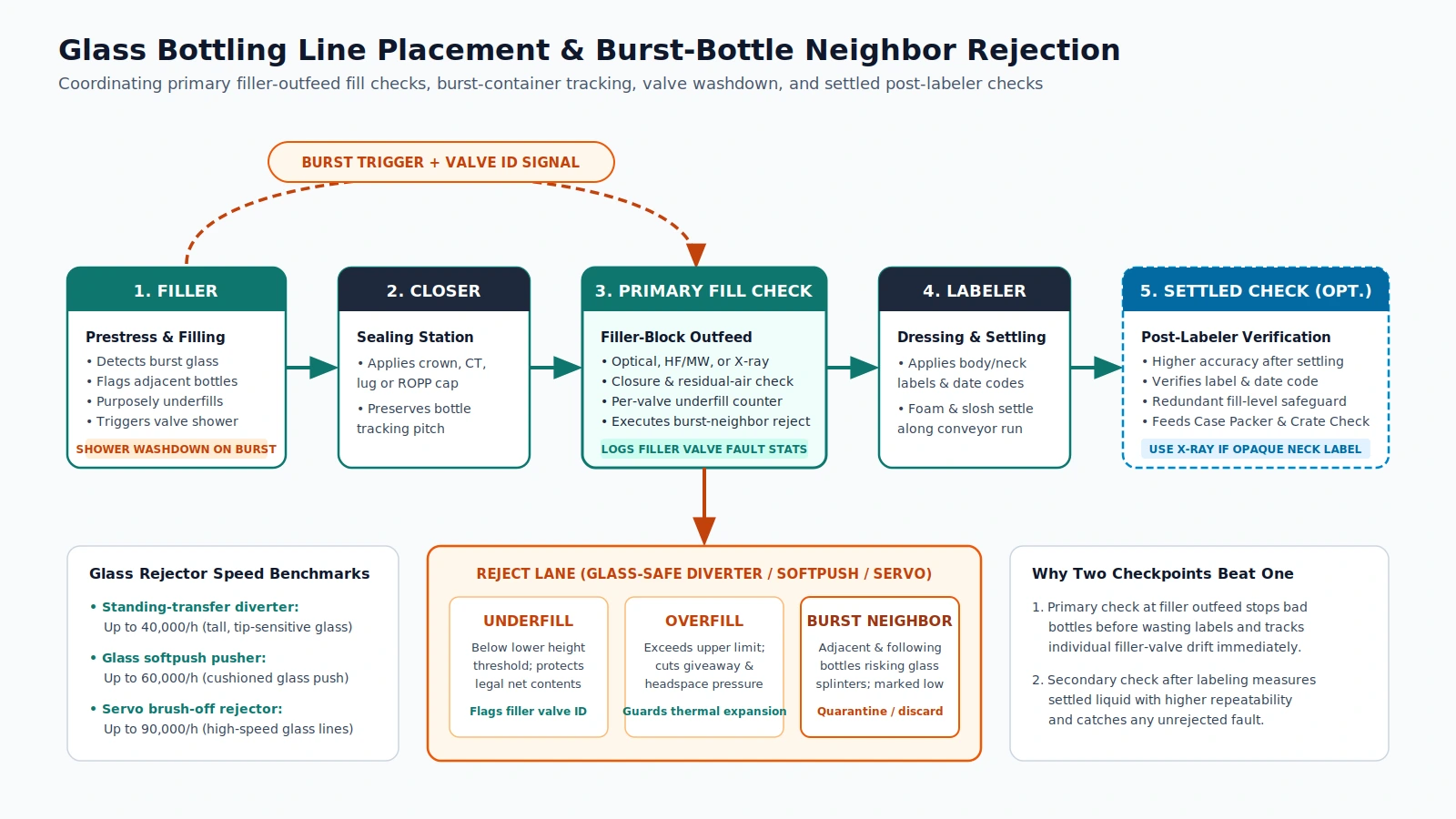
Placing the primary sensor bridge directly downstream of the closer protects downstream material spend and turns the inspector into a real-time maintenance diagnostic for the filler. Modern fill-level devices do not simply eject bad bottles; they track how many times each individual filler valve produces an underfilled container, alerting technicians to drifting valves early before reject rates spike. This same outfeed bridge commonly bundles closure presence and seating checks (coordinated with capping equipment), residual-air detection for beer, and container tightness checks.
Swipe or scroll horizontally to see all columns.
| Line station position | Core inspection tasks | Key operational advantage | Sensor constraint to verify |
|---|---|---|---|
| Primary: Filler-block outfeed (after closer) | Fill level, closure presence and fit, residual air, burst-neighbor rejection, filler-valve statistics | Rejects faults before wasting labels; isolates faulty filler valves immediately | Must tolerate freshly filled foam, slosh, and wet bottle exteriors |
| Secondary: Post-labeler (before case packer) | Settled fill-level re-check, label presence, alignment, and date-code verification | Higher level repeatability after foam and slosh settle; redundant consumer-safety gate | Requires X-ray or RF-compatible geometry if opaque neck labels or foil sleeves are applied |
Wait until after bottle labeling methods only when using a secondary verification station—never rely on a post-labeler camera alone if opaque neck labels or metallic foil capsules cover the target fill zone. Coordinate conveyor straightaways, accumulation zones, and reject-lane spacing early during planning a glass bottling line.
How do downstream fill level inspectors coordinate burst-bottle neighbor rejection?
When a pressurized glass bottle bursts inside the filler during prestressing or filling, the filler control flags adjacent and trailing containers so the downstream fill-level inspector rejects every neighbor that could carry broken glass splinters. Intentional underfill marking and automatic valve washdown showers prevent operators from accidentally returning quarantined bottles to production.
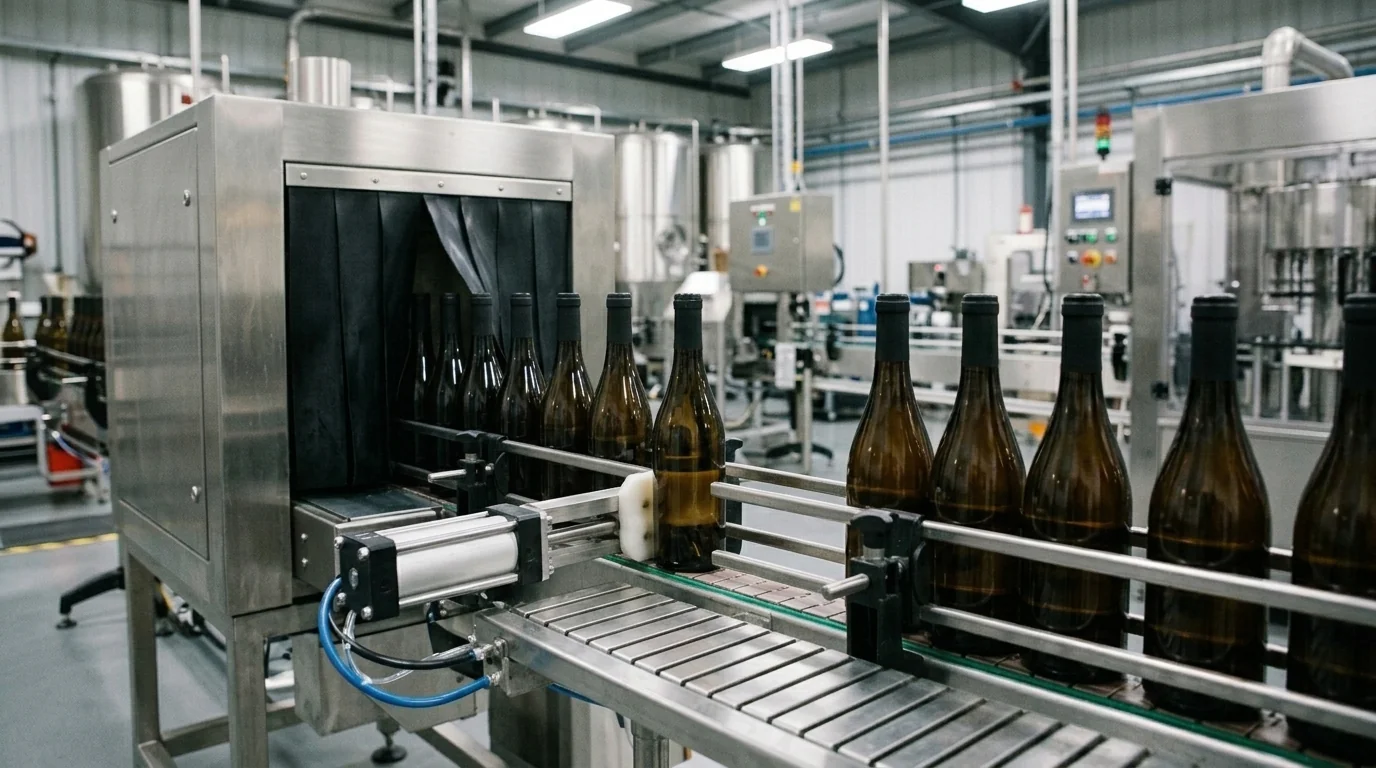
Glass container bursts create a severe physical-hazard risk because flying shards can enter open adjacent bottles before closing. A properly integrated filler-and-inspector loop coordinates four steps automatically:
- In-filler burst detection: Sensors on the filler detect a bottle burst during prestressing or filling and identify the affected pocket position.
- Neighbor tracking to the outfeed inspector: The line controller tracks adjacent and following bottles from the burst pocket through the closer directly to the downstream fill-level check, ejecting every flagged container.
- Intentional underfill marking and valve washdown: Because burst-neighbor bottles can look completely intact to an operator inspecting the reject lane, fillers can purposely underfill flagged adjacent bottles so staff do not return them to the conveyor by hand. Simultaneously, the check unit activates a shower device to wash broken glass off the affected filling valves.
- Glass-safe mechanical rejection: Rejector hardware must match bottle stability and line speed to avoid secondary breakage on the reject lane. Standing-transfer rejectors such as BBULL TRANSLINER keep tall, tip-sensitive wine or water bottles upright at up to 40k/h, cushioned glass pushers such as BBULL SOFTPUSH handle glass bottles at up to 60k/h, and high-speed servo brush-off rejectors such as BBULL BRUSH OFF SERVO (BOS) reach up to 90k/h on glass.
Specification checklist for glass bottle fill-level inspection
Use this engineering checklist alongside the bottling equipment RFQ checklist when specifying a post-fill inspection bridge and reject station for glass containers.
Swipe or scroll horizontally to see all columns.
| Specification area | Engineering parameter to define | Supplier verification to request |
|---|---|---|
| Container optical and metal profile | Glass color (flint, amber, green), embossing, opaque neck labels, metallic cap or foil sleeve | Written confirmation of sensor physics (optical, HF, MW, or X-ray) tested on your actual dressed bottle |
| Product behavior at fill point | Still vs carbonated foam height, viscosity, wall-clinging oils/sauces, filling vs declared reference temperature (40 °F / 4 °C or 68 °F / 20 °C) | Demonstrated height accuracy (±1.0 to ±2.5 mm target) and false-reject rate on live foaming or viscous samples |
| Speed and conveyor pitch | Rated bottles per hour (up to 120k/h for high-speed bridges), minimum bottle spacing, mechanical centering guides | Confirmed sensor processing and trigger timing at peak speed without neighbor-bottle interference |
| X-ray food dose limits (Section 179.21) | X-ray tube peak voltage (500 kilovolt peak cap) and packaged-food absorbed dose (10 grays cap) | Written tube rating and food-inspection labeling compliance under FDA Section 179.21 |
| Cabinet shielding (Section 1020.40) | Cabinet emission (0.5 milliroentgen in one hour at five centimeters), port guarding, and at least two safety interlocks per door | Factory compliance documentation under FDA Section 1020.40 plus local licensing and training scope |
| Filler integration and burst logic | Filler-valve underfill counter, burst-bottle neighbor count, intentional underfill marking, automatic valve washdown trigger | End-to-end commissioning test confirming flagged burst neighbors are tracked and ejected automatically |
| Reject station and verification | Glass-safe rejector type (standing transfer up to 40k/h, softpush up to 60k/h, or servo brush-off up to 90k/h), reject confirmation sensor, stop-on-fail alarm | Challenge-bottle trial proving positive ejection and line-stop or alarm response if a reject fails |
Frequently asked questions
What accuracy do inline fill level inspection systems achieve on glass bottles?
Common industrial inline fill-level technologies—including optical cameras, high-frequency capacitive gauges, and low-energy X-ray units—target a height accuracy on the order of ±1.0 to ±2.5 mm while operating on moving production lines up to 120k/h. Actual volume repeatability also depends on internal glass-bottle capacity variation and liquid temperature stability.
Can optical cameras inspect fill levels in dark amber glass bottles?
Standard visible-light optical cameras struggle on dark amber or opaque glass bottles because the container wall blocks backlight transmission and hides the liquid meniscus. Lines running dark glass, opaque neck labels, or foil capsules should use high-frequency or microwave electromagnetic sensors (when no metal sits in the sensing zone) or low-energy X-ray inspection.
How does high-frequency inspection measure beer fill height under foam?
High-frequency capacitive sensors pass the bottle neck through an electric field inside a resonant circuit. Because dense liquid shifts the electric field far more strongly than low-density foam bubbles, the sensor isolates true liquid volume below the foam head—provided no metallic caps or foil sleeves enter the inspection zone.
Do X-ray fill level inspectors make packaged beverages radioactive?
No. Under federal food-inspection rules (FDA Section 179.21), packaged-food X-ray inspection tubes operate at 500 kilovolt peak or lower and keep food absorbed dose at or below 10 grays, while cabinet shielding under FDA Section 1020.40 limits external emission to 0.5 milliroentgen in one hour at five centimeters. Plants still require door safety interlocks, specially trained personnel, and radiation protection compliance.
Why do bottling lines intentionally underfill bottles next to a burst container?
When a glass bottle bursts during filling, adjacent and trailing bottles may contain invisible glass splinters while looking normal from the outside. Fillers can purposely underfill those flagged neighbors so operators on the reject lane recognize them immediately as faulty and avoid returning contaminated bottles to the conveyor by hand.
Sources
- Microwave Fill Level Inspection System for Industrial Packaged Products, Maraloiu et al., Sensors (Basel), PMCID PMC12737146: comparative evaluation of gamma-ray, X-ray, HF-capacitive, IR, optical, and 1 to 18 GHz microwave inline fill-level inspection on moving 180 ml soda-lime glass bottles across water, oil, and alcohol.
- FDA Cabinet X-Ray Systems Standard (Section 1020.40), Electronic Code of Federal Regulations (eCFR): 0.5 milliroentgen per hour emission limit at five centimeters, dual door safety interlocks, port guarding, and key-actuated control requirements.
- FDA Sources of Radiation Used for Inspection of Food (Section 179.21), Electronic Code of Federal Regulations (eCFR): 500 kilovolt peak X-ray tube cap and 10 grays maximum food absorbed dose for packaged food inspection.
- FDA Declaration of Net Quantity of Contents (Section 101.7), Electronic Code of Federal Regulations (eCFR): 40 °F (4 °C) refrigerated and 68 °F (20 °C) ambient fluid volume reference temperatures and permissible good manufacturing practice variations.
- NIST Handbook 133: Checking the Net Contents of Packaged Goods, National Institute of Standards and Technology (NIST): official Chapter 3 volume-labeled package net-contents verification procedures.
Related guides
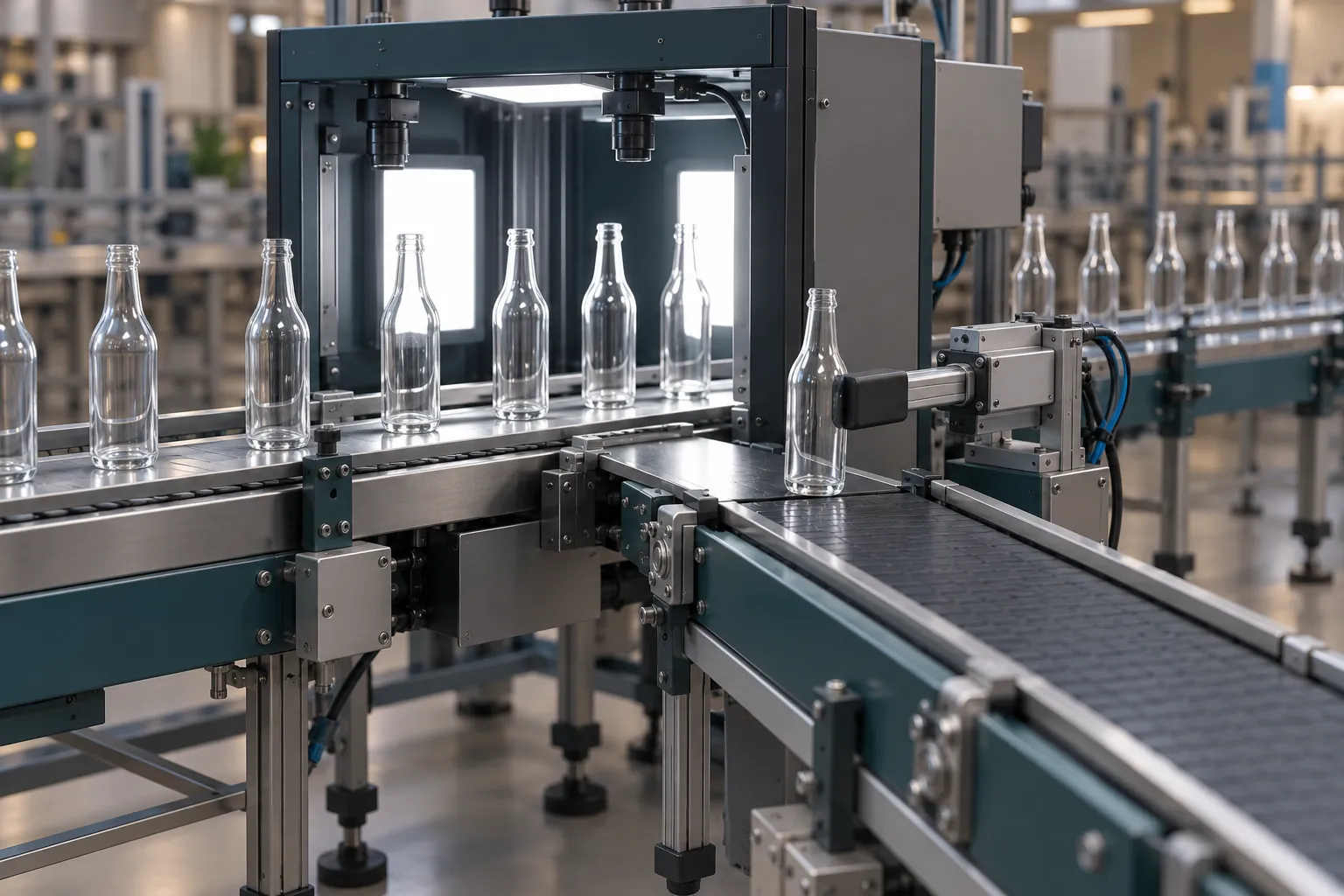
Bottle Inspection Systems: Comparing What Each System Checks
Compare empty bottle, fill level, closure, label and code inspection by scope and limits, and ask for reject verification, test bottles and validation records.
Read the guide
Glass Bottle Filling Machines: How to Compare Filling Principles
Compare gravity, vacuum, counter-pressure, piston and flowmeter filling for glass bottles by product, container and line fit, and learn what to ask suppliers.
Read the guide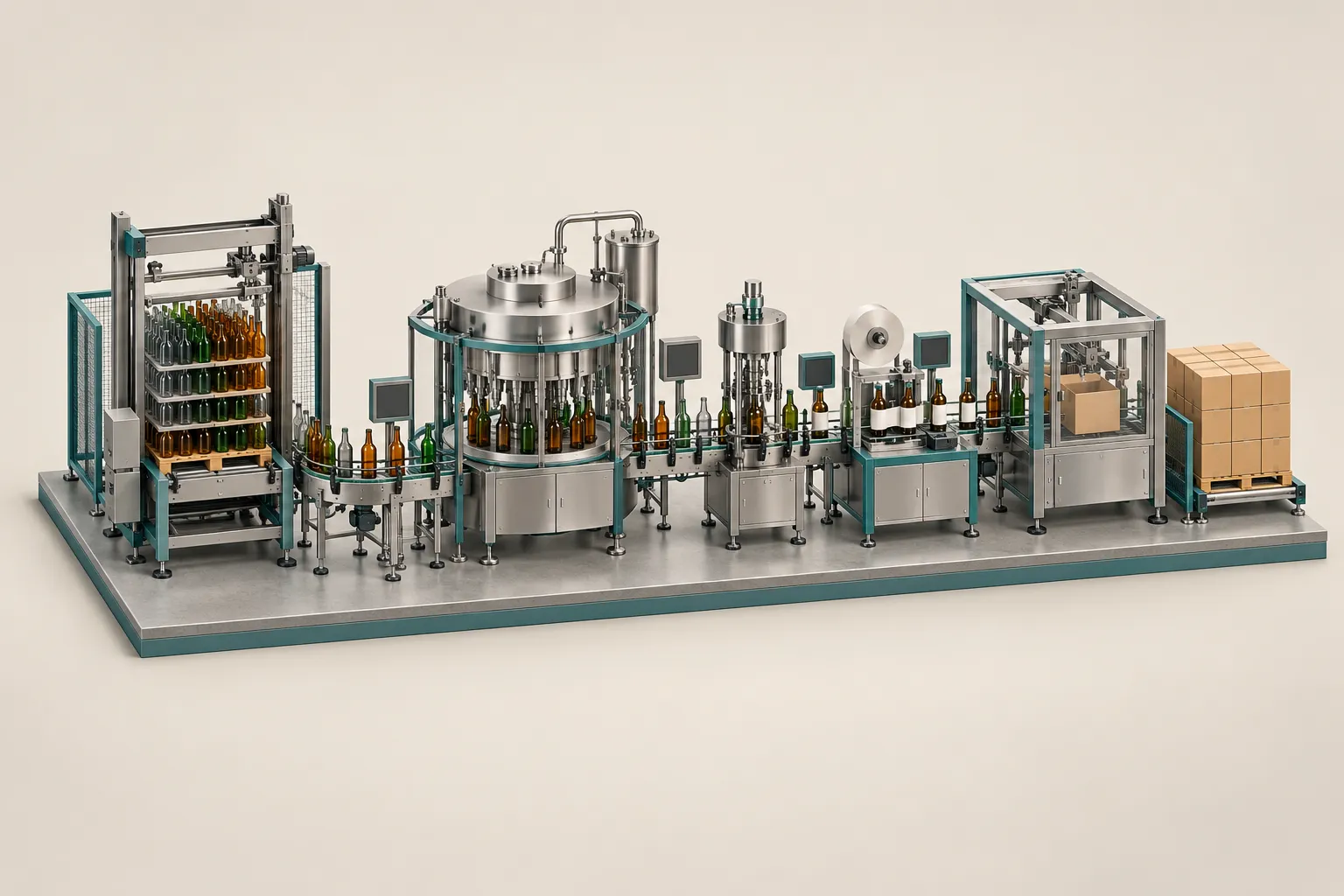
Planning a Glass Bottling Line: From Empty Bottles to Packed Cases
How to divide a glass bottling line into stations, size buffers around the bottleneck machine, and confirm machine interfaces before requesting quotes.
Read the guide