
Glass Milk Bottles: Single-Use or Returnable Documents
Separate single-use glass milk bottles from returnable ones by the bottle, cap, incoming protection, washing, and inspection documents each party confirms.
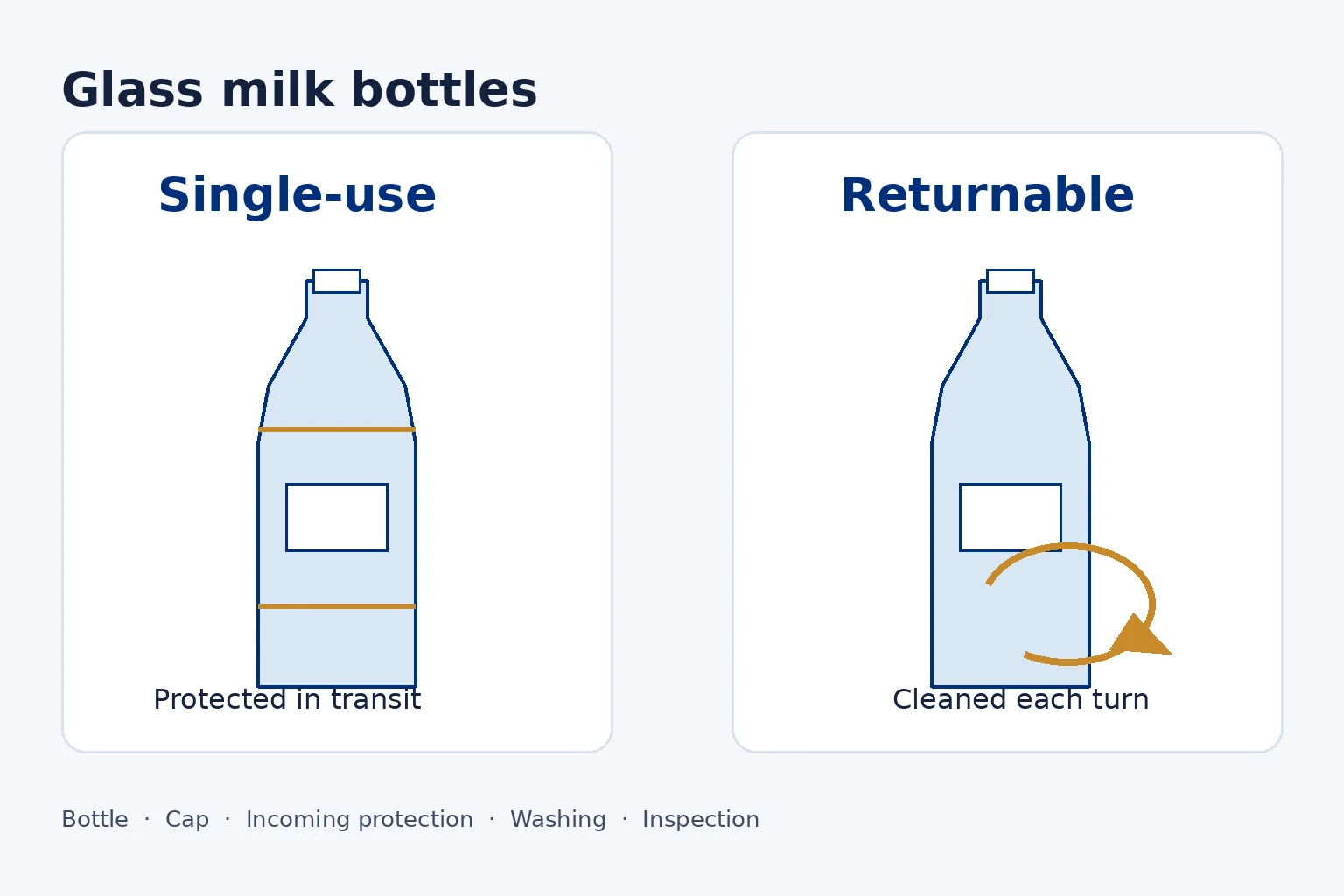
Single-use glass milk bottles and returnable glass milk bottles need different documents for the bottle, the cap, the incoming protection, the washing step, and the inspection record. Filing one scheme for both routes produces a mismatch the bottle plant, the equipment supplier, and the regulator will reject.
Single-service glass bottles stay under Item 12p, paragraph 8, separate from the general bottle-wash clauses. The matrix below is the file those three parties can mark up together. This page does not set a milk formula, a thermal process, a shelf life, or a wash recipe. A comparison of glass and plastic as materials is a different decision, covered in Glass vs. Plastic Bottles: Comparing Product and Line Fit.
Put the route name on the drawing
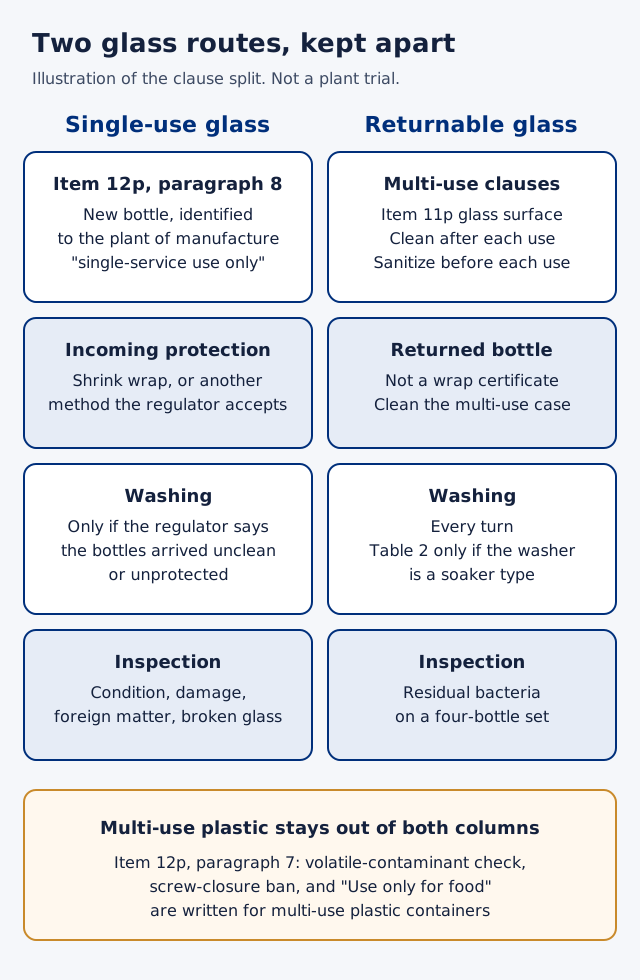
The 2023 Grade “A” Pasteurized Milk Ordinance separates the containers in Item 12p, Cleaning and Sanitizing of Containers and Equipment. Paragraph 8 is written for NCIMS-listed milk plants that choose single-service glass bottles for Grade “A” milk and milk products. The paragraphs before it cover multi-use containers, including automatic bottle washers. Paragraph 7 is written for milk plants that use multi-use plastic containers. A glass bottle does not move between those paragraphs because a catalog calls it a milk bottle.
Write the route on the bottle drawing before anyone quotes a washer, a capper, or an inspection camera. The bottle specification checklist is the place to collect the drawing, the capacity, and the finish. This page adds the dairy route those lines have to name.
Responsibility matrix
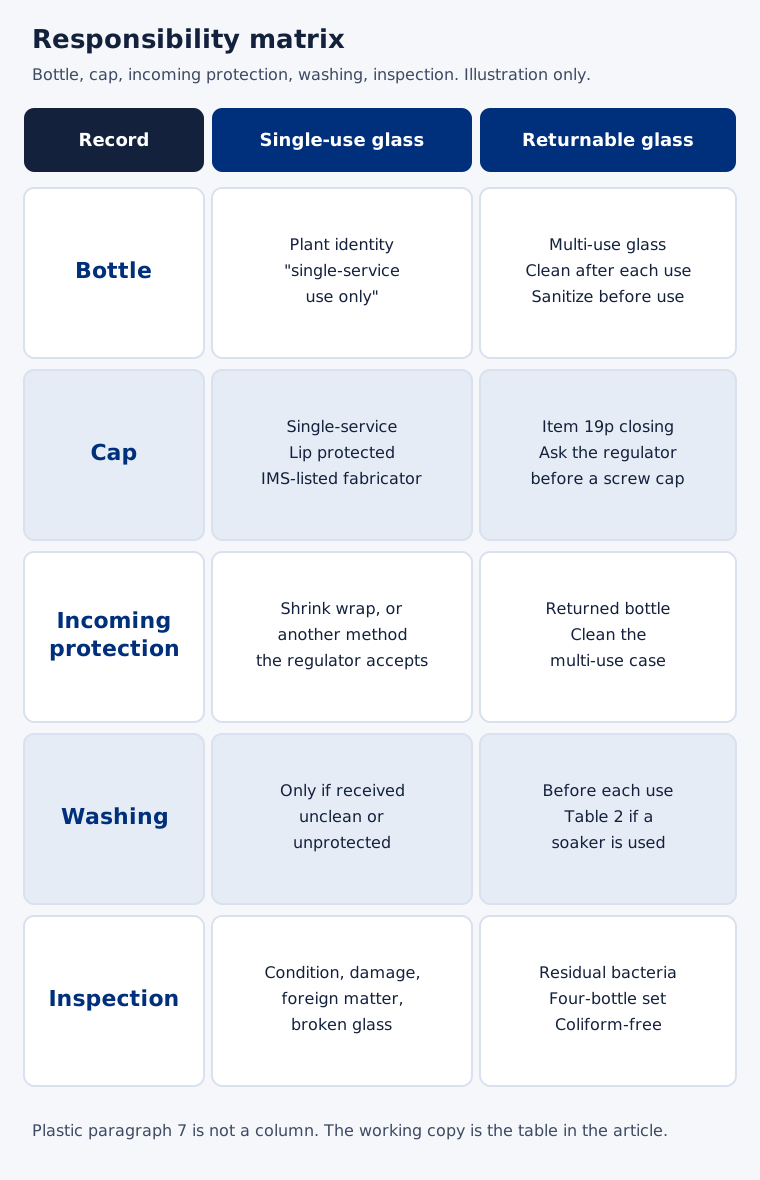
Use one row per record. The single-use column follows Item 12p, paragraph 8, plus the single-service rules that paragraph points at. The returnable column follows the multi-use container rules in Item 11p and Item 12p, paragraphs 1 through 6, plus storage and case cleaning. Paragraph 7, the multi-use plastic paragraph, has no column here.
Swipe or scroll horizontally to see all columns.
| Record | Single-use glass | Returnable glass |
|---|---|---|
| Bottle | Non-toxic materials. Identified to the plant of manufacture; coding is acceptable. Labeled “single-service use only.” Single-service articles are not reused. | Item 11p allows heat-resistant glass as a product-contact surface on a multi-use container. The surface is smooth, impervious, corrosion-resistant, and non-toxic, and the container is kept in good repair. It is cleaned after each use and sanitized before each use. |
| Cap | Single-service, designed to protect the pouring lip, and from an IMS-listed fabricator. Item 19p still requires the lip to be protected to at least its largest diameter, and, for fluid milk, a closure that cannot be removed without detection. Hand capping is prohibited. | Item 19p still governs closing. The screw-closure ban in paragraph 7 is written for multi-use plastic. Ask the regulator which closure is accepted on this glass bottle. If the cap itself is single-service, ask whether Appendix J’s IMS-listed fabricator rule applies to that cap. |
| Incoming protection | Packaged and shipped so they stay protected. The ordinance gives shrink wrap in plastic as an example, or another method the Regulatory Agency accepts. Stored as single-service articles under Item 14p. | A returned bottle is a multi-use container, cleaned and sanitized before it is filled again. Item 15p requires multi-use cases that encase packaged milk containers to be cleaned before use. |
| Washing | Required when the Regulatory Agency determines the bottles arrived unclean or unprotected. That cleaning is immediately before packaging, in a room separate from case washing and from pasteurization, processing, cooling, and packaging. The equipment and procedure have to meet Item 12p, including the sanitization-efficiency tests the agency recommends. | The multi-use clauses apply on every turn. A manual plant uses a two-compartment wash-and-rinse vat and a sanitizing step. An automatic bottle washer provides bactericidal treatment by steam, hot water, or chemical treatment. If the washer is a soaker type, Table 2 of Item 12p is the caustic, time, and temperature combination the agency checks. |
| Inspection | Before filling: general condition, damage, foreign materials, broken glass, and other contaminants. Residual bacteria for single-service containers and closures follow paragraph 6.b. | Residual bacteria for multi-use containers follow paragraph 6.a. The stress-crack, splitting, pitting, discoloration, and cloudiness inspection in paragraph 7 is the plastic inspection. |
Single-use glass under Item 12p, paragraph 8
Paragraph 8 has four parts.
The bottle is manufactured from non-toxic materials and packaged and shipped in a way that protects it from contamination. Shrink wrap in plastic is the example the ordinance gives. Any other method has to be acceptable to the Regulatory Agency. Every container is identified to the plant where it was made. Coding is acceptable. The container is labeled with the wording “single-service use only.” Appendix J repeats that label for single-service glass. Item 11p says articles intended for single-service use shall not be reused.
The closure is single-service, designed to protect the pouring lip, and from an IMS-listed fabricator. Item 19p, Capping, Container Closure and Sealing, applies to milk containers on either route: the cap or closure protects the pouring lip to at least its largest diameter, and on a fluid-milk container it cannot be removed without detection. Capping is done on approved mechanical equipment. Manually operated machinery can qualify. Hand capping is prohibited. The ordinance’s exception is for containers of 12.8 liters (3 gallons) or more, and only when suitable mechanical equipment is not available and the Regulatory Agency approves another method that removes the chance of contamination. Choosing Capping Equipment for Glass Bottles and Jars is the equipment side of that closing step. The finish drawing still has to name the finish; a cap diameter printed on a catalog page is not that drawing. See Bottle Neck Finishes and Closure Compatibility.
Before filling, the plant inspects the bottles for general condition, damage, foreign materials, broken glass, and other contaminants.
Washing is conditional. If the Regulatory Agency determines that single-service glass arrived unclean or unprotected, the plant cleans and sanitizes it immediately before packaging. That work is in a room separate from case washing and separate from the rooms used to pasteurize, process, cool, and package milk and milk products. The washer and the procedure have to meet the requirements of Item 12p, including sanitization-efficiency tests the agency recommends. That is the point at which the general wash clauses can enter a single-use file, and they enter for that conditional cleaning. A shipment the agency accepts as protected does not start in the soaker table.
Appendix F names one sanitizing method for this container. Pulsed light, as described in 21 CFR 179.41, may be used on single-service glass containers for milk and milk products when the interior surface is treated to a minimum fluence of 1 J/cm². Each day the system is checked with a calibrated sensor to confirm that minimum. The sensor is calibrated annually against a standard traceable to a recognized standard such as NIST, and the calibration record is available to the Regulatory Agency. The device also has to meet the pesticide-device provisions the appendix cites. Those are conditions for that method. They are not a chemical wash formula, and this page does not supply one.
Paragraph 6.b sets the residual bacteria count for single-service containers and closures used to package pasteurized milk and milk products. The paragraph states not more than 50 colonies per container, and, for dry-product packaging, not more than 1 colony per milliliter of capacity on the rinse test. It then excepts containers under 100 milliliters, which are held to not more than 10 colonies, or to 50 colonies per 50 square centimeters on the swab test. A set of four samples taken at random on one day fails the standard if two or more exceed it. Every container and closure in the set is free of coliform organisms. The sentence is branched, so ask the regulator which limit and which test apply to this bottle. If the containers and closures are made in another plant that meets Appendix J and the agency already has information that they comply, the agency may accept them without additional testing. Reason to doubt that compliance can bring the testing back.
Item 14p keeps single-service closures, containers, and the other single-service articles in sanitary tubes, wrappings, or cartons, in a clean, dry place, until they are used.
Returnable glass and the multi-use wash clauses
A returnable glass milk bottle is a multi-use container. Item 12p opens by requiring the product-contact surfaces of multi-use containers to be effectively cleaned and sanitized before each use. Paragraph 1 requires multi-use containers and utensils to be thoroughly cleaned after each use. Paragraph 5 requires them to be sanitized before use. After cleaning, Item 13p requires them to be transported and stored so they drain, and protected from contamination. Where practical, they are stored inverted.
Item 11p allows the product-contact surface of a multi-use container to be heat-resistant glass, along with the other materials that paragraph lists. The container has rounded corners, is in good repair, and is free from breaks, crevices, and corrosion. A bottle that carries the single-service label is the wrong bottle for this route, because Item 11p says single-service articles shall not be reused.
Paragraph 3 covers plants that wash containers by hand: a two-compartment wash-and-rinse vat, plus a steam cabinet or individual steam-jet for sanitizing, or a third vat when sanitizing is chemical.
Paragraph 4 covers plants that use automatic bottle washers. The washer provides bactericidal treatment by steam, hot water, or chemical treatment. In a soaker-type washer, where the bactericidal treatment depends on the causticity of the washing solution, the caustic strength for a given soaking time and temperature is the combination in Table 2 of Item 12p. The table is titled as combinations of equal bactericidal value for the soaker tank, and it cites the National Soft Drink Association specification for beverage bottles. The ordinance names the NSDA alkali test, the NSDA caustic test, or another suitable test, and it says the Regulatory Agency tests caustic strength at least once every three months. When caustic is used, the final rinse is water treated with heat or chemicals so the rinse does not put viable pathogenic or otherwise harmful organisms back on the bottle. The plant records the combination it runs against that table. This page does not reprint the concentrations. Reprinting them would turn the ordinance table into a wash recipe, which is outside this file.
Paragraph 6.a sets the residual bacteria count for multi-use containers used to package pasteurized milk and milk products: not more than 1 colony per milliliter of capacity on the rinse test, or 50 colonies per 50 square centimeters (1 colony per square centimeter) on the swab test. The four-sample rule matches the single-service rule: two or more of the four, taken at random on one day, above the standard means the set is out of compliance. Every container in the set is free of coliform organisms. That count is the returnable inspection standard in Item 12p. It is a different number from paragraph 6.b.
The plastic paragraph stays with plastic
Paragraph 7 applies to milk plants that use multi-use plastic containers for pasteurized milk and milk products. It requires identification of the plant, date, and plastic material; a device on the filling line that detects volatile organic contaminants in each container before filling, or an alternative the ordinance spells out; a single-service closure; a ban on screw-type closures; the phrase “Use only for food”; and an inspection for stress cracks, splitting, pitting, discoloration, cloudiness, and unremoved soil. That inspection is described as much more thorough than “the customary cursory inspection given to glass bottles.” The phrase is a comparison inside the plastic rule. It does not set the glass inspection. Single-service glass is inspected under paragraph 8.b. Returnable glass is held to the multi-use cleaning, sanitizing, and residual-bacteria clauses above.
The alternative assurance inside paragraph 7, including its own reference to Table 2, is written for those plastic containers when a volatile-contaminant detector is not the method in use. It is not a glass washer specification.
What a product page can specify
Bottle dimensions in this file come from a seller’s product page, and only from what that page states.
Berlin Packaging’s page for “32 oz Clear Glass Milk Bottles (Cap Not Included),” item v3800B09-B, retrieved 11 October 2026, states a 32 oz clear glass bottle and a cap size of 48 mm, sold separately. The page calls the bottle refillable and reusable. It says “BPA free, FDA approved.” It says the bottle can withstand a 100°F temperature variance, and it gives the example that glass at 70°F should not be filled with liquid hotter than 170°F, because a wider swing risks thermal shock. The same page offers the bottle for water, personal care, sauces, detergent, promotional items, and candies.
Those sentences are catalog statements about that item. They do not show an IMS listing, a “single-service use only” label, a regulator’s acceptance of a returnable washer, or a finish designation. “48 mm” is the cap size the seller prints. It is not, by itself, the neck-finish code the capper supplier needs. The thermal-shock note is the seller’s handling limit for that bottle. It is not a pasteurization or hot-fill specification, and this page does not turn it into one. “Refillable and reusable” does not choose the route. A dairy that wants the returnable column still needs the multi-use wash and inspection records. A dairy that wants the single-use column needs the paragraph 8 file, including the single-service label, and Item 11p still says that single-service article is not reused.
Crescent Ridge Dairy’s bottled-milk page describes a “Glass Bottle Half & Half Quart (32 oz.)” as a “Reusable glass bottled quart of our own half & half.” That is a store’s description of a product it sells. It is evidence that a dairy uses returnable-glass language on a quart. It is not a drawing, a cap specification, or a wash record.
Search results for “milk glass bottles” also include vintage milk-bottle collecting and decorative milk glass. Those are different products. None of their sizes, colors, or deposit stories are used here as a dairy packaging specification.
Bottle Depalletizers and Infeed Systems covers how empty glass arrives, in bulk layers or in cases, and notes that returnable plants also unpack crates. This page does not add a crate-inspection standard on top of that guide. The ordinance point to confirm for the cases themselves is Item 15p: multi-use cases used to encase packaged milk and milk product containers are cleaned before use.
A glass plant’s own defect guide is a manufacturing document, not the dairy’s pre-fill sheet. Emhart Glass, in “Glass container defects: Causes and remedies” (the 2024 PDF BEG_BR0060 Rev A), says a container released for sale should have passed an inspection with standards set to the customer’s needs, and that on the order of one hundred defects can develop in production. Ask the bottle plant which of those defects it screens before shipment, and keep that list with the plant’s release record. The dairy’s pre-fill inspection for single-service glass is the paragraph 8.b list. Bottle Inspection Systems compares empty-bottle, fill-level, closure, and label checks. Those machine scopes do not replace the residual-bacteria sample set.
One scheme for the plant, the supplier, and the regulator
The bottle plant confirms the drawing, the plant-of-manufacture identity, the packing method, and whether the article is labeled “single-service use only” or specified as multi-use glass. The closure supplier confirms the closure drawing, the pouring-lip coverage, and, where the cap is single-service, the fabricator’s listing. The equipment supplier confirms the capper, the washer room, and the inspection points against that same route. The Regulatory Agency confirms whether this 2023 text, and paragraph 8 in particular, is the text that applies at the plant.
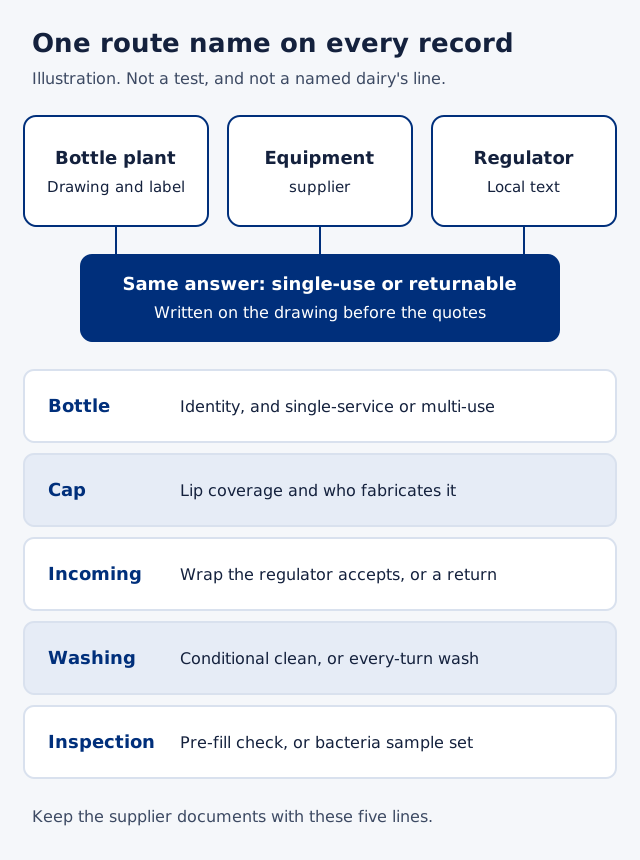
Appendix J says Grade “A” milk plants, other than plants that condense or dry milk or milk products, shall use single-service containers and closures from plants certified and listed on the IMS list. Paragraph 8 names the IMS-listed fabricator inside the single-service glass requirements. Ask the regulator to say which of those sentences covers the cap on a returnable glass bottle, and write the answer on the cap line of the matrix.
The text quoted here is the 2023 revision posted by the New York State Department of Agriculture and Markets. The FDA file at fda.gov/media/180975/download did not open when this copy was saved on 11 October 2026. States adopt the ordinance through their own programs. Ask the regulator whether this edition applies locally before anyone treats a paragraph number as the plant’s rule.
Once the route name is the same on every row, the bottling equipment RFQ checklist is how to ask equipment suppliers to quote that scope. Keep their replies with the matrix.
Questions to keep with the documents
Keep these questions in the same file as the supplier documents. This site does not collect the answers.
- Which route is this bottle: single-service glass under Item 12p, paragraph 8, or multi-use glass under the cleaning clauses? The drawing should carry one answer.
- Does the Regulatory Agency treat this 2023 Pasteurized Milk Ordinance text, including Item 12p, paragraph 8, as the text that applies at this plant?
- What identifies the plant of manufacture, and does the bottle say “single-service use only,” or is it specified as multi-use?
- Which closure drawing protects the pouring lip to at least its largest diameter, and is that closure single-service from an IMS-listed fabricator?
- For a returnable bottle, which closure has the regulator accepted? The screw-closure ban in the multi-use plastic paragraph is not the glass answer.
- How will empty bottles arrive, and which note shows that the Regulatory Agency accepts that protection?
- If single-use bottles can arrive unprotected, where is the separate cleaning room, and which Item 12p sanitization tests will the agency use?
- If the route is returnable and the washer is a soaker, which Table 2 combination will the plant record, and who tests the caustic strength?
- Which record is the paragraph 8.b pre-fill inspection, and which record is the paragraph 6.a or 6.b residual-bacteria set?
- Will the bottle plant, the equipment supplier, and the regulator confirm the same route name on the bottle, the cap, the incoming protection, the washing file, and the inspection record?
Evidence and limitations
Quotations from the ordinance are from the 2023 Grade “A” Pasteurized Milk Ordinance file saved from the New York State Department of Agriculture and Markets page 2023 Pasteurized Milk Ordinance, accessed 11 October 2026. The FDA download named in that file’s provenance did not open. Bottle catalog statements are from Berlin Packaging’s 32 oz Clear Glass Milk Bottles (Cap Not Included) product page, retrieved the same day. The half-and-half quart wording is from Crescent Ridge Dairy’s Glass Bottle Milk page. The manufacturing-defect description is from Emhart Glass, Glass container defects: Causes and remedies (BEG_BR0060 Rev A, PDF dated 2024 on the company site).
This page does not adopt the ordinance for any state, rank suppliers, or report a line trial. Decorative milk glass and vintage collecting sit outside the specification. Keep the supplier documents and the confirmation questions in one file with the drawing.
Related guides

Glass Bottle Specifications: A Checklist for Supplier Enquiries
A checklist of what to state in a glass bottle enquiry: drawing dimensions, capacity and fill point, finish, color, strength, decoration, quality and packing.
Read the guide
Bottle Depalletizers and Infeed Systems: A Selection Guide
How empty glass arrives (bulk pallets with tier sheets or cased), how layer sweep-off compares with other methods, and what to specify for single-filing.
Read the guide
Bottle Inspection Systems: Comparing What Each System Checks
Compare empty bottle, fill level, closure, label and code inspection by scope and limits, and ask for reject verification, test bottles and validation records.
Read the guide