
Wine Bottle Sizes Chart: Names & Fit
Compare wine bottle sizes, traditional format names, metric and inch dimensions, US and EU fill rules, and outer-diameter limits for starwheels and cases.
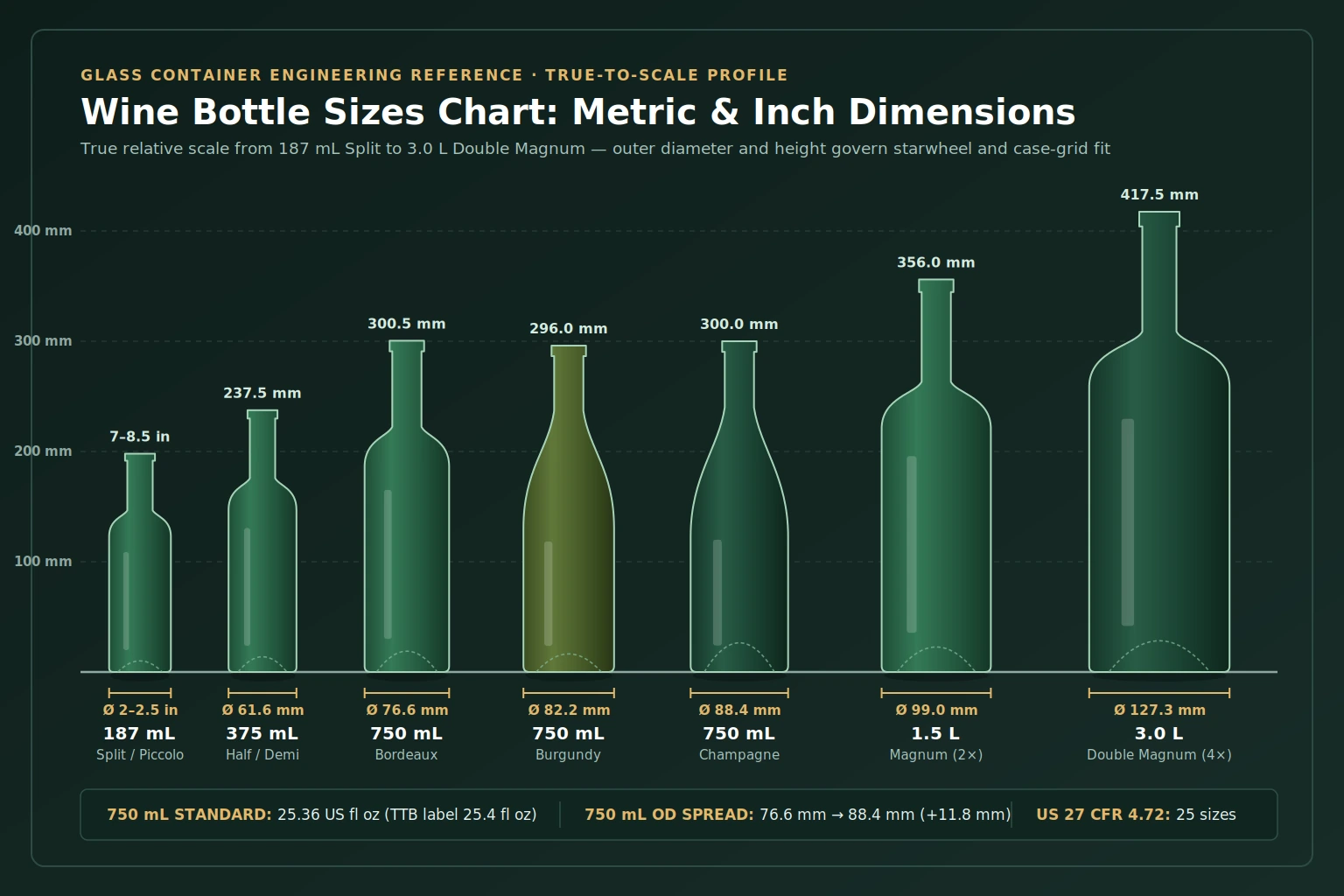
A wine bottle sizes chart anchors still and sparkling formats to the 750 mL standard bottle (25.36 US fl oz; 25.4 fl oz on TTB labels), spanning 0.1875 L Splits (0.25 standard bottles) through 1.5 L Magnums (2 bottles) to 30.0 L Melchizedeks (40 bottles). Because 750 mL outer diameters span 74.5 mm to 88.4 mm across moulds, exterior geometry—not capacity—controls starwheel, labeler, and case-divider fit.
Use this size reference alongside the glass container overview when planning bottle procurement, case partitions, or rotary line changeovers. For single-bottle neck bore, punt datum, and fill-height tolerances on a standard bottle, continue to the 750 mL empty bottle finish and punt guide.
What are the standard wine bottle sizes, traditional names, and capacities from splits to large formats?
Traditional wine bottle sizes scale in multiples of the 0.75 L (750 mL) standard bottle, running from 0.1875 L Piccolo or Split quarter-bottles and 0.375 L Demi half-bottles up to 1.5 L Magnums, 3.0 L Double Magnums, 6.0 L Imperials or Methuselahs, and 30.0 L Melchizedeks. Regional naming shifts at 3.0 L, 4.5 L, and 6.0 L, so purchase orders should state metric volume rather than historical titles alone.
The complete capacity hierarchy below aligns historical format names documented in the Wikipedia wine bottle size reference with official US label equivalents published in TTB Wine Labeling: Net Contents.
Swipe or scroll horizontally to see all columns.
| Format name | Volume | Standard 750 mL ratio | TTB US fl oz equivalent | Traditional use and regional notes |
|---|---|---|---|---|
| Piccolo / Split / Pony / Snipe | 0.1875 L (187 mL US fill) | 0.25 | 6.3 fl oz (at 187 mL) | Quarter bottle for single-serve still and sparkling wine |
| Quarter | 0.2 L (200 mL) | 0.2667 | 6.8 fl oz | Champagne and sparkling wine; common Piccolo volume in Germany |
| Demi / Half bottle | 0.375 L (375 mL) | 0.5 | 12.7 fl oz | Half of a standard bottle; common across Bordeaux, Burgundy, Champagne, and ice wine |
| Half-liter | 0.5 L (500 mL) | 0.67 | 16.9 fl oz | Used for Tokaj, Sauternes, Jerez, and other sweet wines |
| Clavelin | 0.620 L (620 mL) | 0.83 | 21.0 fl oz | Primarily used for vin jaune |
| Standard bottle | 0.75 L (750 mL) | 1 | 25.4 fl oz | Global industry baseline (25.36 US fl oz; 26.40 imp fl oz; six 125 mL servings) |
| Litre | 1.0 L (1,000 mL) | 1.33 | 33.8 fl oz | Popular size for Austrian wines |
| Magnum | 1.5 L (1,500 mL) | 2 | 50.7 fl oz | Two standard bottles; largest routine size for traditional Champagne secondary fermentation |
| Marie Jeanne / Tregnum | 2.25 L | 3 | 76.1 fl oz | Three standard bottles; also called tappit hen in the port wine trade |
| Double Magnum / Jeroboam | 3.0 L | 4 | 101 fl oz | Double Magnum across regions; called Jeroboam in Champagne and Burgundy |
| Rehoboam | 4.5 L | 6 | Even liters (4 to 17 L rule) | Six standard bottles; Jeroboam indicates different sizes across French regions |
| Imperial / Methuselah | 6.0 L | 8 | Even liters (4 to 17 L rule) | Eight standard bottles; Imperial in Bordeaux and Methuselah in Burgundy and Champagne |
| Salmanazar | 9.0 L | 12 | Even liters (4 to 17 L rule) | Twelve standard bottles, matching a 12-bottle case |
| Balthazar / Belshazzar | 12.0 L | 16 | Even liters (4 to 17 L rule) | Sixteen standard bottles |
| Nebuchadnezzar | 15.0 L | 20 | Even liters (4 to 17 L rule) | Twenty standard bottles |
| Melchior | 18.0 L | 24 | Exempt (18 L or more) | Twenty-four standard bottles; above the US 18 L standard-of-fill ceiling |
| Solomon | 20.0 L | 26 | Exempt (18 L or more) | Twenty-six standard bottles in traditional reference tables |
| Sovereign | 26.25 L | 35 | Exempt (18 L or more) | Thirty-five standard bottles; specialty Champagne display format |
| Primat / Goliath | 27.0 L | 36 | Exempt (18 L or more) | Thirty-six standard bottles |
| Melchizedek / Midas | 30.0 L | 40 | Exempt (18 L or more) | Forty standard bottles |
Regulatory standards of fill: US 27 CFR 4.72 versus EU Directive 2007/45/EC
Commercial bottling cannot select arbitrary capacities between 50 mL and 17 L without verifying destination-market fill laws. Under 27 CFR 4.72, updated through Treasury Decision TTB-200 in January 2025 (with updated TTB guidance issued in May 2026), the United States authorizes 25 metric standards of fill from 50 mL to 3 L, including 700 mL and 720 mL alongside 187 mL, 375 mL, 500 mL, 750 mL, 1 L, 1.5 L, 2.25 L, and 3 L.
Above 3 L, 27 CFR 4.72 requires containers of 4 L to 17 L to be filled and labeled in even liters such as 4 L, 5 L, or 6 L. That even-liter requirement excludes fractional traditional sizes such as 4.5 L unless an exemption applies, whereas 27 CFR 4.70 exempts wine packed in containers of 18 L or more from standard-container and standard-of-fill rules.
Exporting still wine into the European Union narrows the compliant range further. Between 100 mL and 1,500 mL, EU Directive 2007/45/EC permits only eight nominal quantities for still wine: 100 mL, 187 mL, 250 mL, 375 mL, 500 mL, 750 mL, 1,000 mL, and 1,500 mL. A US-legal 700 mL or 720 mL wine bottle cannot legally enter the EU retail still-wine range, while 750 mL and 1,500 mL clear both jurisdictions.
What is the standard height and outer diameter of a 750 mL wine bottle across Bordeaux, Burgundy, and Champagne moulds?
Standard 750 mL wine bottles span roughly 11.5 to 13 inches (290.12 mm to 329.39 mm across reference drawings) in overall height and 2.9 to 3.6 inches (74.5 mm to 88.4 mm) in outer body diameter depending on glassmaker mould and regional style. Bordeaux moulds are tall and straight-sided with high shoulders, Burgundy moulds run wider with sloping shoulders, and Champagne moulds are widest and heaviest to withstand internal pressure.
Because glassmakers adjust wall thickness, punt depth, and shoulder taper across stock articles, two bottles labeled 750 mL Bordeaux rarely share identical outside envelopes. Reference drawings from Saverglass, O-I, and Berlin Packaging show how wide the dimensional spread is within a single nominal capacity.
Swipe or scroll horizontally to see all columns.
| Reference 750 mL glass mould | Style family | Height (mm) | Outer diameter (mm) | Empty glass weight | Finish, brimful, and punt details |
|---|---|---|---|---|---|
| Berlin Packaging 29484P3 lightweight | Bordeaux | 292 mm | 74.5 mm | 360 g | 765 mL brimful; BVS 30H60 screw finish |
| O-I W5 Cork | Bordeaux | 290.12 mm | 76.61 mm | 455 g | Cork finish 30-3115 |
| Saverglass Bordelaise Tradition 4427 | Bordeaux | 300.50 mm | 76.60 mm | 550 g | 18.5 mm bore; 30.00 mm punt |
| Saverglass Bordelaise 1855 | Bordeaux (tapered) | 300.5 mm | 79.4 mm base / 84.8 mm shoulder | 760 g | 68 mm fill level; 58 mm punt |
| O-I WCF Cork | Tall reserve Bordeaux | 329.39 mm | 77.95 mm | 696 g | Cork finish; tallest Bordeaux reference |
| Saverglass Burgundy reference | Burgundy | 296.00 mm | 82.20 mm | 578 g | Sloping shoulders; wider body than Bordeaux |
| Saverglass Champagne 75 cl reference | Champagne | 300 mm | 88.4 mm | 900 g | Thick pressure walls; widest 75 cl profile |
Across these four traditional shape families, silhouette geometry matches wine style and structural load. Port, sherry, and Bordeaux moulds use straight sides, high shoulders, and a pronounced punt; Burgundy and Rhône moulds use sloping shoulders and a smaller punt; Rhine (hock), Mosel, and Alsace flutes run tall and narrow with little or no punt; and Champagne moulds combine sloping shoulders with thicker glass walls and a deeper punt.
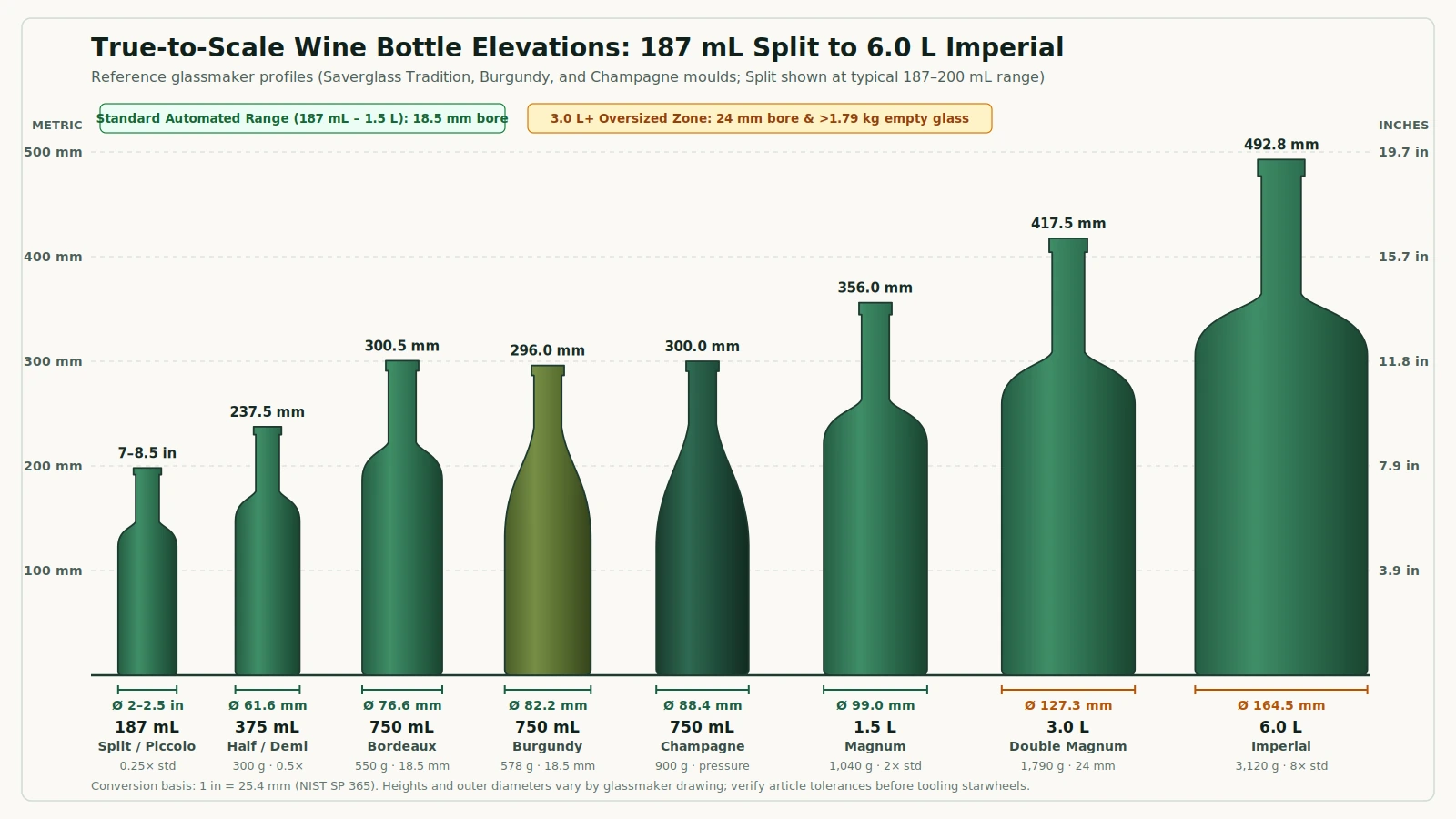
Empty glass weight moves alongside wall thickness and shoulder profile. An empty 750 mL wine bottle averages 500 g, ranging from 300 g to 900 g, which makes glass 40% of a filled bottle’s total weight. When evaluating lighter moulds for freight or carbon reduction, review strength and wall-distribution checks in lightweight wine bottles before finalizing a thinner drawing.
How do wine bottle sizes compare in centimetres, millimetres, and US inches for cases and wine racks?
Metric drawings govern European and global glass moulds in millimetres and centimetres, whereas North American corrugated shippers and cellar racks specify openings in inches using the NIST SP 365 factor of 2.54 cm per inch. Planning dividers or racks strictly around a 750 mL Bordeaux diameter leaves no room for wider Burgundy, Champagne, or Magnum profiles.
The dual-unit planning table below pairs typical North American inch envelopes with concrete glassmaker millimetre measurements from 187 mL Splits through 6.0 L Imperials.
Swipe or scroll horizontally to see all columns.
| Format and nominal volume | Typical height (in) | Typical diameter (in) | Reference glassmaker height (mm) | Reference glassmaker OD (mm) | Empty weight (reference) |
|---|---|---|---|---|---|
| Split / Piccolo (187 to 200 mL) | 7 to 8.5 in | 2 to 2.5 in | Varies by mould | Varies by mould | Varies by mould |
| Half / Demi (375 mL) | 9 to 10.5 in | 2.4 to 2.9 in | 237.50 mm (Saverglass 4558) | 61.60 mm (Saverglass 4558) | 300 g |
| Standard Bordeaux (750 mL) | 11.5 to 13 in | 2.9 to 3.2 in | 300.50 mm (Saverglass 4427) | 76.60 mm (Saverglass 4427) | 550 g |
| Standard Burgundy (750 mL) | 11.5 to 12.5 in | 3.1 to 3.5 in | 296.00 mm (Saverglass) | 82.20 mm (Saverglass) | 578 g |
| Standard Champagne (750 mL) | 11.5 to 12.5 in | 3.3 to 3.6 in | 300 mm (Saverglass) | 88.4 mm (Saverglass) | 900 g |
| Magnum (1.5 L) | 13.5 to 15.5 in | 3.8 to 4.5 in | 356.00 mm (Saverglass 4655) | 99.00 mm (Saverglass 4655) | 1,040 g |
| Double Magnum (3.0 L) | 17 to 19 in | 4.5 to 5.5 in | 417.50 mm (Saverglass 1434) | 127.30 mm (Saverglass 1434) | 1,790 g |
| Imperial (6.0 L) | Oversized custom slot | Oversized custom slot | 492.80 mm (Saverglass 0714) | 164.50 mm shoulder / 156.50 mm base | 3,120 g |
Worked 12-bottle shipper and pallet-layer check
A real 12-bottle corrugated box illustrates why millimetre-level and centimetre-level diameter checks prevent packing-line stops. In a 4 × 3 twelve-bottle case measuring 31.8 × 24.6 × 31.7 cm inside (318 × 246 mm footprint and 317 mm interior height, TeleCajas reference shipper), twelve 77.3 mm Bordeaux bottles occupy 309.2 × 231.9 mm before partition thickness, and a 300 mm tall bottle clears the 317 mm interior height cleanly.
Swapping into the same carton with a 750 mL Burgundy bottle at 82.20 mm diameter or an 88.4 mm Champagne mould pushes the bare 4 × 3 bottle footprint past the 318 × 246 mm interior walls with zero room for corrugated dividers. Tall reserve Bordeaux moulds such as the 329.39 mm O-I WCF also exceed the 317 mm interior box height, crushing flaps or blocking case sealers.
Empty-glass pallet density shifts just as sharply with shoulder width and body height:
- Standard straight Bordeaux (Saverglass Château and Caudalie): 203 bottles per layer across 6 layers equals 1,218 empty bottles per pallet, weighing 764 to 778 kg at 1.97 to 1.99 m loaded height.
- Wide-shoulder tapered Bordeaux (Saverglass 1855, 84.8 mm shoulder): pallet density drops to 143 bottles per layer across 6 layers, totaling 858 empty bottles at 705 kg.
- Shorter Burgundy profile (Saverglass BG Tradition 2): packs 194 bottles per layer across 7 layers, totaling 1,358 empty bottles per pallet.
Why does bottle outer diameter in millimetres control starwheel pockets and bottling line changeovers?
Rotary fillers, corkers, cappers, and rotary labelers index glass bottles inside machined starwheel pockets and curved guide rails sized to a narrow outer-diameter window. Switching from a 76.60 mm Bordeaux bottle to an 82.20 mm Burgundy bottle or an 88.4 mm Champagne bottle—even though all three hold 750 mL—causes pocket binding, transfer jams, or glass-to-glass impact unless dedicated change parts are installed.
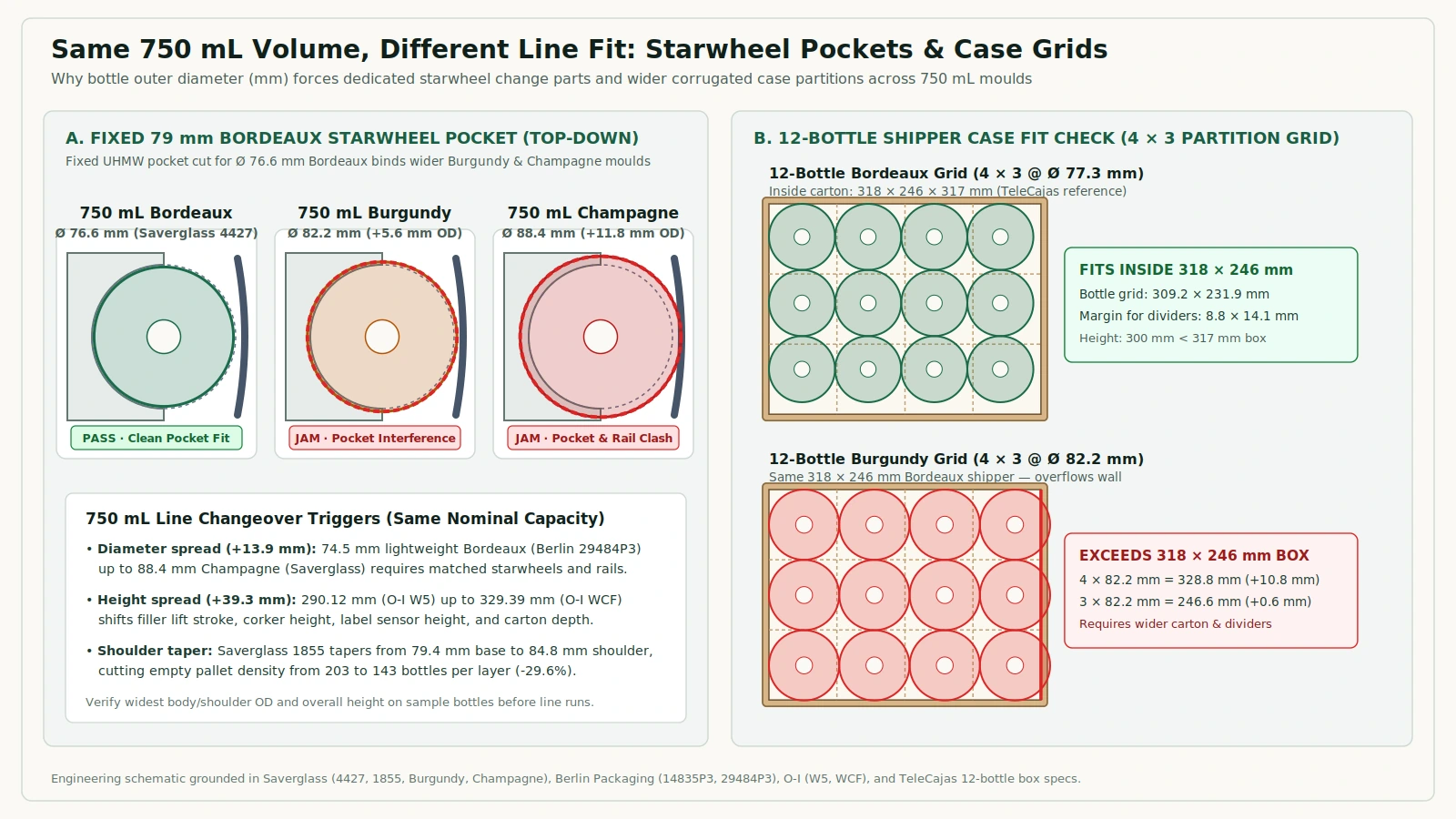
Four dimensional transitions trigger physical line changeovers even when the nominal fill stays at 750 mL:
- Body diameter jump: Across real 750 mL moulds, outer diameter spans from 74.5 mm (Berlin Packaging 29484P3 lightweight) through 76.60 mm (Saverglass 4427) and 82.20 mm (Saverglass Burgundy) up to 88.4 mm (Saverglass Champagne)—requiring matched feed screws, starwheels, and guide-rail widths.
- Tapered shoulder widest point: Tapered moulds like Saverglass Bordelaise 1855 measure 79.4 mm at the base but flare to 84.8 mm at the shoulder, meaning a lower guide rail cleared for the base can still pinch or scuff the upper shoulder at rotary transfers.
- Overall height span: Moving from a 290.12 mm O-I W5 to a 329.39 mm O-I WCF changes overall bottle height substantially, resetting filler pedestal height, corker or capper head elevation, label sensor position, and case-packer vertical clearance.
- Closure finish transition: Moving from an 18.5 mm cork-mouth finish (governed by EN 12726 for still wine containing no more than 1.2 g/L CO2) to a BVS 30H60 screw finish switches closing tooling completely from a corking turret to a roll-on pilfer-proof capping head.
Before approving a second mould on an existing bottling line, log every station’s diameter, height, shoulder, and finish limits using the bottling-line changeover guide and record article-specific tolerances in the bottle specification checklist.
How much larger are Magnum and oversized wine bottles, and where do automatic lines stop?
Stepping up from a 750 mL Bordeaux bottle (300.50 × 76.60 mm, 550 g) to a 1.5 L Magnum (356.00 × 99.00 mm, 1,040 g on Saverglass 4655) jumps markedly in height, outer diameter, and empty glass mass. Beyond 1.5 L, a 3.0 L Double Magnum expands to 417.50 × 127.30 mm, 1,790 g empty glass, and a wider 24 mm neck bore, pushing most wineries off standard high-speed automatic turrets onto dedicated semi-automatic or manual stations.
Swipe or scroll horizontally to see all columns.
| Format jump | Saverglass reference article | Height (mm) | Outer diameter (mm) | Empty glass weight | Neck bore and handling boundary |
|---|---|---|---|---|---|
| 375 mL Half / Demi | Bordelaise Tradition 4558 | 237.50 mm | 61.60 mm | 300 g | Standard 18.5 mm bore; needs narrow starwheel set and lift spacers |
| 750 mL Standard | Bordelaise Tradition 4427 | 300.50 mm | 76.60 mm | 550 g | 18.5 mm bore (widening to 21 mm inside neck); standard automated baseline |
| 1.5 L Magnum | Bordelaise Tradition 4655 | 356.00 mm | 99.00 mm | 1,040 g | Largest format routinely fermented in-bottle for Champagne; needs wide-pitch change parts |
| 3.0 L Double Magnum | Bordelaise Tradition 1434 | 417.50 mm | 127.30 mm | 1,790 g | 24 mm neck bore requires oversized corks, jaws, and manual or dedicated slow filling |
| 6.0 L Imperial | Bordelaise Tradition 0714 | 492.80 mm | 164.50 mm shoulder / 156.50 mm base | 3,120 g | Exceeds standard rotary pitch, conveyor rails, and overhead filler lift travel |
Two concrete process boundaries separate routine automated production from specialty large-format runs:
- Neck bore step-up at 3.0 L: Standard 375 mL and 750 mL cork-mouth bottles share an 18.5 mm mouth bore that widens to 21 mm down the neck, whereas the 3.0 L Saverglass 1434 Double Magnum expands to a 24 mm bore. Standard corking jaws and compression blocks built for 18.5 mm necks cannot seal 24 mm large-format stoppers without dedicated tooling or hand corking.
- Secondary fermentation limit above 1.5 L Magnum: Most Champagne houses cannot run traditional in-bottle secondary fermentation in formats larger than a 1.5 L Magnum because riddling large, heavy bottles is mechanically impractical. Larger sparkling bottles are typically transferred from fermented magnums, which introduces pressure loss and greater oxidation risk.
Even within the 1.5 L Magnum tier, mould specs vary across suppliers: Berlin Packaging’s 34470P3 Magnum measures 350 × 98 mm at 800 g empty weight with 1,524 mL brimful capacity, whereas Saverglass 4655 stands 356.00 × 99.00 mm at 1,040 g. Include every planned small and large format in the equipment brief described in wine bottling equipment planning before ordering line change parts.
How many fluid ounces are in a 750 mL wine bottle, and what headspace rules apply?
A standard 750 mL wine bottle holds 25.36 US fluid ounces (or 26.40 imperial fluid ounces), equal to 0.20 US gallons, 0.16 imperial gallons, or six 125 mL pours. When US producers add optional fluid-ounce equivalents beside the mandatory metric declaration, TTB net contents guidance rounds 750 mL to 25.4 fl oz to the nearest tenth of a fluid ounce.
Before 1979, the United States used the non-metric “fifth”—one-fifth of a US gallon, or 25.6 US fluid ounces (757 mL)—as its standard wine and liquor bottle. In 1979, US regulations adopted the 750 mL metric standard used in Europe, aligning transatlantic bottle volumes while leaving unit conversions governed by NIST SP 365 (each US fluid ounce equals approximately 29.57 mL).
Swipe or scroll horizontally to see all columns.
| Metric size | Exact or TTB US fl oz label equivalent | US headspace limit (27 CFR 4.71) | TTB net-contents min. type size | EU capacity tolerance (75/107/EEC) |
|---|---|---|---|---|
| Less than 187 mL (e.g., 100 mL) | 3.4 fl oz (at 100 mL) | Max 10% after closure | 1 mm minimum | Per nominal class |
| 187 mL (Split) | 6.3 fl oz | Max 6% after closure | 1 mm minimum | Per nominal class |
| 375 mL (Half / Demi) | 12.7 fl oz | Max 6% after closure | 2 mm minimum | ±2% of nominal capacity |
| 750 mL (Standard) | 25.4 fl oz (25.36 US fl oz exact) | Max 6% after closure | 2 mm minimum | ±10 mL either way |
| 1.5 L (Magnum) | 50.7 fl oz | Max 6% after closure | 2 mm minimum | ±1% of nominal capacity |
| 3.0 L (Double Magnum) | 101 fl oz | Max 6% after closure | 2 mm minimum | Above 1.5 L EU range |
Headspace compliance links directly back to the glass bottle drawing’s brimful volume. Under 27 CFR 4.71, headspace after closure cannot exceed 6% of total container capacity for wine bottles of 187 mL or more, and cannot exceed 10% for bottles under 187 mL. For example, filling 750 mL of wine into a 770 mL brimful bottle leaves 20 mL of empty space, or 2.6% of capacity before cork insertion, keeping sealed headspace comfortably inside the 6% federal cap.
Common questions about wine bottle sizes
What is the difference between a Double Magnum and a Jeroboam?
A Double Magnum holds 3.0 L, equivalent to four standard 750 mL bottles. The name Jeroboam indicates different sizes in different regions of France: it designates 3.0 L in Champagne and Burgundy, whereas traditional Bordeaux usage assigns Jeroboam to a larger capacity and uses Double Magnum for 3.0 L. Confirm the metric volume on bottle purchase orders and shipping paperwork.
Are all 750 mL wine bottles the same height and diameter?
No. Across reference glassmaker drawings, 750 mL heights range from 290.12 mm (O-I W5) to 329.39 mm (O-I WCF), and outer diameters span from 74.5 mm (Berlin Packaging 29484P3 lightweight Bordeaux) to 82.20 mm (Saverglass Burgundy) and 88.4 mm (Saverglass Champagne). Verify the exact bottle drawing before setting starwheels or ordering corrugated case dividers.
How many standard wine bottles fit inside a Magnum, Salmanazar, or Melchizedek?
A Magnum holds 1.5 L (2 standard 750 mL bottles), a Salmanazar holds 9.0 L (12 standard bottles, matching a 12-bottle case), and a Melchizedek or Midas holds 30.0 L (40 standard bottles). Intermediate large formats include the 3.0 L Double Magnum (4 bottles), 6.0 L Imperial or Methuselah (8 bottles), 12.0 L Balthazar (16 bottles), and 15.0 L Nebuchadnezzar (20 bottles).
What US wine bottle sizes are legal under current TTB standards of fill?
Under 27 CFR 4.72 as amended by Treasury Decision TTB-200, the United States authorizes 25 metric standards of fill from 50 mL to 3 L—including 187 mL, 375 mL, 500 mL, 700 mL, 720 mL, 750 mL, 1 L, 1.5 L, 2.25 L, and 3 L—plus even-liter containers from 4 L through 17 L. Containers of 18 L or larger are exempt from standards of fill under 27 CFR 4.70.
Why do Champagne bottles need wider rack slots and starwheels than Bordeaux bottles?
Champagne and sparkling wine bottles require thicker glass walls and a deeper punt to resist internal carbonation pressure. As a result, a 750 mL Champagne mould reaches 88.4 mm (3.3 to 3.6 inches) in outer diameter and 900 g empty glass weight, compared with 76.60 mm (2.9 to 3.2 inches) and 550 g for a standard Bordeaux mould.
Technical references
- Wine Labeling: Net Contents, US Alcohol and Tobacco Tax and Trade Bureau (TTB), updated May 21, 2026 (Treasury Decision TTB-200 standards of fill, fluid-ounce equivalents, type size, and headspace summary).
- 27 CFR 4.72 Metric standards of fill, Electronic Code of Federal Regulations (eCFR), authorized metric standards of fill and even-liter rule above 3 L.
- 27 CFR 4.71 Standard wine containers, Electronic Code of Federal Regulations (eCFR), 6% and 10% after-closure headspace limits.
- 27 CFR 4.70 Application, Electronic Code of Federal Regulations (eCFR), 18 L standard-of-fill exemption.
- Approximate Conversions from U.S. Customary Measures to Metric (NIST SP 365), National Institute of Standards and Technology (NIST), length (2.54 cm per inch) and fluid volume (29.57 mL per US fl oz) conversion factors.
- Wine bottle, Wikipedia, traditional bottle size multiples, regional shape families, 1979 US metrication, internal bore range, and average empty glass weight.
Related guides

Bottle Neck Finishes and Closure Compatibility
How to read finish designations such as 28-400 and the T, E, I, H and S dimensions, and why a matching nominal diameter does not prove a closure fits.
Read the guide
Lightweight Wine Bottles: What Buyers Should Verify
Beyond the gram count: glass distribution, strength test evidence, finish fit, line trials and how to read weight and carbon claims on light wine bottles.
Read the guide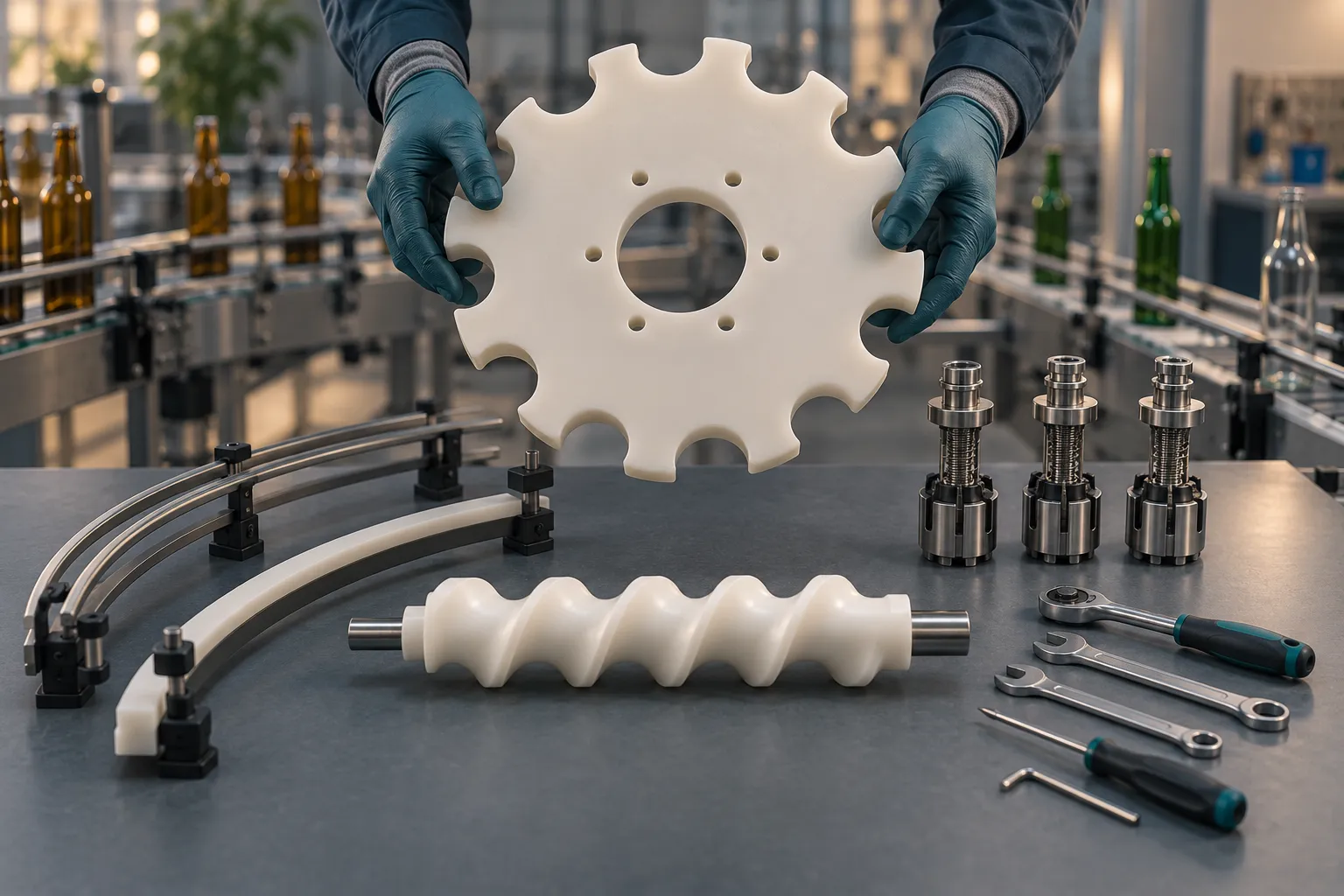
Bottling-Line Changeovers: What to Check Before Adding a New Bottle
Which change parts a new glass bottle touches, which bottle data to check, and how to run and document a trial before the bottle goes into production.
Read the guide