
Glass Jar Supplier Drawing Checklist: Finish & Seal Specs
Prepare a glass jar supplier drawing checklist covering continuous-thread and lug neck finishes, top sealing land planarity, headspace, and thermal shock.
Sourcing wide-mouth containers from a glass jar supplier without engineering drawings risks capper rejects and seal leakage, so every inquiry must lock neck finish geometry, sealing surface flatness, overflow capacity, and thermal shock resistance before mould release or pallet dispatch. Buyers who compare proposals across glass jar suppliers, a direct glass jars manufacturer, or regional jars wholesalers can pair this drawing checklist with the buying guides overview and the glass bottle supplier qualification guide to evaluate technical capability without relying on nominal catalog labels.
Requesting quotes by nominal ounce capacity and nominal cap diameter alone leaves critical closure interfaces undefined. For container shape and application context, see our guide to glass jars for food shapes, finishes, and closures.
Why Nominal Capacity and Diameter Fail Without Glass Jar Supplier Drawings
When a glass jar supplier quotes a wide-mouth container by nominal volume and millimeter cap size alone, the quotation omits the functional zones that control gasket compression and lug engagement on the packaging line.
Part 1 of a glass jar is the finish, the very top part of the jar that contains threads or lugs that contact and hold the cap or closure.
Specific areas identified in the glass jar finish are the sealing surface, glass lug, continuous thread, transfer bead, vertical neck ring seam, and neck ring parting line.
The closure gasket is the actual sealing member of the cap that must make intimate contact with the glass finish at the proper point to form an effective seal, and is made of rubber or plastisols.
Structurally, the lug cap consists of a steel shell and can have four, six, or eight metal lugs depending on its diameter, and normally contains a flowed-in plastisol gasket.
With a lug type of closure, the top of the glass finish makes contact with the gasket on the inside of the lid, and in most instances the lids are heated with steam to soften the compound.
A Plastisol-Lined Continuous Thread (PLCT) cap contains a flowed-in plastisol gasket on the inside that makes intimate contact with the top of the finish when the cap is screwed onto the jar finish.
Swipe or scroll horizontally to see all columns.
| Sealing System Class | Sealing Surface Position and Closure Engagement |
|---|---|
| Thread or Lug Top Sealing | In thread or lug top sealing systems used for wide-mouth jars and narrow-neck bottles, the sealing surface on the top of the finish is closed by a screw type cap |
| Side Sealing (Item 2) | In item 2, side sealing systems used for wide-mouth jars in the food industry, the sealing surface is on the side of the finish and the cap is pressed on to seal the contents |
Out-of-specification closure lug height, lug width, or compound thickness, and damaged or crushed lugs can lead to closure misapplications.
Bottle tilt, bottle height variation, and out-of-specification bottle L, K, E, or T dimensions can also lead to closure misapplications.
Key takeaway: Every inquiry sent to glass jar suppliers must separate the top sealing surface, thread or lug profile, and transfer bead on a dimensioned finish drawing rather than accepting a nominal cap diameter.
Continuous-Thread vs Vacuum Lug Neck Finish Drawings
Whether a buyer sources stock cartons from jars wholesalers or custom moulds from a glass jars manufacturer, the finish drawing must specify the five primary neck dimensions alongside the governing continuous-thread or vacuum-lug datasheet. For a broader explanation of finish nomenclature across narrow-neck and wide-mouth containers, review bottle neck finishes and closure compatibility.
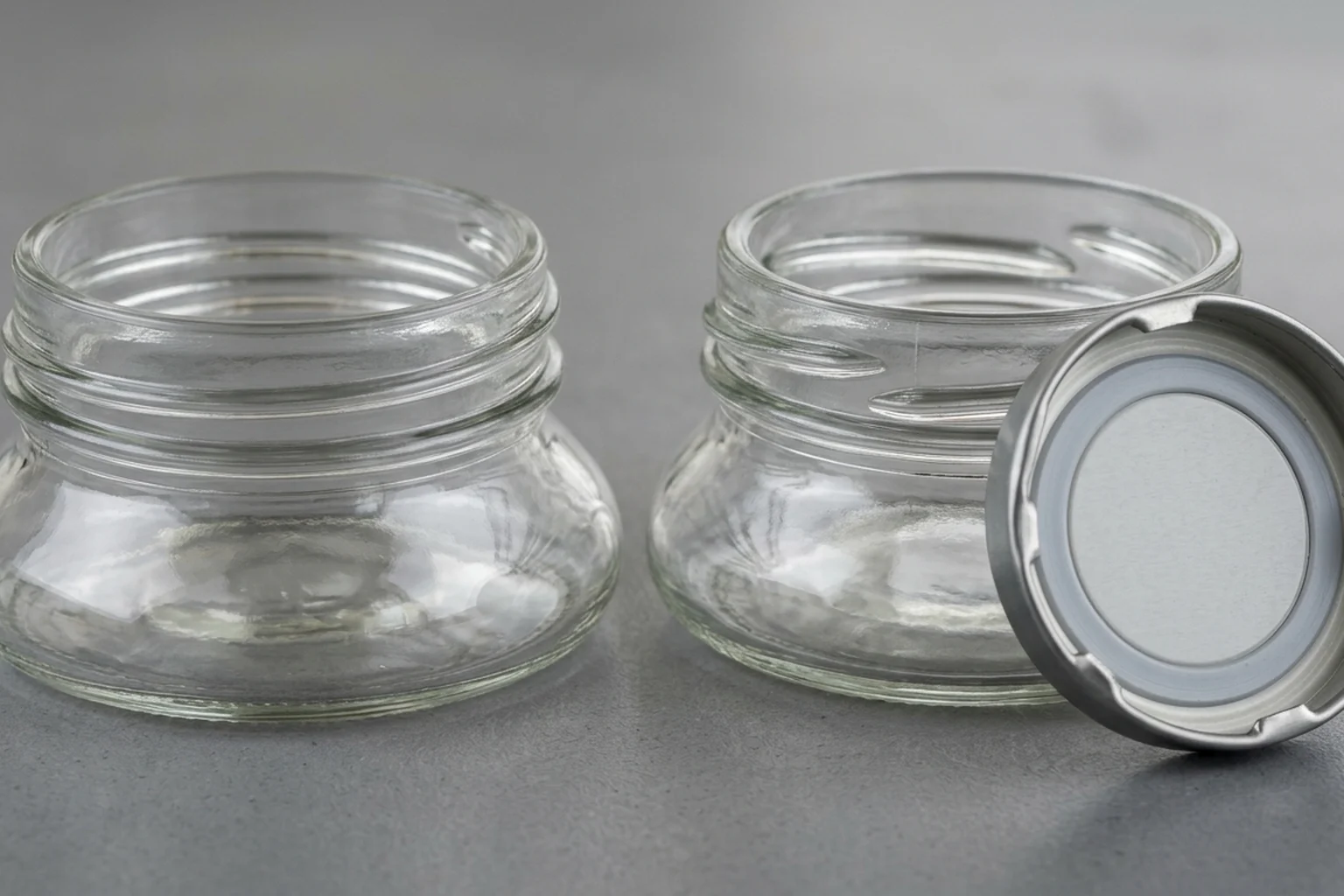
Core Neck Finish Dimensions (T, E, I, S, and H)
In a neck finish designation, 38 represents the T dimension or neck width, which is the measurement across the neck opening including the threading in millimeters.
The E dimension measures the outside diameter of the neck without threads, and the thread depth is determined by the difference between E and T divided by two.
The I dimension measures the inner diameter of the bottle neck, and specifications for I are required at the very minimum for sufficient clearance for filling tubes.
The S dimension measures from the top of the finish to the top edge of the first thread and is the key factor to determine the orientation of the closure.
The H dimension is the height of the neck finish measured from the top of the neck to the point where the diameter T extends down to intersect the shoulder.
Wide-Mouth Continuous-Thread Finish Specifications
Published manufacturer tables illustrate how wide-mouth continuous-thread jars pair nominal ounce capacities with standard finish codes and inch tolerance windows.
Wheaton catalog W216920 is a 4 oz (125 mL) clear straight-sided jar measuring 62 x 73 mm with a 58-400 cap size.
Wheaton catalog W216921 is an 8 oz (250 mL) clear straight-sided jar measuring 75 x 94 mm with a 70-400 cap size.
Wheaton catalog W216922 is a 16 oz (500 mL) clear straight-sided jar measuring 91 x 95 mm with an 89-400 cap size.
Wheaton catalog W216923 is a 32 oz (1000 mL) clear straight-sided jar measuring 95 x 170 mm with an 89-400 cap size.
Swipe or scroll horizontally to see all columns.
| Neck Size | T Dimension Range | E Dimension Range | H Dimension Range | S Dimension Range | Minimum I Bore | Thread Pitch |
|---|---|---|---|---|---|---|
| Size 48 | 1.87 to 1.844 in | 1.776 to 1.75 in | 0.418 to 0.388 in | 0.061 to 0.031 in | 1.309 in | 6 threads per in |
| Size 53 | 2.067 to 2.041 in | 1.973 to 1.947 in | 0.423 to 0.393 in | 0.061 to 0.031 in | 1.508 in | 6 threads per in |
| Size 58 | 2.224 to 2.198 in | 2.13 to 2.104 in | 0.423 to 0.393 in | 0.061 to 0.031 in | 1.664 in | 6 threads per in |
| Size 63 | 2.461 to 2.433 in | 2.367 to 2.339 in | 0.423 to 0.393 in | 0.061 to 0.031 in | 1.899 in | 6 threads per in |
| Size 70 | 2.736 to 2.708 in | 2.642 to 2.614 in | 0.423 to 0.393 in | 0.061 to 0.031 in | 2.145 in | 6 threads per in |
| Size 89 | 3.511 to 3.479 in | 3.391 to 3.359 in | 0.55 to 0.52 in | 0.107 to 0.077 in | 2.918 in | 5 threads per in |
Cetie data sheet GME21.00 covers glass continuous-thread neck finishes in sizes from 43 to 90 mm with one continuous thread, designed to fit mainly with plastic caps.
Wide-Mouth Vacuum Lug Finish Standards
When a packaging line runs quarter-turn twist-off metal lids rather than continuous-thread closures, the glass jar supplier drawing must reference the exact regular or deep vacuum lug finish standard. Downstream capping head and torque mechanics are covered in steam-vacuum lug, continuous thread, and ROPP closure specs.
Swipe or scroll horizontally to see all columns.
| Cetie Data Sheet | Nominal Lug Finish Size and Profile | Documented Scope |
|---|---|---|
| GME20.03 | 43 mm and 48 mm regular | Specifies the dimensions of vacuum lug finishes with a nominal size of 43 mm and 48 mm regular for wide-mouth glass containers |
| GME20.04 | 53 mm and 58 mm regular | Specifies the dimensions of vacuum lug finishes with nominal sizes of 53 mm and 58 mm regular for wide-mouth glass containers |
| GME20.06 | 63, 66, and 70 mm regular | Specifies the dimensions of vacuum lug finishes with nominal sizes of 63, 66, and 70 mm regular for wide-mouth glass containers |
| GME20.07 | 63, 66, and 70 mm deep | Specifies the dimensions of vacuum lug finishes with nominal sizes of 63, 66, and 70 mm deep for wide-mouth glass containers |
| GME20.09 | 82 mm regular | Specifies the dimensions of a vacuum lug finish with a nominal size of 82 mm regular for wide-mouth glass containers |
| GME20.10 | 89 mm regular | Specifies the dimensions of a vacuum lug finish with a nominal size of 89 mm regular for wide-mouth glass containers |
| GME20.11 | 100 mm regular | Specifies the dimensions of a vacuum lug finish with a nominal size of 100 mm regular for wide-mouth glass containers |
| GME20.12 | 110 mm regular | Specifies the dimensions of a vacuum lug finish with a nominal size of 110 mm regular for wide-mouth glass containers |
Tecnocap’s Classic Canner deep twist closure comes in 63, 66, and 70 mm deep sizes with other sizes in development.
Key takeaway: Require the glass jars manufacturer to state the exact T, E, I, S, and H tolerance range for continuous-thread necks or the specific regular or deep vacuum lug finish sheet before ordering closures.
Top Sealing Surface Planarity, Parallelism, and Finish Defect Controls
Even when diameter T and thread root E sit within drawing limits, a dipped, warped, or fractured top sealing land prevents the closure gasket or induction foil from forming a continuous hermetic seal.

Standard Tolerance and Planarity Reference Sheets
Cetie data sheet DT02.00 provides information on standard tolerances for capacity, height, diameter, verticality, and base-to-mouth parallelism of the finish for glass containers.
Cetie data sheet DT06.00 defines the standard European tolerances for normal wide-mouth glass jars.
Cetie data sheet DT15.05 specifies practical industry values for glass finish planarity tolerances on moulded flaconnage containers.
Cetie fact sheet FS03.00 specifies glass manufacturing controls for containers with vacuum lug and press-on finishes.
Induction machines create hermetic seals in 200 milliseconds.
Finish and Top Sealing Surface Defects to Reject
Incoming quality specifications attached to the glass bottle specification checklist should define rejection criteria for five critical finish defects documented in glass-forming defect manuals.
Swipe or scroll horizontally to see all columns.
| Glass Finish Defect | Physical Definition and Sealing Impact |
|---|---|
| Crizzles on Top Sealing Surface | Defects such as crizzles on the top sealing surface may cause a container to leak slowly |
| Overpress or Wire Edge | An overpress or wire edge defect is a finish which has excessive glass projecting upward from the inside edge of the finish |
| Split Finish | A split finish is a finish which has a crack across the top surface extending from the top of the finish down towards the neck |
| Unfilled Finish | An unfilled finish is a finish which is incompletely filled in the top, the bead, or the thread |
| Out-of-Round and Off-Gauge Finish | An out-of-round and off-gauge finish is oval-shaped and may be pinched or flattened, and detection gauges are usually supplied to check for this defect |
Key takeaway: Anchor the supplier quality agreement to Cetie planarity and parallelism sheets while rejecting crizzled, overpressed, split, unfilled, or out-of-round finishes at incoming inspection.
Brimful Capacity, Headspace, Steam-Vacuum Capping, and Thermal Shock
A complete glass jar supplier drawing links internal overflow capacity and glass composition to the thermal demands of hot-fill-hold tunnels, steam-vacuum cappers, and overpressure retorts.

Gravimetric Brimful Capacity and Headspace Design Rules
For distilled water, standard ISO 8106 specifies the gravimetric test method for determining the capacity of glass containers.
Cetie fact sheet FS07.00 specifies design headspace recommendations for liquid products in glass bottles and jars.
The correct amount of headspace varies with products, processes, and package design, but a rule-of-thumb in the industry is that it should be not less than 6% of the container volume.
Silgan Closures also states as a general rule that headspace volume should be above 6%.
Steam-Vacuum Capper Verification and Closure Pumping Thresholds
For glass containers with vacuum closures, capper efficiency must be checked by a measurement of the cold water vacuum before actual filling operations.
In a cold-water vacuum check, a series means 4 to 6 containers for a straight-line capper, and 1 container for each capping head on a rotary capper.
Cold-water check vacuum is measured using a standard vacuum gage, and the range of vacuum is recommended by the container manufacturer, but typically should be 22 inches or more.
Sufficient cap chute steam must be used to properly soften the plastisol sealing material prior to capping to achieve recommended application parameters.
The VTOPS MR5D30 series steam vacuum capping machine for glass jars is compatible with multiple cap types suitable for 3, 4, and 6 lug twist-off caps.
The VTOPS MR5D30 steam vacuum capper operates at 0.4 MPa steam pressure and reaches a maximum vacuum level of 67 kPa (502 mmHg).
In closure pumping, packages that develop less than 5 inHg vacuum at the capper will not allow closures to properly seat during application.
Thermal Processing Regimes and Soda-Lime Glass Thermal Shock
Acid and acidified foods can be safely processed by heating them to temperatures above 180°F (82°C).
Hot fill or open pasteurization products processed at 180F to 212F have a pH of 4.6 or below.
During closed retort cycles, Silgan recommends holding an overpressure such that the pressure differential between external and internal is between 3-5 PSI.
Silgan recommends a maximum overpressure of 32PSI to avoid low remaining gasket thickness and plastisol compound cut-through.
Silgan also recommends a maximum retort cook temperature of 252°F.
Thermal shock occurs when there is a significant temperature difference between the inside and outside surfaces of a glass container.
Common signs of thermal shock include vertical cracks or sudden collapse during or shortly after filling.
USP Type III is a soda-lime glass with moderate chemical resistance.
Wheaton glass linear coefficient of thermal expansion (0-300°C, x 10-7) ranges from 33 for borosilicate tubing to 88 for clear molded soda-lime and 91 for amber molded soda-lime.
Key takeaway: Verify that the glass jar supplier drawing reserves sufficient headspace below the brimful rim and specifies soda-lime thermal shock resistance matched to hot-fill or retort temperatures.
Glass Jar Supplier RFQ Drawing Checklist and Line Teardown Loop
Closing the procurement loop between a glass jar supplier and the filling plant requires pairing pre-shipment drawing sign-off with scheduled online closure inspections.
Visual closure examinations must be done at sufficient frequency to ensure proper closure and must be performed at least every 30 minutes of continuous closing machine operation.
Destructive physical closure examinations must be performed either before or after thermal processing at intervals not to exceed 4 hours of continuous closing machine operation.
Pull-up is a quality check on angled flat finishes and lug finishes only, measuring the degree of application of a closure to the bottle finish threads.
Security is a quality check on helix lug finishes only that measures the lug tension of an applied closure and how tight a closure is applied.
In a destructive lug security test, the distance between the marked vertical lines on the cap and container is measured in 1/16-inch increments.
On helix lug finishes, security values below 0 suggest the closure does not have a proper seal and should be corrected immediately.
For PT closures, the lean must be less than 3/32 in preprocessing, because greater tilt than this can suggest a level of misapplication is happening and may lead to loss of seal.
Swipe or scroll horizontally to see all columns.
| RFQ Drawing & QA Gate | Specification to Request from Glass Jar Suppliers |
|---|---|
| Continuous-Thread Finish Drawing | Cetie data sheet GME21.00 covers glass continuous-thread neck finishes in sizes from 43 to 90 mm with one continuous thread |
| Vacuum Lug Manufacturing Controls | Cetie fact sheet FS03.00 specifies glass manufacturing controls for containers with vacuum lug and press-on finishes |
| Finish Planarity Tolerances | Cetie data sheet DT15.05 specifies practical industry values for glass finish planarity tolerances on moulded flaconnage containers |
| Gravimetric Capacity Method | Standard ISO 8106 specifies the gravimetric test method for determining the capacity of glass containers using distilled water |
| Minimum Headspace Volume | Industry rule-of-thumb is that headspace should be not less than 6% of the container volume |
| Pre-Fill Capper Efficiency Check | For glass containers with vacuum closures, capper efficiency must be checked by a measurement of the cold water vacuum before actual filling operations |
Key takeaway: Combine pre-shipment finish, planarity, and capacity drawing sign-off with scheduled online visual and teardown inspections so glass jar suppliers and filling lines share the same acceptance criteria.
Frequently Asked Questions
Which neck finish dimensions must a glass jar supplier include on a wide-mouth CT jar drawing?
In a neck finish designation, 38 represents the T dimension or neck width, which is the measurement across the neck opening including the threading in millimeters. The E dimension measures the outside diameter of the neck without threads, and the thread depth is determined by the difference between E and T divided by two. The I dimension measures the inner diameter of the bottle neck, and specifications for I are required at the very minimum for sufficient clearance for filling tubes. The S dimension measures from the top of the finish to the top edge of the first thread and is the key factor to determine the orientation of the closure. The H dimension is the height of the neck finish measured from the top of the neck to the point where the diameter T extends down to intersect the shoulder.
How does a buyer specify regular versus deep vacuum lug finishes when quoting glass jar suppliers?
Cetie data sheet GME20.06 specifies the dimensions of regular vacuum lug finishes with nominal sizes of 63, 66, and 70 mm for wide-mouth glass containers. Cetie data sheet GME20.07 specifies the dimensions of deep vacuum lug finishes with nominal sizes of 63, 66, and 70 mm for wide-mouth glass containers.
Why must a glass jar drawing reserve headspace volume above the fill point?
The correct amount of headspace varies with products, processes, and package design, but a rule-of-thumb in the industry is that it should be not less than 6% of the container volume. In closure pumping, packages that develop less than 5 inHg vacuum at the capper will not allow closures to properly seat during application.
How are lug closure security and PT closure tilt checked during production runs?
In a destructive lug security test, the distance between the marked vertical lines on the cap and container is measured in 1/16-inch increments. On helix lug finishes, security values below 0 suggest the closure does not have a proper seal and should be corrected immediately. For PT closures, the lean must be less than 3/32 in preprocessing, because greater tilt than this can suggest a level of misapplication is happening and may lead to loss of seal.
Sources
- USDA Food Safety and Inspection Service — Thermal Processing Systems Student Guide on glass container closures.
- Silgan Closures — Technical assistance bulletin on steel closure operating guidelines, glass finishes, and steam vacuum capping.
- Bucher Emhart Glass — Causes and remedies for glass container defects reference manual.
- DWK Life Sciences (Wheaton) — Glass container technical guide and continuous-thread finish dimensions.
- Drug Plastics and Glass Co. — Technical information sheet on understanding neck finishes.
- Cetie (International Technical Centre for Bottling) — Finish data sheets, general data sheets, and manufacturing control recommendation sheets.
- Glassworks International — Technical guidance on thermal shock in glass bottles and jars.
- Tecnocap Group — Technical specifications for twist-off metal closures for glass food jars.
- Paramount Global — Guide to bottle neck finishes, thread sizes, and finish dimensions.
- U.S. Food and Drug Administration — Code of Federal Regulations on thermally processed low-acid foods packaged in hermetically sealed containers.
- Kansas State University Research and Extension — Hot-fill-hold process guidance for acid and acidified foods.
- VTOPS — Linear steam vacuum capping machine technical specifications.
- Wolf Packing — Automated jar sealing and labeling compatibility technical guide.
Related guides
Glass Jars for Food: Choosing Shapes, Finishes and Closures
How to choose a food jar by treating the body, the finish and the closure as one package, with notes on lug, CT and PT caps, vacuum sealing and hot fill.
Read the guide
Bottle Neck Finishes and Closure Compatibility
How to read finish designations such as 28-400 and the T, E, I, H and S dimensions, and why a matching nominal diameter does not prove a closure fits.
Read the guide
Glass Bottle Closures: Steam-Vacuum Lug, Continuous Thread and ROPP Capping Specs
Compare glass bottle closures across steam-vacuum lug, continuous thread (CT), and ROPP aluminum caps with torque, liner compression, and dud-detection specs.
Read the guide