
Bottling Cost: Changeover, Breakage and Yield
Evaluate bottling cost through beverage bottling line changeover, sauce line changeover, glass bottle breakage rate, and liquid filling yield drivers.
Real bottling cost per saleable case is governed by operational losses across line stops, container damage, and liquid product waste rather than machine nameplate speed alone. When a packaging operation audits Buying Guides alongside equipment specifications in the Bottling Equipment RFQ Checklist, every unscheduled stop, format swap, broken jar, and overfilled gram directly erodes net line output.
How Changeover, Breakage, and Yield Drive Bottling Cost
Evaluating bottling cost on a glass packaging line starts by separating productive time from stop time, speed losses, and rejected containers.
The simplest calculation of Overall Equipment Effectiveness (OEE) is OEE = (Good Count × Ideal Cycle Time) / Planned Production Time, which expresses the ratio of Fully Productive Time to Planned Production Time.
OEE is calculated by multiplying the three OEE loss-related factors: OEE = Availability × Performance × Quality.
Availability is calculated as Availability = Run Time / Planned Production Time, where Run Time = Planned Production Time − Stop Time across both Unplanned Stops (Breakdowns) and Planned Stops (Changeovers).
Swipe or scroll horizontally to see all columns.
| Loss Category | OEE Factor | Operational Scope |
|---|---|---|
| Setup and Adjustments | Availability Loss | Setup and Adjustments is an Availability Loss covering planned stops for setup, changeovers, major adjustments, tooling adjustments, cleaning, warmup time, planned maintenance, and quality inspections, and changeovers can be addressed through a SMED (Single-Minute Exchange of Die) program. |
| Idling and Minor Stops | Performance Loss | Idling and Minor Stops (small stops) is a Performance Loss where equipment stops for a short period of time with reasons including misfeeds, material jams, obstructed product flow, incorrect settings, misaligned or blocked sensors, equipment design issues, and periodic quick cleaning. |
| Process Defects and Reduced Yield | Quality Loss | Quality Loss includes Process Defects and Reduced Yield, where Reduced Yield accounts for defective parts produced from startup until stable (steady-state) production is reached and is most commonly tracked after changeovers. |
Tracking shift output with the Filling Line Output Worksheet illustrates how each loss layer compounds across a production shift.
In a shift where Shift Length is 480 minutes and Breaks total 60 minutes, Planned Production Time is 480 minutes − 60 minutes = 420 minutes.
When Planned Production Time is 420 minutes and Stop Time is 47 minutes, Run Time equals 420 minutes − 47 minutes = 373 minutes.
With 373 minutes of Run Time out of 420 minutes of Planned Production Time, Availability is 373 minutes / 420 minutes = 0.8881 (88.81%).
Performance is calculated as (Ideal Cycle Time × Total Count) / Run Time; (1.0 seconds × 19,271 widgets) / (373 minutes × 60 seconds) = 0.8611 (86.11%).
In the Good Count calculation Total Count − Reject Count, 19,271 widgets − 423 widgets = 18,848 widgets.
Quality is calculated as Good Count / Total Count (18,848 widgets / 19,271 widgets = 0.9780 or 97.80%), and multiplying Availability × Performance × Quality gives 0.8881 × 0.8611 × 0.9780 = 0.7479 (74.79%).
Key takeaway: Measuring bottling cost through Availability, Performance, and Quality exposes how planned changeover stops, minor conveyor stops, and startup rejects compound to reduce saleable output per shift.
Beverage Bottling Line Changeover and Sauce Line Changeover
Both beverage bottling line changeover and sauce line changeover remove productive hours from the schedule while adding residual product waste and startup rejects. Teams comparing mechanical guide swaps in Bottle Changeovers: Starwheels, Guides, and Recipe Repeatability must account for both mechanical format parts and wet product circuit sanitation.
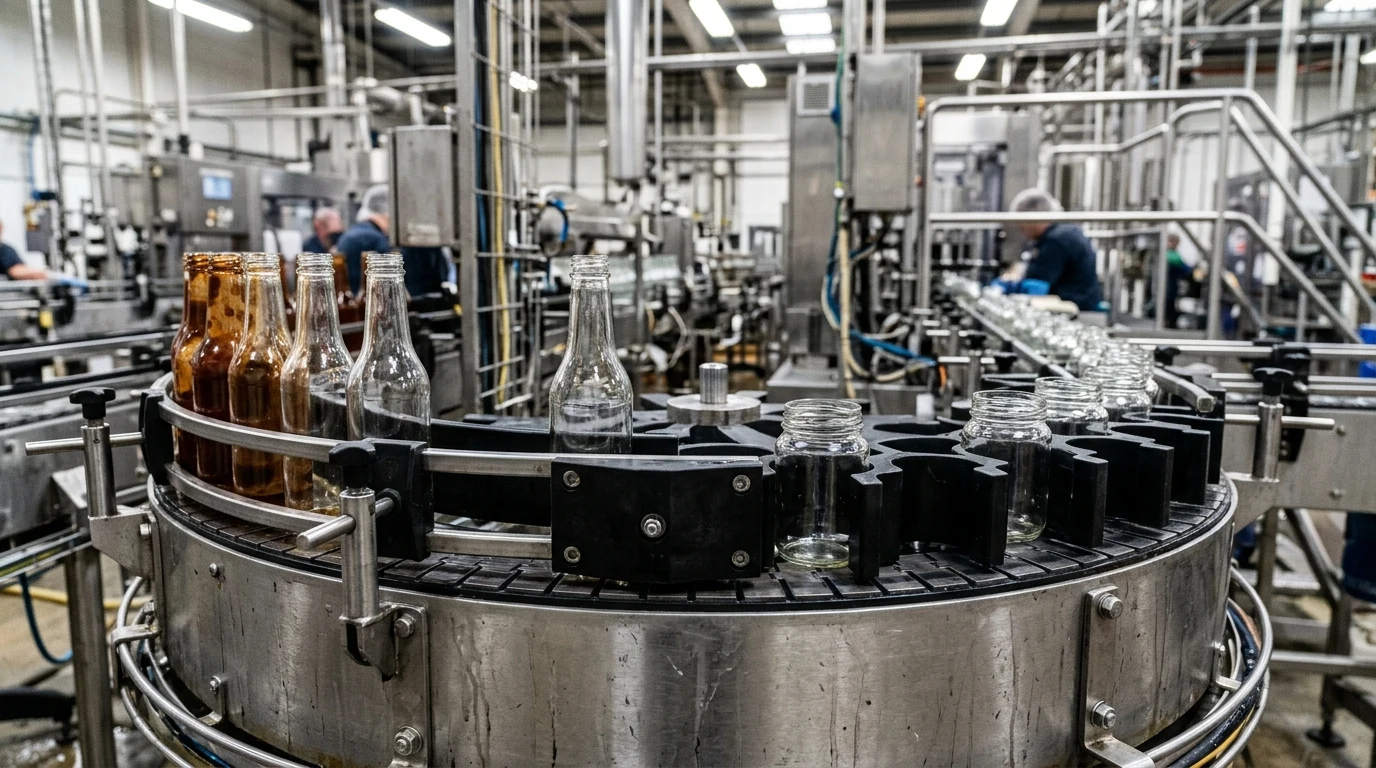
Sauce Line Changeover and Campaign Length
Whenever production switches from one sauce to another, the filling line must stop producing and the factory is no longer generating revenue while operators empty product circuits, perform cleaning procedures, replace change parts, adjust filling parameters, prepare new packaging components, validate the first containers, and progressively restart production.
Every cleaning cycle generates additional product losses because valuable sauce remains inside tanks, pipelines, pumps, and filling valves at the end of production.
SKU proliferation influences all three OEE components simultaneously: frequent product transitions reduce equipment availability because more production time is devoted to cleaning and changeovers, short production campaigns often prevent filling lines from reaching their optimal operating speed, reducing performance, and recipe transitions frequently increase start-up rejects and quality adjustments before stable production conditions are achieved.
As production campaigns become shorter, the fixed activities surrounding each batch—planning, cleaning, quality validation, machine adjustment, and documentation—occupy an increasingly large proportion of total manufacturing time, so manufacturing costs per bottle increase even when annual production volume remains unchanged.
Sequencing, Changeover Matrices, and Hygienic Circuits
When producing multiple sauces in one day, the general rule is to organize production from the least impactful product to the most impactful, taking four main criteria into account: color, flavor, texture, and allergens.
For every transition from Recipe A to Recipe B, a changeover matrix can specify whether the transition is permitted without full cleaning, requires product purging, requires rinsing, requires a complete cleaning cycle, or is prohibited without a specific procedure.
A properly drainable circuit makes it easier to remove remaining product, a cleaning manifold can collect fluids circulating through the filling nozzles during the cleaning cycle, preparation tasks performed in parallel reflect SMED principles applied to recipe changeovers, and digital recipe management can save settings associated with each sauce in the machine interface.
Beverage Bottling Line Changeover and Starwheel Tooling
On Krones systems where pocket starwheels were used to transport bottles around the fillers, different bottle shapes or sizes meant converting the pocket starwheels, and such an exchange is usually carried out daily in bottling plants and takes around two hours.
The Krones MultiGuide Base clamping starwheel uses clamps as injection-moulded special parts made from iglidur RN367, rollers and plain bearings made from iglidur X, and liners made from iglidur E7 for the linear movements.
With the universal gripping solution on the Krones MultiGuide Base starwheel, fewer replacement and conversion parts are needed and a whole 2.5t of material is no longer required.
Indexing Cycle Timing and Line Sizing
On an eight head filling machine where it takes six seconds for bottles to index into the fill area, 3 seconds for fill heads to dive into the bottles, and six seconds to actually fill the bottles, the cycle lasts 15 seconds so 4 cycles run in one minute and eight fill heads times 4 cycles gives 32 bpm.
If a packager needs to prepare 16,000 bottles of product per day in an eight hour day, the filling machine would need to run 2,000 bottles per hour or just about 34 bottles per minute (16,000/8/60 = 33.3 bpm).
Glass Bottle Breakage Rate Across Filling and Capping
Controlling glass bottle breakage rate requires matching glass surface coatings, finish dimensions, headspace, capper vacuum, internal pressure, and empty-bottle optical inspection across the line. Buyers evaluating container geometry in Stock vs. Custom Glass Bottles and reject gates in Bottle Inspection Systems: Fill Level, Cap, and Defect Rejects should verify how container defects and thermal or mechanical stresses interact at the filler and capper.
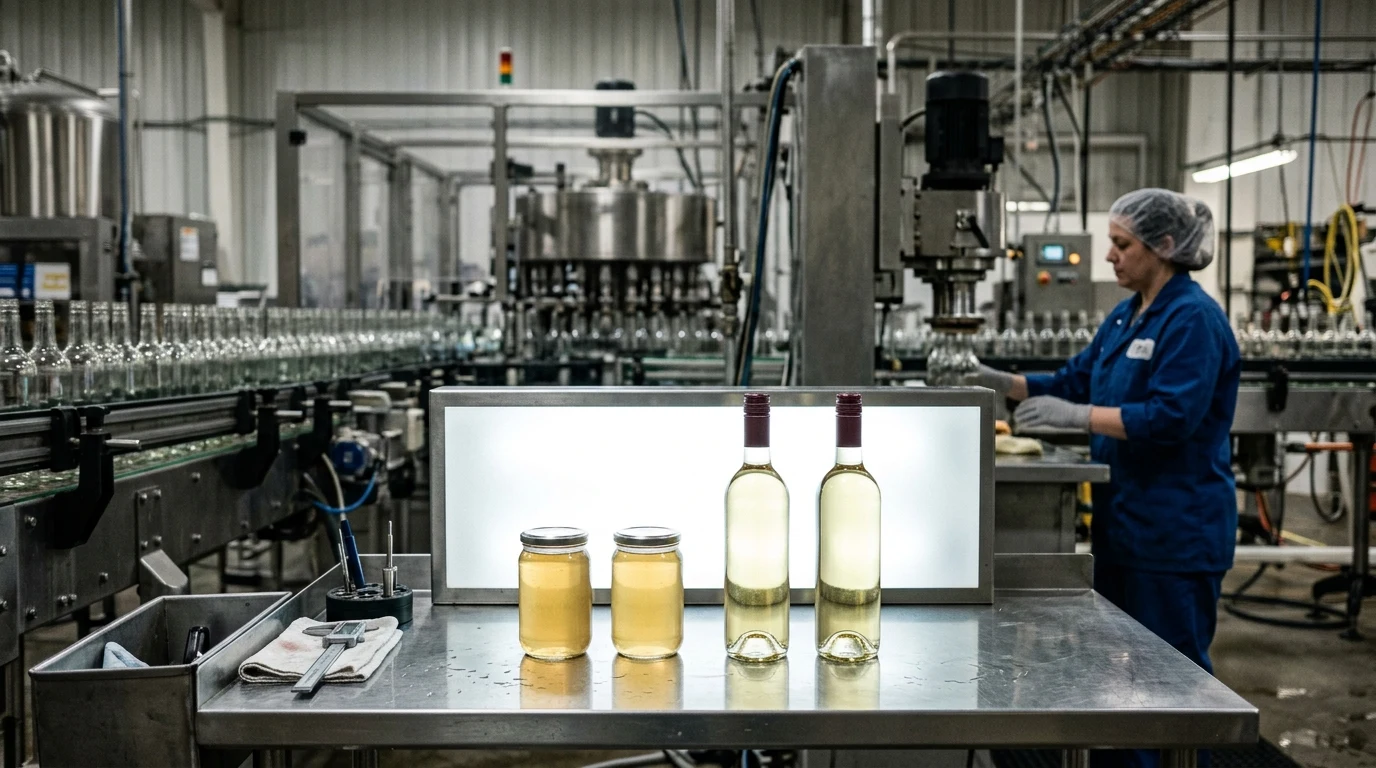
Surface Coatings, Finish Dimensions, and Mold Sampling
During glass manufacturing, glass is coated on both the hot and cold end: hot end coatings help close any glass micro cracks and allow cold end coating to adhere, while the cold end coating protects glass from scuffing when contacting each other as they move down conveyors.
Common glass container issues include height variation of greater than 1/16” between glass from the same lot, greater than .1” jar tilt, excessive jar saddling, out of spec jar dimensions such as E, T, K, or L, and lack of hot end coatings or the presence of cold end coatings on the finish.
In glass container inspection, approximately once every 20 minutes, depending on production speed, one container from each mold should be set out and allowed to cool so it can be handled and examined more closely for defects.
Headspace, Capper Vacuum, Closure Tilt, and Thermal Processing
A general rule for headspace requirements is that headspace volume should be above 6%; as headspace decreases below 6%, potential for acceptable vacuum decreases, and an exponential increase in internal pressure can occur during thermal processing.
It is essential to perform cold water efficiency checks at regular intervals (at a minimum, once per shift) to ensure the capper is providing adequate steam flow for vacuum formation.
Tilt is the height difference between minimum and maximum post sealing applied closure height measurements, and for PT closures, the lean must be less than 3/32” preprocessing because greater tilt can suggest misapplication and may lead to loss of seal.
In closure pumping, packages that develop less than 5”hg vacuum at the capper will not allow closures to properly seat during application, which can be caused by low capper vacuum efficiency, excessively high fill temperatures, or low headspace.
The type of thermal treatment process is dependent on product pH: hot fill or open pasteurization products (180F – 212F) have a pH ≤ 4.6, while sterilized closed retort products (212F-256F) have a pH ≥ 4.6.
Thermal shock occurs when there is a significant temperature difference between the inside and outside surfaces of a glass container, creating internal stresses where cracks or catastrophic failure can occur when cold glass bottles or jars are filled with hot product or when hot containers are exposed to cold wash water or ambient conditions.
Carbonation Pressure, Optical Sidewall Inspection, and Lightweighting
Under CETIE Guide No. 6 for metallic screw capping for still wines on BVS type glass finishes according to EN 16293, wine is considered to be still with a CO2 content < 1,2 g CO2/l.
Under CETIE Guide No. 9 for metallic screw capping for pressurised wines and other beverages on BVS type glass finishes with a CO2 content > 1.2 g CO2/l, both the cap and the bottle must be foreseen for the application subject to a written agreement between the cap supplier, the bottle supplier, and the filler, with special precautions for carbonation levels above ~3 g/l CO2 or a pressure exceeding 6 bars.
In the HEUFT InLine II IX empty bottle inspector, image resolution is eight times higher in the quadruple sidewall inspection, which covers well over 360 degrees of the bottle volume.
The HEUFT InLine II IX empty bottle inspector lists an output range up to 72,000 empty bottles / h with a ≤ 0.2 percent false rejection rate.
The Sustainable Wine Roundtable (SWR) proposes a Bottle Weight Accord under which its retail members agree to a shared position to reduce the average weight of the 750ml still wine bottles they sell from the current average of approximately 550 grams to an average bottle weight below 420 grams by the end of 2026.
In Sustainable Wine Roundtable (SWR) interviews, bottlers report that bottles as light as 350g can be used on most filling lines with only relatively slight tweaks needed, that 390g bottles have been used on a mobile filling line for several years with no real problems, and that moving from 750g to 600g and now to 417g showed no significant increase in breakage rates while looking at a 380g bottle.
Key takeaway: Lowering glass bottle breakage rate depends on maintaining hot-end and cold-end glass coatings, keeping headspace and capper steam vacuum on target, preventing thermal shock differentials, and deploying empty-bottle sidewall inspection.
Liquid Filling Yield, Rheology, and Overfill Giveaway
Liquid filling yield directly shapes bottling cost because high-speed dosing amplifies viscosity shifts, temperature drift, and per-container overfill giveaway.
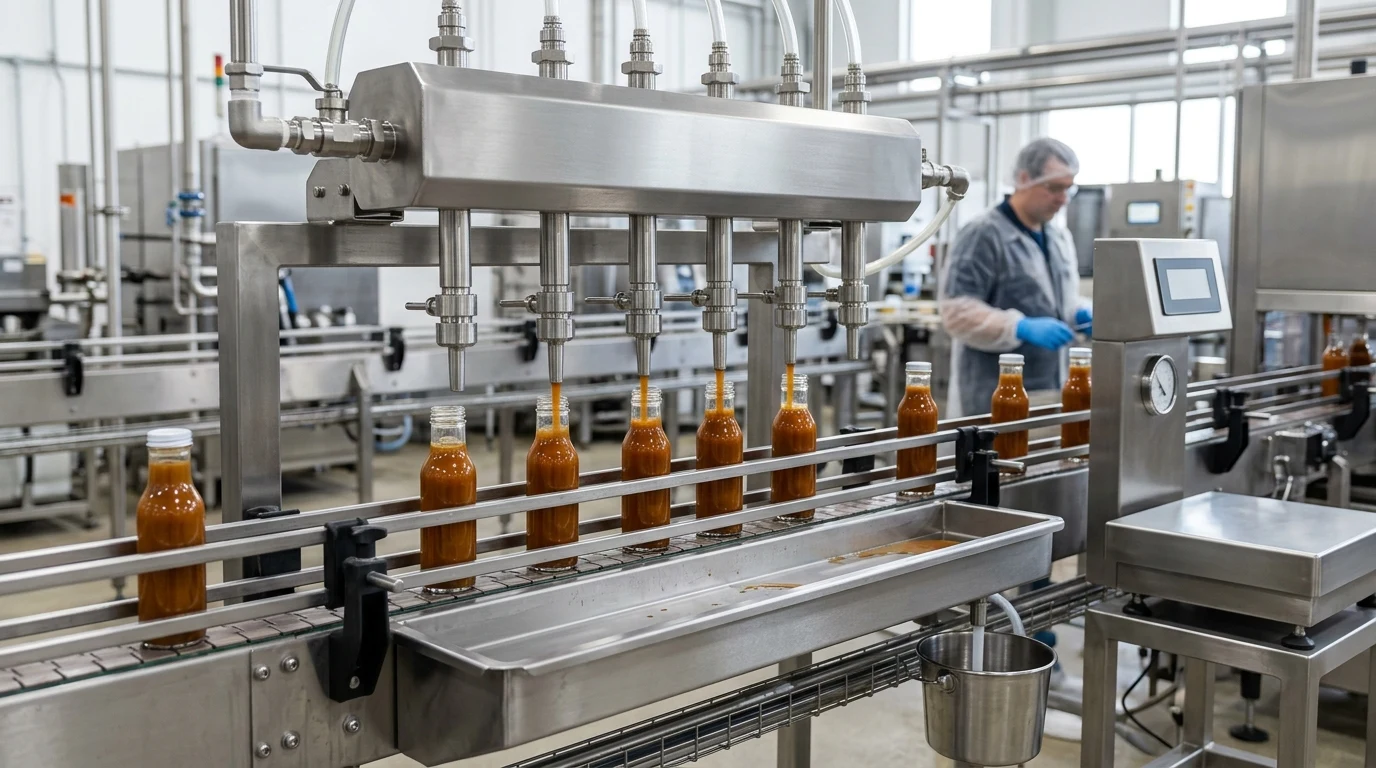
When a sauce recipe must be pumped, transferred, dosed, and filled at up to 18,000 bottles per hour, 5 containers are filled every second, and small variations in temperature, viscosity, ingredient distribution, or filling parameters can quickly become visible across thousands of bottles.
Many sauces are non-Newtonian fluids whose apparent viscosity changes according to the force applied to them, so manufacturers consider viscosity at processing and filling temperatures, behavior at different shear rates, yield stress, thixotropy, stringing or dripping after dosing, the tendency to retain air, emulsion stability, and the size and concentration of particulates.
A sauce filled at 20°C may behave differently from the same sauce filled at 60°C or 85°C, and even smaller temperature variations between the beginning and end of a production batch can affect filling performance.
In the Liquid Packaging Solutions viscosity chart, Water @ 70° F has a low viscosity of 1 and high viscosity of 5, Heinz Ketchup or French’s mustard ranges from 50,000 to 70,000, and Tomato Paste or Peanut Butter ranges from 150,000 to 200,000.
On a line producing 18,000 bottles per hour, if each bottle receives just one unnecessary gram of product, the line gives away 18 kilograms per hour, 144 kilograms during an eight-hour production shift, and 36 metric tons over 250 eight-hour production days.
In the United States, the National Institute of Standards and Technology publishes Handbook 133 for checking the net contents of packaged goods, while in the European Union, Directive 76/211/EEC establishes rules for nominal quantities and tolerable negative errors in certain prepackages.
Weight filling offers the advantage that the quantity delivered is measured as mass during the filling cycle, which can be relevant for sauces whose density may vary because of temperature, formulation, or ingredient distribution.
With average fill accuracy to +/- 0.25% standard deviation, the DTM Packaging Purefil 1500 indexing in-line flow meter filler can be configured with up to 16 filling heads and is capable of speeds up to 150 bottles per minute.
The Purefil 1500 incorporates a sanitary product path and 316L stainless steel product contact parts and includes a flush-in-place tray to support efficient FIP and CIP processes.
For more demanding liquid products, the Purefil 1500 can be configured with a stainless pressure tank rated up to 75 PSI with 316L stainless steel construction.
Key takeaway: Protecting liquid yield requires matching flow-meter or net-weight filling hardware to product rheology and fill temperature so net-content targets are met without excessive overfill giveaway or drain losses.
Bottling Cost Shift Audit Worksheet and Acceptance Protocol
Before signing off on new packaging machinery or auditing an existing line, plant teams align acceptance protocols and shift logs so changeover duration, glass rejects, and liquid yield losses are tracked consistently.
The OpX Leadership Network Capital Projects Solutions Group developed the One Voice Factory Acceptance Tests; Protocols for Capital Equipment in the CPG Industry, which should, when utilized appropriately, resolve criteria for FAT, vFAT, and SAT expectations or miscommunication that often result in confusion for both parties, unbudgeted costs in travel and material, and increased timelines.
Swipe or scroll horizontally to see all columns.
| Shift Audit Area | Line Focus | Shift Audit Record |
|---|---|---|
| Shift OEE Audit | Planned Production Time | Record Good Count, Ideal Cycle Time, Planned Production Time, and Stop Time (or compute OEE = (Good Count × Ideal Cycle Time) / Planned Production Time) |
| Sauce Changeover Audit | Product Circuits and Change Parts | Record time to empty product circuits, perform cleaning procedures, replace change parts, adjust filling parameters, prepare new packaging components, and validate containers |
| Glass Coating Audit | Hot End and Cold End Coatings | Check hot end coatings that close glass micro cracks and cold end coating that protects glass from scuffing on conveyors |
| Capper Vacuum Audit | Steam Vacuum Formation | Record cold water efficiency checks at regular intervals to ensure the capper provides adequate steam flow for vacuum formation |
| Sauce Weight Filling Audit | Filling Cycle Mass | Record mass delivered during the filling cycle when sauce density may vary because of temperature, formulation, or ingredient distribution |
Questions to Settle Before Auditing Bottling Cost
How do short production runs increase unit bottling cost when annual volume stays flat?
Planning, cleaning, quality validation, machine adjustment, and documentation remain necessary regardless of batch size, so as production campaigns become shorter, those fixed activities occupy an increasingly large proportion of total manufacturing time.
What container and finish issues should be checked when auditing capper rejects?
Container and finish verification checks for height variation between glass from the same lot, jar tilt, excessive jar saddling, out of spec jar dimensions, lack of hot end coatings, or the presence of cold end coatings on the finish.
Why is weight filling used when sauce density varies during a run?
Weight filling measures the quantity delivered as mass during the filling cycle, which can be particularly relevant for sauces whose density may vary because of temperature, formulation, or ingredient distribution.
Sources
- Vorne Industries — Overall Equipment Effectiveness calculation and manufacturing loss documentation.
- Serac Group — Technical guidance on sauce filling rheology, campaign changeover losses, and circuit cleaning reduction.
- igus GmbH — Application documentation on Krones MultiGuide Base polymer clamping starwheel components.
- Liquid Packaging Solutions — Technical notes on automatic liquid filler cycle timing and liquid viscosity reference tables.
- DTM Packaging — Product documentation for inline flow-meter liquid filling systems and sanitary fluid paths.
- Silgan Closures — Technical assistance bulletin on glass container finishes, headspace, steam vacuum, and closure application.
- Bucher Emhart Glass — Glass container defect inspection and mold sampling reference manual.
- Cetie — Technical bottling guides for metallic screw capping on still and pressurized glass finishes.
- HEUFT Systemtechnik GmbH — Technical brochure for optical empty glass bottle sidewall inspection systems.
- Glass Works — Technical guidance on glass container thermal stress and hot-fill pre-warming.
- Sustainable Wine Roundtable — Industry report and accord on lightweight glass wine bottle trials.
- PMMI OpX Leadership Network — Capital equipment factory and site acceptance testing protocols for packaged goods lines.
Related guides

Bottling Equipment RFQ Checklist: Comparing Supplier Proposals
How to write a bottling equipment RFQ so suppliers quote the same inputs, scope and performance basis, with a matrix for FAT, SAT, spares and warranty.
Read the guide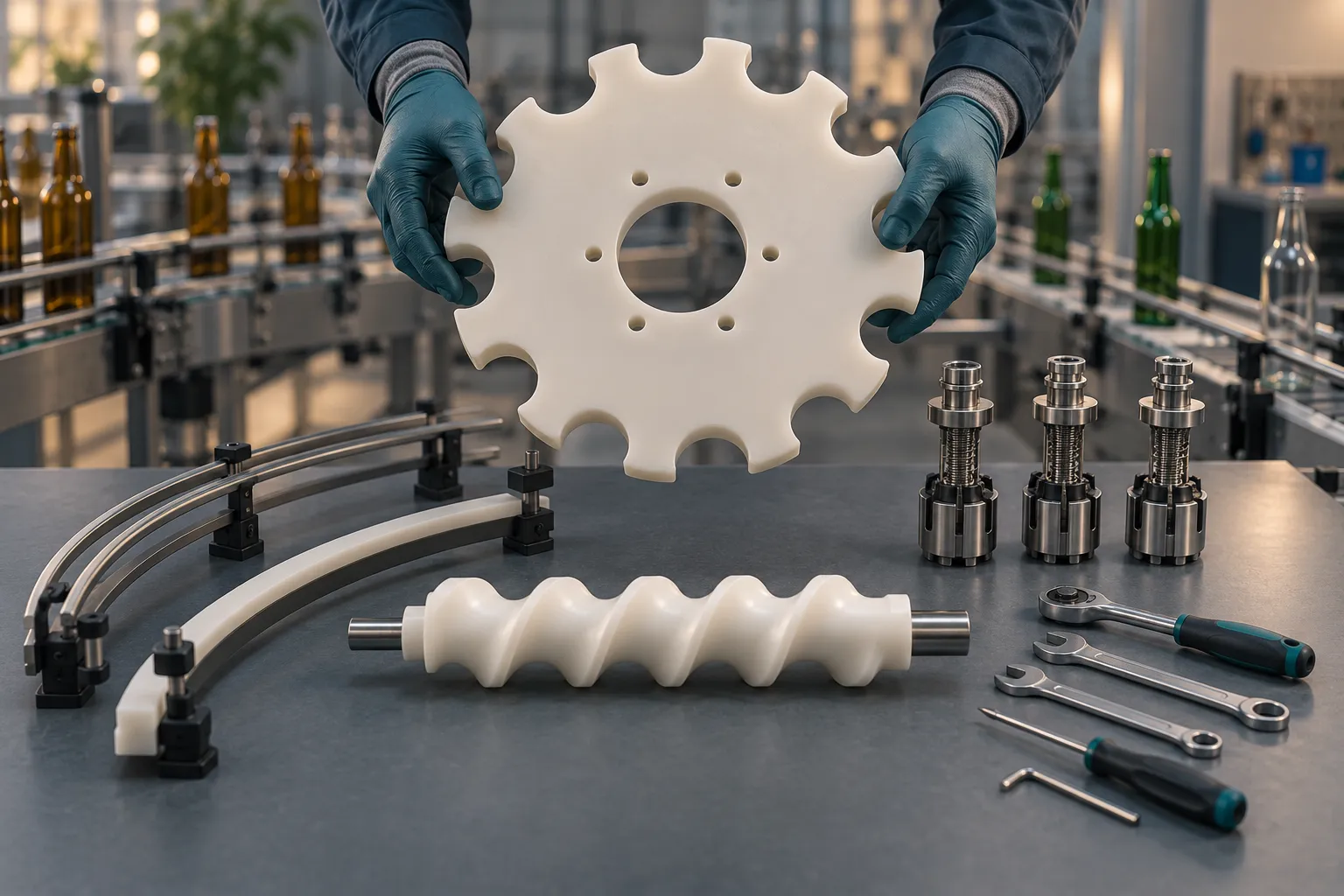
Bottling-Line Changeovers: What to Check Before Adding a New Bottle
Which change parts a new glass bottle touches, which bottle data to check, and how to run and document a trial before the bottle goes into production.
Read the guide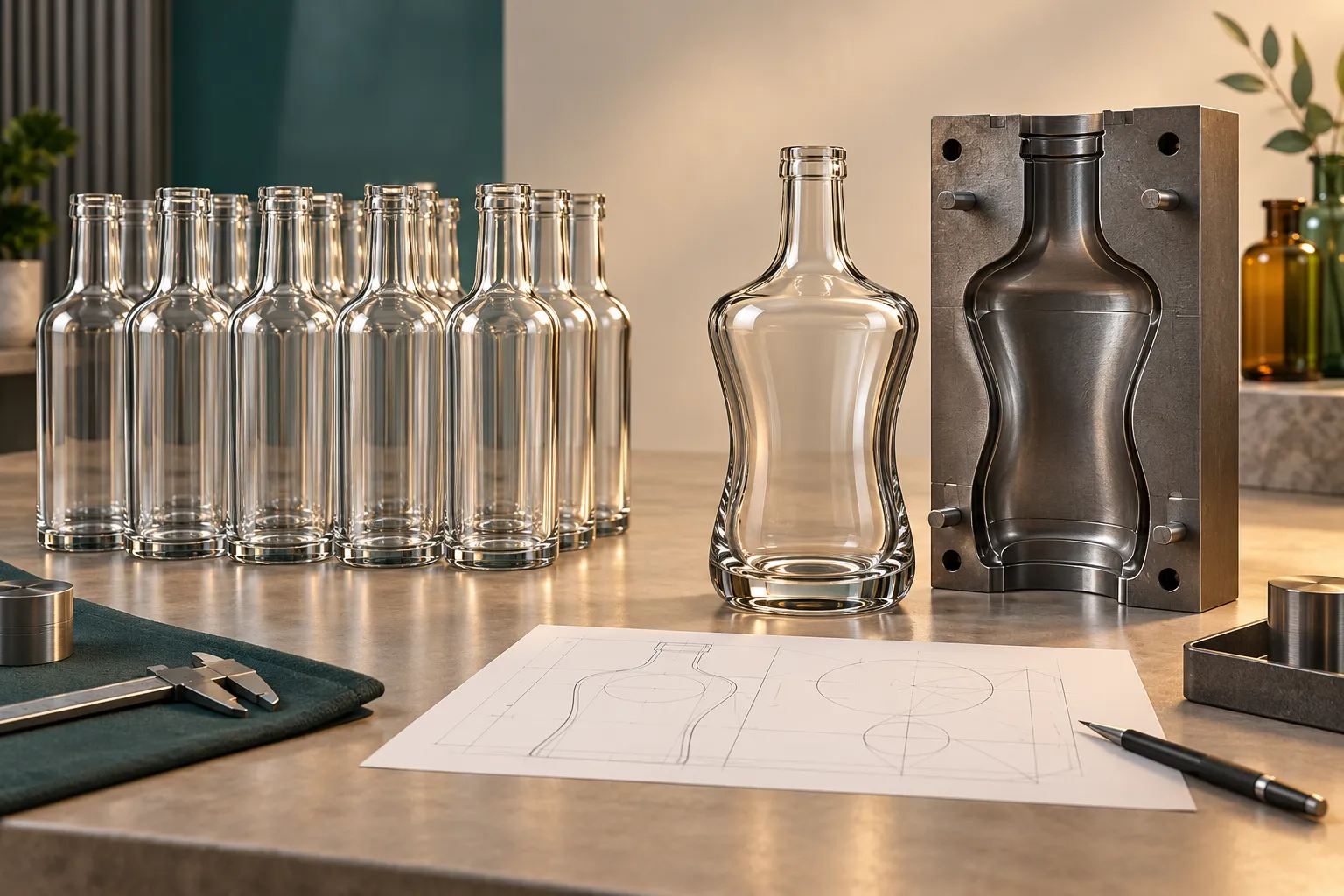
Stock vs. Custom Glass Bottles: What to Compare Before Ordering
Compare stock and custom glass bottles on tooling ownership, minimum quantities, sampling, documentation, line trials and supply continuity before you order.
Read the guide