
Amber Glass Bottles: UV Protection Specs and Claim Limits
Specify amber glass bottles with a defined spectral band, article-specific evidence and separate checks for beer lightstruck risk and package exposure.
Approving amber glass bottles by color alone can waste a filled batch when the UV protection specification misses the product’s light sensitivity. Choose amber when its documented spectral protection matches the product requirement, then specify the relevant wavelengths, the bottle article and the evidence that supports the claim.
Amber glass bottles are a light-protection candidate when the filled product is sensitive to wavelengths the selected bottle attenuates. The decision needs a spectral report or a clearly scoped manufacturer specification, followed by product and package validation under the intended exposure. A color name cannot supply the missing spectrum. Pharmaceutical glass transmission claims and beer lightstruck claims also answer different questions: the former concerns a defined optical test or specification; the latter depends on beer chemistry and exposure. Keep those evidence streams separate when deciding whether the bottle, an opaque outer pack, or both should provide protection.
Quick specs: what belongs in the light-protection record?
Record the product requirement before selecting a shade. The glass container overview places color alongside capacity, finish and process; a successful optical choice still needs those other decisions resolved.
Swipe or scroll horizontally to see all columns.
| Input or item | Value or source to record | Why it matters |
|---|---|---|
| Product sensitivity | Product stability work and relevant wavelength band | Defines what the bottle must protect against |
| Bottle identity | Maker, article, color technology and specification revision | Ties the claim to a particular container |
| Spectral evidence | Wavelength endpoints, transmission criterion and method | Separates a measurable claim from a color description |
| Exposure | Intended filling, storage, display and use conditions | Makes the evaluation relevant to the route to the consumer |
| Secondary packaging | Actual opaque coverage and when it is removed | Identifies protection that disappears during use |
| Acceptance record | Responsible reviewer and product/package test results | Establishes what was approved and what triggers review |
The distinction between colored glass and an exterior coloring treatment matters. Ask which construction the cited document describes. Do not transfer a coating claim to a different bulk-colored bottle merely because the samples look alike.
What does a retrieved spectral claim actually establish?
A manufacturer statement supports its stated product and wavelength range. It does not establish a universal amber-glass transmission percentage.
DWK’s Diagnostics Packaging catalog, printed page 40, retrieved October 19, 2026, describes exterior amber coloring of clear borosilicate bottles in the DURAN PURE context. It prints a light-transmission rate below 10% over 290–450 nm. Those are the conditions and scope of this catalog example; the document is not a spectral test certificate for an unspecified bottle shipment.
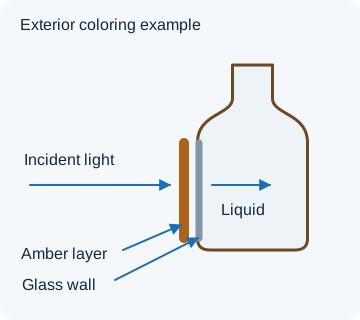
The same page attributes EP and USP compliance to that technology. Treat this as a manufacturer claim to reconcile with the required standard edition and the actual article documentation. It does not make every amber bottle compliant. The glass manufacturing guide provides the production context for asking how the selected container and its color are controlled.
Swipe or scroll horizontally to see all columns.
| Evidence or packaging choice | Decision it can support | Dominant Failure Mode & Prevention |
|---|---|---|
| Color sample alone | Appearance approval | A visually acceptable shade lacks optical evidence; obtain the relevant spectral specification |
| Scoped manufacturer spectral statement | Shortlisting the described bottle technology | Claim transferred to another article; retain exact product and construction references |
| Article-specific spectral report | Checking the documented wavelengths against the requirement | Missing wavelengths or unclear specimen identity; reconcile method, band and sample traceability |
| Opaque secondary pack | Planning protection while the bottle remains enclosed | Exposure after unpacking; include display and consumer use in validation |
How do you audit the wavelength range?
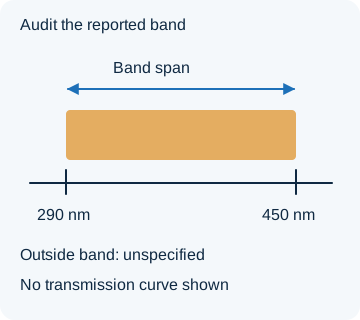
Calculate the reported span, then compare its endpoints with the product requirement. A span describes coverage; it does not describe how much light passes through the bottle.
Formula: W = wavelength_upper - wavelength_lower.
Worked example: for the DWK exterior-coloring statement above, W = 450 nm - 290 nm = 160 nm. This is an editorial calculation from the endpoints printed on catalog page 40, retrieved October 19, 2026. It is a wavelength span, not an attenuation result or a shelf-life multiplier.
Threshold rule: If transmission T < 10% throughout 290–450 nm under the documented DWK DURAN PURE exterior-coloring conditions → retain that technology as a candidate because it matches the maker’s published optical claim. Equality is not “below,” and a passing candidate still needs its own article evidence and product validation. This screening rule applies to the cited catalog claim, not to an independently verified current USP acceptance limit.
If the product needs protection beyond the documented band, choose a candidate with evidence covering that requirement or evaluate opaque protection. A low transmission value within a narrow band cannot answer an unmeasured wavelength question. Similarly, an average across a band should not silently replace a requirement that applies throughout it.
Why must beer lightstruck claims stay separate?
Beer lightstruck risk depends on formulation as well as the light that reaches the liquid. An optical statement about pharmaceutical or laboratory glass cannot predict a beer’s flavor stability.
In “Focus on stability,” dated March 17, 2023, hop specialist BarthHaas explains that light-sensitive bitter acids can degrade and that light-stable hop products change this route to off-flavor. It also warns that residual conventional iso-alpha acids undermine the intended light-stability strategy. This supports checking the beer recipe with the brewer; it does not supply a bottle transmission curve or a guaranteed storage duration.
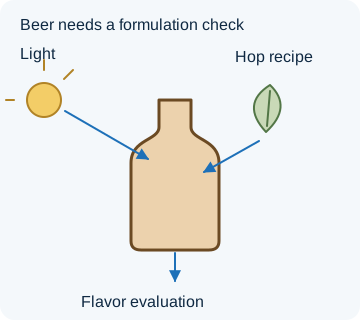
For a conventional light-sensitive formulation, put amber on the shortlist and evaluate the complete exposure route. Where the brewer uses a light-stable formulation, document that formulation boundary rather than attributing the resulting performance entirely to bottle color. Use the beer bottling guide for the surrounding package and filling decisions. Flavor protection also does not settle pressure suitability, closure performance or filling-line compatibility.
Where does rework stop being a color substitution?
Reopen the specification whenever a change invalidates the evidence used for approval. A different bottle article, color process, secondary pack or product formulation needs a review of the affected claim before it becomes a routine substitution.
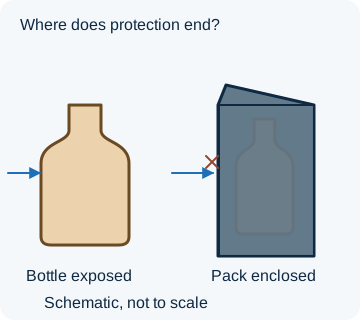
The practical rework boundary is the approved product-container-exposure combination. If the proposed substitution cannot be traced to that record, return to the bottle specification checklist and identify what must be reconfirmed. Adding amber color cannot be assumed to recover product already affected by light.
Account for hidden costs in the same review: quarantine while evidence is reconciled, repeat stability work, revised carton artwork, repacking labor and discarded affected contents. Record the actual quantities and time from the operation before attaching money to them. A nominal bottle-price comparison misses these consequences, while an invented savings percentage cannot resolve them.
Method and sources
Sources were retrieved October 19, 2026. The DWK catalog supplies the scoped optical example; BarthHaas supplies the formulation distinction. Diagrams explain relationships and contain no measured transmission curves.
The accessible official USP chapter preview establishes pharmaceutical-container scope. The official proposal preview discusses proposed changes to spectral testing. Neither retrieved preview provides the full acceptance table, so no current USP numerical limit is asserted here. Obtain the applicable controlled text and article documentation when making a compliance decision.
Related guides
Beer Bottling Equipment: Questions for Line Suppliers
Questions for bottling-line suppliers on oxygen pickup, counter-pressure filling, foaming, crowning, pasteurization, and fill-level and crown inspection.
Read the guide
How Glass Bottles Are Made: From Batch Materials to Inspection
A plain-language walk through glass bottle manufacturing: batch, furnace, forehearth, gob feeding, IS machine forming, coatings, annealing and inspection.
Read the guide
Glass Bottle Specifications: A Checklist for Supplier Enquiries
A checklist of what to state in a glass bottle enquiry: drawing dimensions, capacity and fill point, finish, color, strength, decoration, quality and packing.
Read the guide